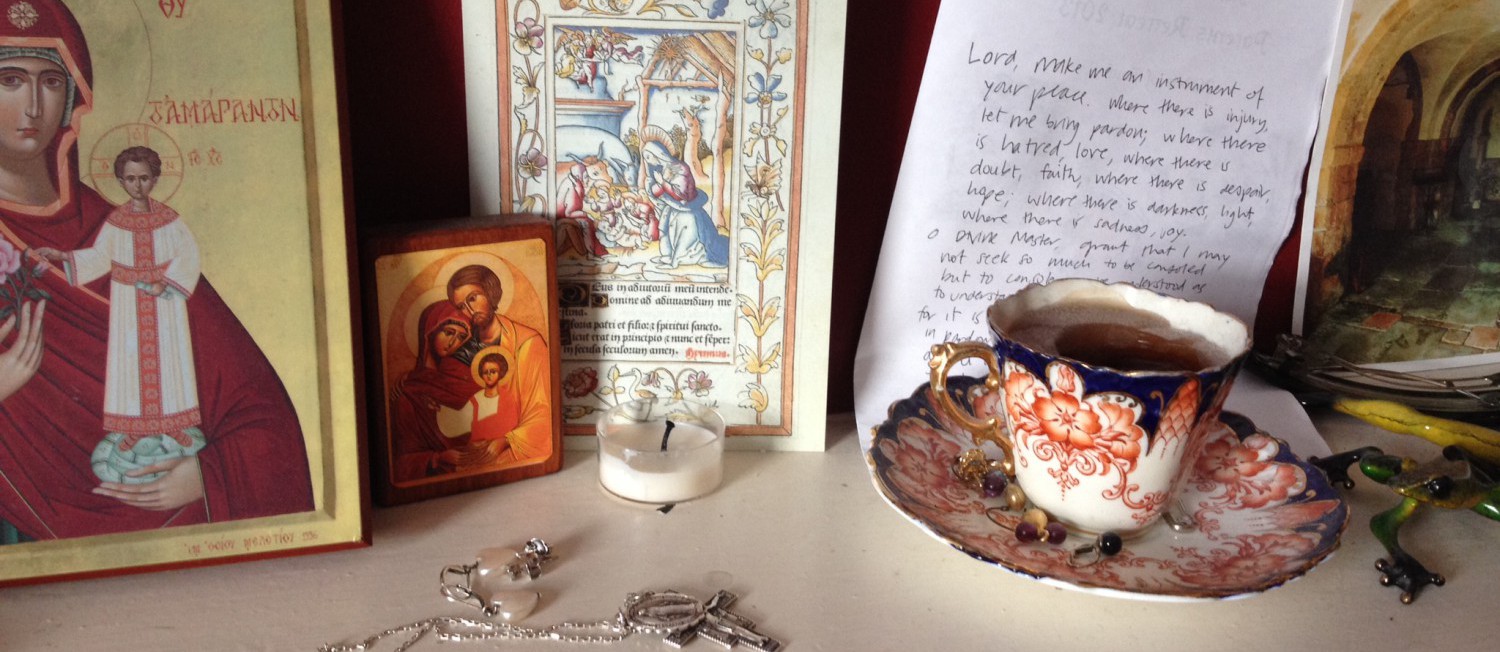
Monday in Holy Week

He does not break the crushed reed,
nor quench the wavering flame.
                               -Isaiah 42
*           *        *
I am glad that something has gone haywire with my email account, at least for the moment. Because the email from Universalis with the daily Mass readings hasn’t arrived, I visited the site for Lauds and the Mass readings. A few lines into the Benedictus, I thought, this is a strange translation of the Benedictus. And then I remembered why I like this “strange” translation so much:
Through the bottomless mercy of our God,
  one born on high will visit us
to give light to those who walk in darkness,
  who live in the shadow of death;
  to lead our feet in the path of peace.
The heart of our salvation is this, “the bottomless mercy of our God,” whose coming among us we remember in a distinct way this week. God chose this bizarre way to save us, this way that seems so foolish and un-God-like. Gregory of Nyssa contended with those who thought the Incarnation and the Passion were wholly unworthy of God. But it shows God’s infinite mercy spectacularly. It is that “bottomless mercy” that inspires the way of the Lord’s coming to “visit us.”
“He does not break the crushed reed/nor quench the wavering flame.” Indeed not. Instead, God opts to be crushed, though Isaiah insists that “he will neither waver nor be crushed until true justice is established on the earth.” So the One who cannot be crushed is crushed (Isaiah 53), and so true justice is established on the earth; and we are not crushed, but saved. 
And so all of our Lenten practice comes down to this, this week, in which we remember that all our endeavors to join the Lord in his suffering serve not to crush us, but to prepare us to receive him once again in his mercy–bottomless mercy!–at Easter. 
 Deo gratias.

fallow year

Tonight I had most of an evening off from the ordinary duties of mothering. But it wasn’t an evening out with friends or even a quiet night at home. I am grateful to our friend Ian Markham, Dean and President of Virginia Theological Seminary, for an opportunity to talk about my intellectual project. 

For a while there, I’d nearly forgotten I had one. Homeschooling our 11-year-old and running the others back and forth to school keeps me pretty well occupied. But tonight, as I had some space to reflect on what I am doing, I gave this year a new name: a fallow year.  Without teaching and administrative duties, or any work-related obligations, I’ve committed to a year of rest–of a sort. The “land” on which my research and writing usually take place is not being cultivated, not really. This academic year I’ve given myself to another sort of work, work I find much more difficult: the work of being a patient and kind mother to my children.

It’s difficult, and yet necessary. Because I hadn’t spent much time lately talking to grown-ups, I was more jittery than usual in anticipation of the event. As I paced around, I realized that I had my priorities all wrong. Being the person “up front” makes me vulnerable to the temptation to be the expert, to try to be the cleverest person in the room. I’m pretty sure that I am never the cleverest person in any room I enter (really: my kids are cleverer than I am; I’ve just got more experience of the world), hence I feel nervous at the thought of people listening to me and asking questions.

In the quiet (for which I thank Lewis: the children were driving him mad this evening) I realized (again) that I was mistaken. The object of the game, for me, is not to be the cleverest one. That’s not a game I am ever going to win, nor is it a game worth playing. I’m a theologian and a mother. Both of those occupations require patience and kindness, humility and generosity. Jesus didn’t say, “Blessed are the clever, for they shall win all the arguments,” but “Blessed are the meek, for they shall inherit the earth.”

The clever do win arguments, it’s true. And I lose them, often. But I would much, much rather inherit the earth.

What’s Down Syndrome?

I am running behind: World Down Syndrome Day was yesterday. In our house, though, every day is Down Syndrome day, so I am posting the video made by the Lejeune Foundation this year. We watched it together, the children and I. My daughter Anna, who has Down Syndrome, wasn’t as interested as I expected. My 8-year-old son, however, asked the $64,000 question: “what’s Down Syndrome?”

I’m not sure whether I answered his question perfectly. He doesn’t know anything about genetics, or chromosomes, or anything like that. I tried. But I don’t think it matters. He’ll grow up knowing what trisomy-21 looks like.

Family.

pain in childbearing, part 2

That little verse from Genesis 3 sticks with me. I reflected some in my previous post about the pain of losing children, and of heartbreak in raising them. This week, we had some time with a psychologist who repeated (not in so many words) one of the key lessons I am learning in this great adventure of parenting: it’s not intuitive.

Bearing children may be a perfectly natural event. But raising them is an art. Doing what comes naturally, unless we are near-perfect in our virtue, isn’t usually a good idea when responding to the various provocations of our beloved (and utterly infuriating) offspring. Most parents come to realize this, so I am not saying anything new there. And I am not qualified to give child-raising advice. All I can say for certain is that losing your temper is always going to end badly, but keeping it perfectly is impossible, at least in my experience.

The counter-intuitiveness of parenting, though, has theological significance, I believe. Because having children is something good. It’s God’s plan. “Be fruitful and multiply,” God tells Adam and Eve. God repeats the instruction when Noah and his kin disembark from the ark. The propagation of the species matters to God. And the psalmist remarks that children are a blessing from God.

But it certainly doesn’t always feel like that. Of course there is joy as well, and the work of parenting is meaningful perhaps above all other work. Human beings are precious, and powerful creatures, capable of great things–some very good, and some very bad. Some days the responsibility seems overwhelming. And doing it properly just doesn’t come naturally. So it’s painful. It’s part of the discipline that yields the peaceful fruit of righteousness (Hebrews 12:11), or so I hope.

For the grace to get through it day by day, Deo gratias.

Monday of the third week of Lent

“My father,” [Naaman’s servants] said, “if the prophet had told you to do something extraordinary, would you not have done it? All the more now, since he said to you, ‘Wash and be clean,’ should you do as he said.”  So Naaman went down, and plunged into the Jordan seven times at the word of the man of God. His flesh became again like the flesh of a little child, and he was clean.
A brother came to Scetis to visit Abba Moses and asked him “Father, give me a word.” The old man said to him “Go, sit in your cell, and your cell will teach you everything.”
*        *      *
It is the ordinary stuff of life that most escapes our sense of God’s presence: if it is an ordinary thing, God must not really be involved in it. The miraculous is extraordinary, we think. Miracles, like that which Naaman desired, look spectacular. The miracle he got, however, was no less miraculous for being ordinary.

Unfortunately, progress in Christian faith seems to require, as Naaman’s servants and the desert fathers and mothers knew, a steady diet of very ordinary disciplines. Ascetic superheroes get short schrift in the Sayings; Elisha sent Naaman to wash in the Jordan, and Abba Moses sent the brother to go and sit in his cell. Nothing fancy. 

Once upon a time, I used to try do do heroic things during Lent. Then I had children. Now I find that the most basic observance of Lent, according to what the Church teaches, can be a struggle. Is this it? I wonder. Is this really all I can do? And is that enough? 

We don’t get to choose how we suffer for the sake of the gospel. We don’t get to choose which things will form us in obedience and humility. If we did, well, it wouldn’t be obedience, would it? So I drag myself through this Lent, hoping I can make a good confession between now and Holy Week, at least. Somewhere in the dragging, the apparently meaningless and pointless suffering of a very low mood, God is at work. All is now chaos and darkness, and the swirling, struggling feeling inside must be the Spirit, stirring up the water, making ready in some mysterious way for that great command: fiat lux!

And there will be light. There will be light. Not because of anything I do or do not do, but because the One who commands all our obedience is faithful and strong and true: the light shines in the darkness, and the darkness cannot overcome it. 

In the meantime, I think I’ll look again at the inside of my cell, and see what it has to teach me.