Wednesday of the fifth week in ordinary time

Genesis 2:4-9,15-17; Psalm 103:1-2,27-30(LXX); Mark 7:14-23


Bless the LORD, O my soul!
  O LORD, my God, you are great indeed!
You are clothed with majesty and glory,
  robed in light as with a cloak.
All creatures look to you
  to give them food in due time.
When you give it to them, they gather it;
  when you open your hand, they are filled with good things.
If you take away their breath, they perish
  and return to their dust.
When you send forth your spirit, they are created,
  and you renew the face of the earth.  (Ps 103)

.  .  .


One of the most persistent themes in the Psalms–and indeed throughout the Scripture–is the gratuitous nature of creation. All that is, life itself and all that sustains life, is pure gift from the source of life and being. Everything that lives, lives because God’s Spirit sustains it; we live because God’s breath continues to enliven us, as it did in the beginning (Genesis 2). 


When I am tempted to think that what I am going through will crush me, that I will not be able to recover from whatever blows life brings, I am called back by this thought: that God, who allows the storms to blow, and who allowed Job to be tested, is the One who gives the strength not only to survive, but to overcome. That’s not to say that every difficulty becomes easy; it just draws me away from the abyss called despair. I may be angry–because the plea to God, ‘but I won’t survive’, simply won’t do. I can certainly say to the Lord, ‘if it is possible, take this cup from me’–and that as stridently as I can manage. But in the end, I have to give in, and say, ‘not my will but yours be done’, not as resignation to a fate that threatens to destroy me, but in joyful expectation that the One to whose will I submit is the One who will bring me through whatever dark and thorny ways I must pass. 


That doesn’t always seem like good news, I confess. But I know that the light shines in the darkness, and the darkness cannot overcome it. And this is, and always will be, my one true and steadfast hope. 
Monday of the fifth week in ordinary time

Genesis 1.1-19; Psalm 103.1-2, 5-6, 10, 12, 24 & 35 (LXX); Mark 6.53-56

In the beginning God created the heavens and the earth. and the earth was formless and void, and darkness was over the surface of the deep; and the Spirit of God was moving over the surface of the waters. Then God said ‘Let there be light’; and there was light. (Gen 1. 1-3)

He established the earth upon its foundations,
So that it will not totter forever and ever.
Thou didst cover it with the deep as with a garment;
The waters were standing above the mountains. (Ps 104. 5-6)

And wherever He entered villages, or cities, or countryside, they were laying the sick in the market places, and entreating Him that they might just touch the fringe of His cloak; and as many as touched it were being cured. (Mk 6. 56)

.  .  .

The logical New Testament passage to be added here is Colossians 1, especially vv. 16-17: ‘For by Him all things were created, both in the heavens and one earth, visible and invisible, whether thrones or dominions or rulers or authorities–all things have been created by Him and for Him. And He is before all things, and in Him all things hold together’.

A few months ago, I heard a lecture on theology and creation by a professor who is both a theologian and a scientist. The laws of physics, he explained, can tell us how the universe developed from the tiniest fraction of a second after its actual beginning. At that point (10 to the -42 of a second), though, the laws of physics break down. I thought, yes, but the ‘law’ of Colossians 1.17 still holds: ‘in Him all things hold together’.

Two things in the readings for today are noteworthy, and take that idea a step further. First, Psalm 103 suggests that any interpretation of Genesis 1 that implies that ‘stuff’ was already there for God to shape and order misses the point: God covered the earth ‘with the deep as with a garment’. All that was ‘already there’ in the beginning was God. Second, there is a connection between the creation and the curing: the arrangement of these readings together points us to the identity of Jesus with the Creator, an identity made more clear by the verses from Colossians. The One who created and sustains all things can set things right.

I long to be in those crowded streets, close enough to touch the fringe of his cloak, so that all that’s out of kilter with me might be set right. But my healing has to come another way, through the Scripture, which teaches me, and the sacraments, by which He touches me still.

St Agatha (5 February)

Hebrews 13:15-17,20-21; Psalm 22:1-6(LXX); Mark 6:30-34

The apostles rejoined Jesus and told him all they had done and taught. Then he said to them, ‘You must come away to some lonely place all by yourselves and rest for a while’; for there were so many coming and going that the apostles had no time even to eat. So they went off in a boat to a lonely place where they could be by themselves. But people saw them going, and many could guess where; and from every town they all hurried to the place on foot and reached it before them. So as he stepped ashore he saw a large crowd; and he took pity on them because they were like sheep without a shepherd, and he set himself to teach them at some length.  (Mk 6.30-34)

.  .  .

I know what I should hear in these passages (all of which refer to the Lord as a shepherd), taken together: I should remember that the Lord is indeed my shepherd, and rest in him. Instead, my first thought is, Jesus knew exactly what motherhood is like: just when you think you’ll have a moment’s rest and peace, the needs of the ‘flock’ insist on being met. And your heart goes out to them, and you set yourself to doing what needs to be done.

This, I tell my husband, is why I like to go to daily Mass. If it is at all possible, I go: there I get to be the sheep. There the Lord restores my soul, feeds me and gives me rest. The Lord is indeed my shepherd: he gives me everything I need, and I am glad.

.  .  .

The Office of Readings (http://www.universalis.com/0/i-readings.htm) for St Agatha’s feast day includes the following:

From a homily on Saint Agatha by Saint Methodius of Sicily, bishop
The gift of God, the source of all goodness

My fellow Christians, our annual celebration of a martyr’s feast has brought us together. She achieved renown in the early Church for her noble victory; she is well known now as well, for she continues to triumph through her divine miracles, which occur daily and continue to bring glory to her name.
  She is indeed a virgin, for she was born of the divine Word, God’s only Son, who also experienced death for our sake. John, a master of God’s word, speaks of this: He gave the power to become children of God to everyone who received him.
  The woman who invites us to this banquet is both a wife and virgin. To use the analogy of Paul, she is the bride who has been betrothed to one husband, Christ. A true virgin, she wore the glow of pure conscience and the crimson of the Lamb’s blood for her cosmetics. Again and again she meditated on the death of her eager lover. For her, Christ’s death was recent, his blood was still moist. Her robe is the mark of her faithful witness to Christ. It bears the indelible marks of his crimson blood and the shining threads of her eloquence. She offers to all who come after her these treasures of her eloquent confession.
  Agatha, the name of our saint, means “good.” She was truly good, for she lived as a child of God. She was also given as the gift of God, the source of all goodness to her bridegroom, Christ, and to us. For she grants us a share in her goodness.
  What can give greater good than the Sovereign Good? Whom could anyone find more worthy of celebration with hymns of praise than Agatha?
  Agatha, her goodness coincides with her name and way of life. She won a good name by her noble deeds, and by her name she points to the nobility of those deeds. Agatha, her mere name wins all men over to her company. She teaches them by her example to hasten with her to the true Good. God alone.

Thursday of the fourth week in ordinary time

Hebrews 12:18-19,21-24; Psalm 47:2-4,9-11(LXX); Mark 6:7-13


For you have not come to what may be touched, a blazing fire, and darkness, and glom, and a tempest… But you have come to Mount Zion and to the city of the living God, the heavenly Jerusalem, and to innumerable angels in festal gathering, and to the assembly of the first-born who are enrolled in heaven, and to a judge who is God of all, and to the spirits of just men made perfect, and to Jesus, the mediator of a new covenant, and to sprinkled blood that speaks more graciously than the blood of Abel.  (Heb 12.18, 22-24)
                                                                                                     

We have thought on thy steadfast love, O God, 
  in the midst of thy temple.
As thy name, O God, 
  so thy praise reaches to the ends of the earth.
Thy right hand is filled with victory; 
  let Mount Zion be glad!
Let the daughters of Judah rejoice
  because of thy judgements.
                           (Ps 47.9-11)


.  .  .


It seems to me that the occasion for all this gladness nearly goes unnoticed in the descriptions of rejoicing: Jesus. The steadfast love of God is ours in him, ‘the mediator of a new covenant’; the judge and the judgement and the judged all come together in Jesus. He is the Word of God, who is God, and who became flesh; he is the one in whom all the promises of God find their ‘Yes’–God’s yes to humanity, which is judgement and redemption; and he is the one who stands to be judged in our place, and in him (and only in him) we may be found among the ‘just… made perfect’.


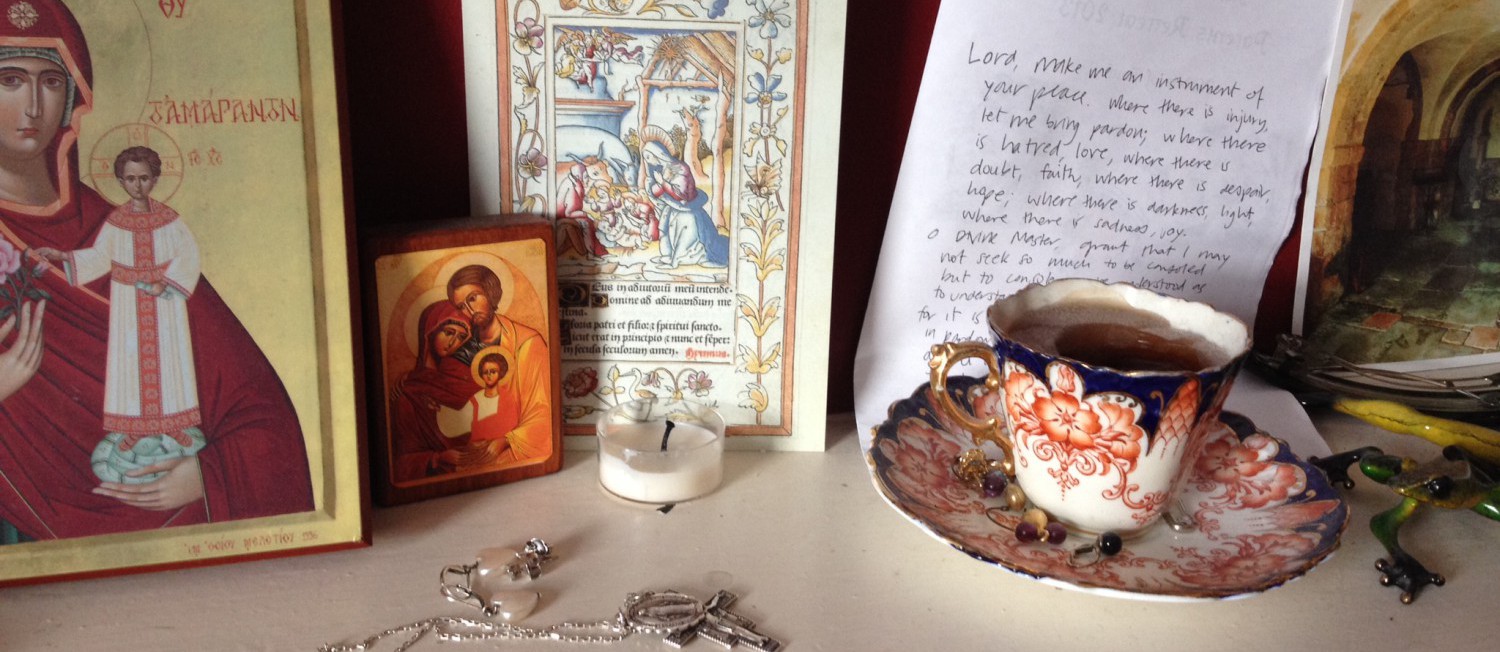
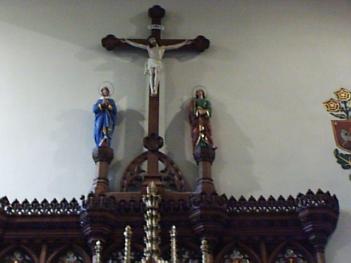
And there, above, is the image I keep in my imagination of Jesus, the king of glory, the redeemer, the one whose ‘blood… speaks more graciously than the blood of Abel’. No matter what’s happening in my life, I can look up and see that there is hope for me. Nothing can separate us from the steadfast love of God, displayed so eloquently and so tenderly. God’s praise indeed ‘reaches to the ends of the earth’; how can I do anything but rejoice with the daughters of Judah, and be glad in the presence of the Lord?


Glory be to the Father, and to the Son,
  and to the Holy Spirit, 
  as it was in the beginning, 
  is now, and ever shall be, 
  world without end, 
  Amen.


The Presentation of the Lord

Malachi 3:1-4; Psalm 23:7-10; Hebrews 2:14-18; Luke 2:22-40


Behold, I send my messenger to prepare the way before me, and the Lord whom you seek will suddenly come to his temple; the messenger of the covenant in whom you delight, behold, he is coming, says the Lord of hosts. But who can endure the day of his coming, and who can stand when he appears? 
For he is like a refiner’s fire and like fuller’s soap; he will sit as a refiner and purifier of silver, and he will purify the sons of Levi and refine them like gold and silver, till they present right offerings to the Lord. 
                                                                   (Mal 1.1-3)

Lift up your heads, O gates!
  and be lifted up, O ancient doors!
  that the King of glory may come in. 
Who is the King of glory? 
  The Lord, strong and mighty,
  The Lord, mighty in battle!
                                   (Ps 23.7-8)

Since therefore the children share in flesh and blood, he himself likewise partook of the same nature, that through death he might destroy him who has the power of death, that is, the devil, and deliver all those who through fear of death were subject to lifelong bondage.             
                                                                                              (Heb 2.14-15)

.  .  .

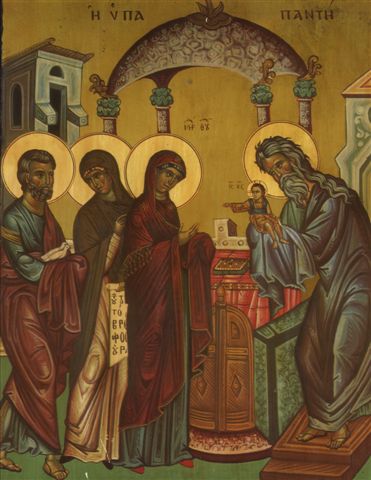
The gospel story is familiar enough: Jesus is presented in the temple; Simeon makes his famous proclamation, ‘mine eyes have seen thy salvation’; and Anna recognizes in the Christ child the redemption of Israel. But how? Both Malachi and the psalmist point to a fearsome figure: the one who is coming is ‘like a refiner’s fire’ and ‘The Lord, strong and mighty’. Yet the ‘light for revelation to the Gentiles’ is neither a soldier nor a refiner, but a baby. 

A baby? So it is: he ‘partook of the same nature’: ours. The Lord does not enter the temple in strength and glory, but in obedience. Joseph and Mary ‘brought in the child Jesus, to do for him according to the custom of the law’ and ‘when they had performed everything according to the law of the Lord’, they returned home. The pioneer and perfecter of our faith began in the usual manner, being taken to the temple as the law commanded. 

The light of salvation dawns in the most unexpected way; God’s extraordinary grace comes in the most ordinary way. And it is for us–the writer to the Hebrews makes that clear: 

‘For surely it is not with angels that he is concerned, but with the descendants of Abraham. therefore he had to be made like us in every respect, so that he might become a merciful and faithful high priest in the service of God, to make expiation for the sins of the people. For because he himself has suffered and been tempted, he is able to help those who are tempted’ (Heb 2.16-18).

His obedience makes possible our redemption; in his faithfulness, we are made faithful; he became all that we are, so that we might become like him. 

That is good news, indeed. 


Tuesday of the second week in ordinary time

Hebrews 12:1-4; Psalm 21:26-28,30-32 (LXX); Mark 5:21-43


Therefore, since we are surrounded by so great a cloud of witnesses, let us also lay aside every weight, and the sin which clings so closely, and let us run with perseverance the race that is set before us, looking to Jesus, the pioneer and perfecter of our faith, who for the joy that was set before him endured the cross, despising the shame, and is seated at the right hand of the throne of God.  (Heb 12.1-2)

.  .  .


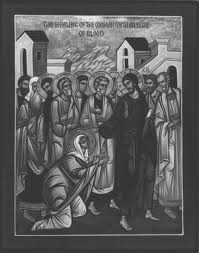
It just happens, I suppose, that one of my favorite stories from Mark’s gospel (the healing of the woman with an issue of blood and the raising of Jairus’ daughter) is paired with these verses from Hebrews 12, which I know by heart. Hearing either would take me back to the context in which these passages of Scripture first came alive for me: my days as a college student in southern California. Nothing was more important then than being a disciple of Jesus, and studying Scripture and praying with friends was the focus of my life. 


Twenty years later, work and family demand my attention and energy. Being a disciple of Jesus doesn’t look the same. But I am grateful for the way these passages have stuck with me; over the years the cloud of witnesses has grown, as I have come to know more about the lives of the saints, and my appreciation for the complexity of Jesus’ interaction with the woman with an issue of blood has deepened. 


In some ways, everything has changed. In others, everything remains the same. I may be twenty years older, but I stand in as great a need of that cloud of witnesses, and as entangled by sin as I was at twenty. Of course, it doesn’t look the same: I have no difficulty these days staying away from fraternity parties and all the temptations involved. But the sinful inclinations persist like the issue of blood: I still stand in as great a need of healing as I ever did. Perhaps in some ways, my need is greater, though the lapses in judgement that led me straight into temptation are fewer and farther between. It takes time for the issue of blood to drain away the woman’s resources, while she seeks remedies that do not cure her. 


Her experience might be better expressed by a few lines of the psalm not included in today’s responsorial: 
I am poured out like water, 
  and all my bones are out of joint;
my heart is like wax, 
  it is melted within my breast; 
my strength is dried up like a potsherd, 
  and my tongue cleaves to my jaws;
  thou dost lay me in the dust of death.
                                                 (Ps 21.14-15)


And it is into that context that the words of the end of the psalm and the encouragement to persevere are spoken. Not for the content or the strong, but for those ‘poured out like water’, for the desperate and the afflicted. For all those in need of healing, Jesus ‘endured the cross, despising the shame’; and he sits at the right hand of the throne of God having accomplished her salvation and mine: 


Yea, to him shall all the proud of the earth bow down;
  before him shall bow all who go down to the dust, 
   and he who cannot keep himself alive.
Posterity shall serve him; 
  men shall tell of the Lord to the
  coming generation,
and proclaim his deliverance to a people yet unborn, 
  that he has wrought it. 
                                                 (Ps 21. 30-31)

Monday of the fourth week of ordinary time

Hebrews 11:32-40; Psalm 30:20-24 (LXX); Mark 5:1-20


Gideon, Barak, Samson, Jephthah, or of David, Samuel and the prophets – these were men who through faith conquered kingdoms, did what is right and earned the promises.  (Heb 11.32)


Be strong, and let your heart take courage,
  all you who wait for the Lord!       (Ps 30.24)

So he gave them leave. and the unclean spirits came out, and entered the swine; and the herd, numbering about two thousand, rushed down the steep bank in to the sea, and were drowned in the sea. (Mk 5.13)

.  .  .

Jephthah? My first thought at reading the first verse of the passage from Hebrews was utter disbelief. How does Jephthah make it to the litany of the faithful in Hebrews 11? The story told about him and his family in Judges 11 does record his victory in battle, but one wonders whether even Jephthah himself would have considered the victory worth what it cost him: his daughter, his only child. His tale is tragic, and his loss as mysterious as Job’s. There is no doubt, reading Judges 11, that God allowed Jephthah to make the vow that  won the battle and took his daughter from him. Why?

Mark’s gospel offers no answers, only more–and different–questions. The demoniac is healed, but someone lost a herd of pigs in the bargain. One might argue that the life of the man is worth more, but I would still ask whether the demoniac could not have been healed without the loss of the pigs? (I know, the pigs weren’t of particular concerns to the Israelites. But still.) Likewise, could not Jephthah’s battle have been won without that vow? Or could the Lord not have arranged for a goat to be first to meet Jephthah on his return? Yet there he is, listed among some of the most remarkably faithful characters in the history of Israel: clearly we are not meant to forget his story, or to push him aside in our recollection of God’s faithfulness to Israel, but to remember him for his faith.

It doesn’t make sense. But then, there’s quite a bit in the history of Israel and the Church, and in my own history, that just doesn’t make sense. But would a reason really make it easier? Would Jephthah’s loss be less tragic if there were a reason for his daughter’s death?

And so, in the middle of it all, there’s a psalm. It is a psalm that recounts the faithfulness of God and celebrates the steadfast love of the Lord. Somehow, in the midst of the suffering, even the most apparently senseless suffering, God’s justice and mercy prevail. So the only response to the tragedies that shatter us, and fly in the face of the goodness of God, is to hear the psalmist’s encouragement:

Be strong, and let your heart take courage,
  all you who wait for the Lord.


Saturday of the third week in ordinary time.

Hebrews 11:1-2,8-19; Luke 1:69-75; Mark 4:35-41

.  .  .


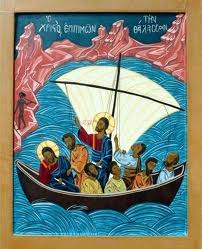
The icon captures the climactic moment in the gospel story: Jesus calms the storm, and the disciples are amazed: ‘Who then is this, that even wind and sea obey him?’ 


But before the awe comes terror. Jesus is asleep in the stern, as the wind tosses the boat around on the rising waves. Many times during the last several months, this particular story from Mark’s gospel has come to mind. I have felt like the disciples, in a boat at the mercy of the storm. And I have pleaded with the master also: ‘Teacher, do you not care if we perish?’ 


Jesus asks whether they have no faith. The evidence, actually, is that they do. They’re the boatsmen. If getting safely through the storm required skill, there would have been no reason to wake Jesus. What did they expect him to do? How could he possibly help? Perhaps they did not have much faith, since they seem surprised to find that he was, in fact, able to calm the storm. 


But a little faith is all it takes. (See also yesterday’s gospel: Mark 4:26-34.) The letter to the Hebrews shifts in chapter 11 from the great high priest to the faithful men and women of the Old Testament: ‘Now faith is the assurance of things hoped for, the conviction of things not seen. For by it the men of old received divine approval’ (11.1-2). Among those so credited is Sarah, who ‘received power to conceive, even when she was past the age, since she considered him faithful who had promised’ (v. 11). As I read that bit of Genesis, though, Sarah’s faith is less obvious: she laughed


The disciples in Mark’s gospel are notorious for not getting the point. That seems to be the way, though, and God doesn’t seem to mind terribly. Sarah laughs, but conceives anyway; Jesus scolds the disciples for having ‘no faith’, but calms the storm, and not long after, sends them out two by two, giving them authority over the unclean spirits. 


Maybe, just maybe, there’s hope for me, after all. 


Thursday of the third week in ordinary time

Hebrews 10.19-25; Psalm 23.1-6(LXX); Mark 4.21-25

Through the blood of Jesus we have the right to enter the sanctuary, by a new way which he has opened for us, a living opening through the curtain, that is to say, his body. And we have the supreme high priest over all the house of God. So as we go in, let us be sincere in heart and filled with faith, our minds sprinkled and free from any trace of bad conscience and our bodies washed with pure water. Let us keep firm in the hope we profess, because the one who made the promise is faithful. Let us be concerned for each other, to stir a response in love and good works. Do not stay away from the meetings of the community, as some do, but encourage each other to go; the more so as you see the Day drawing near.
                                                                                                               (Heb 10.19-25; Jerusalem Bible)

Who may ascend the hill of the Lord?
And who may stand in his holy place?
He who has clean hands and a pure heart,
Who has not lifted up his soul to falsehood,
And has not sworn deceitfully.
                                               (Ps 23.3-4; NASB)

.  .  .

Apparently I was not the first person to think this psalm fit together well with this section of the letter to the Hebrews. As I read the first reading, my first thought was, ‘I should have waited; this is a much better fit with the psalm’.

I am left, however, in the same place: humbled by the testimony of Scripture to the faithful love of the God who saves. Through Christ we have been saved, and through the gift of Scripture we come to understand that salvation, and are moved to thanksgiving and praise.

Glory be to the Father, and to the Son,
  and to the Holy Spirit,
  as it was in the beginning,
  is now and ever shall be,
  world without end,
  Amen.

St Timothy and St Titus, Bishops

Hebrews 10:11-18; Psalm 109:1-4 (LXX); Mark 4:1-20


All the priests stand at their duties every day, offering over and over again the same sacrifices which are quite incapable of taking sins away. He, on the other hand, has offered one single sacrifice for sins, and then taken his place forever, at the right hand of God, where he is now waiting until his enemies are made into a footstool for him. By virtue of that one single offering, he has achieved the eternal perfection of all whom he is sanctifying.  (Hebrews 10.11-14, Jerusalem Bible)


Who shall ascend the hill of the Lord?
  And who shall stand in his holy place?
He who has clean hands and a pure heart,
  who does not lift up his soul to what is false,
  and does not swear deceitfully.
He will receive blessing from the Lord, 
  and vindication from the God of his salvation. 
                                        (Ps 23.3-5 [LXX])

.  .  .


I hope I can be forgiven for having grown a bit weary of the same four verses about Melchizedek that seem to accompany many of the readings from the middle of the letter to the Hebrews. As I read the invitatory psalm for today (an alternate to the usual Ps 94 [LXX]), it seemed to fit well with the passage from Hebrews.

These few verses in particular always used to worry me: I despaired of ever being the one with clean hands and a pure heart, worthy to ascend the hill of the Lord. But eventually I came to realize that the one who has clean hands and a pure heart is Christ, the Lord, the priest who ‘has offered one single sacrifice for sins’ and, in so doing, ‘has achieved the eternal perfection of of whom he is sanctifying’.

The psalm no longer worries me as it once did. Some days, I confess to feeling a bit complacent, though: Jesus has done it all, and my sins have been done away with by his sacrifice. And I am perhaps not as contrite as I should be. Other days–better days, I think–I am humbled by the knowledge and the comfort that this psalm brings me. Not only the big, dramatic sins of the world and its great ones (the Apostle Paul comes to mind here), but for my stupid, petulant, and self-serving sins, Christ has overcome by his life, death and resurrection. At least Paul, I surmise, thought he was doing the right thing, however wrong-headed his persecution of the church was. Often I stumble forward, not even trying very hard to determine what the right thing is: I am, rather, concerned about avoiding pain. I seek the pleasures, small and great, that make life enjoyable and give me something to look forward to after the chores are done.

To think that the Lamb of God, who takes away the sins of the world, stoops to take away my sins of ignorance and stubbornness, pettiness and weakness, is humbling indeed. In return, all I have to offer is what has been asked of God’s people: a sacrifice of praise and thanksgiving.

Glory be to the Father, and to the Son, and to the Holy Spirit,
  as it was in the beginning, is now and ever shall be,
  world without end,
  Amen.