being human, part 2: on suicide

Humans are indeed created in the image of God. In us, God has planted the desire for eternity, and for true happiness–in other words, for God. The difficulty is that sin misdirects our desire and fools us into thinking that other things will satisfy us. Most of the stuff we see around us every day reinforces this false belief. Things cannot make us happy, no matter what the advertisements say.

We are also deceived in our self-image. That is, we are mistaken about who we are and what makes us good. The good that we are, and the good that we do comes from the Good itself: God. God created us in his image so that we might reflect it to one another and respect it in one another. This means, however, that we belong not only to ourselves, but to God and to our neighbors. So we are not meant to take our own lives in the same way that we are not meant to take the lives of others: they do not belong to us, to do with what we will.

But there is more. Choosing to live for the sake of bearing God’s image, when I am not sure I bear it clearly enough for anyone to make it out…is just not appealing. That’s when I think I ought to carry on because of the stuff that I do. If I am not around for my kids, for example, who will be? On a better day, I might even think about the theological work that I do. I should stick around; I might eventually do some good, when the dark fog lifts.

Wrong–for two reasons. First, the lifting of the dark fog is only ever temporary. Depression is a little bit like the weather. The sun may shine, but the rain is bound to return eventually. Second, and way more importantly, the good I might do, whether for my kids or for the world, is not what makes me significant. I tend to think that the meaning of my life is somehow bound up with what I can accomplish. (Nothing against accomplishments, here! They’re good.) It’s not true. God hasn’t put us in the world to do stuff, as if there were stuff he couldn’t get done on his own. The essential feature of human life is its relationship to God: to be loved by God, and to learn to love in return. That’s it.

Suicide might seem like the solution to the weary, grey, and lifeless burden of depression. After all, even if it does go away, the fog will return. Whatever happens after suicide, I’m guessing depression (as it’s related to  our way of being in the world in this life) isn’t going to be part of it. It’s hard to endure depression because it hurts, it slows me down, it makes me feel as if nothing I have done or will do justifies my existence on this planet. But what if my existence on this planet is already justified by God? What if I don’t have to do anything? What if God is like that teacher in Florida who compliments his students every day–if only I would come forward and listen?

Here’s what I have learned: self-respect is much, much more difficult than self-hatred. Hating yourself is easy: the whole world displays for us what we ought to be and do. And we fail. (At least I do–maybe some folks don’t.) So the natural response is to think, ‘I really ought to try harder. I could do better, couldn’t I?’ Then, when trying harder doesn’t do it, and I’m exhausted from the effort, I think, ‘Well, maybe I am just not good enough.’ Enter self-loathing. Self-respect, on the other hand, has to refuse the comparison. Self-respect has to be satisfied with what is truly my best effort and not reject it because it doesn’t produce the hoped-for results.

Maybe it’s good news, then, that self-hatred is sin. Not because now we can condemn it in one another–heavens, no! It’s good news because seeing this self-hating orientation as misdirection, as a turning away from God as well as an attack on self (an inward turning!), puts it in the light of grace. That doesn’t make it go away, but it does make fighting it part of the good fight of faith.

Deo gratias.


addendum: further to the last

ps. If you read to the end of this piece by David Brooks in the New York Times today, you’ll find that this human task of reflecting God’s love and attention to the world is not only the random thought of a Catholic theologian. The mother of Kennedy Odede told him something similar. It isn’t because God is busy, though, that we bear this responsibility. When we fulfill this calling, to show forth God’s likeness, we also are changed.

being human, part 1

Made_in_Gods_Image_by_MacIomhairIn my quasi-professional life, the life in which I write the sorts of things academic theologians are supposed to write but without any compensation for doing so, I am working on an essay on Catholic moral anthropology. Mostly I stick pretty close to what the official teaching of the Church is–this piece is, after all, for the Oxford Handbook of Catholic Theology.
The official teaching is good, I think, so I feel no need to stray. There is an emphasis on the way in which we human creatures are meant to live, that is, to live up to the image of God in which we have been made. Again, this is good: I do believe that we ought to be the image of God in the world. Elaborating on this, I would say (and will in the piece to be published) that means following Jesus in humility with love. I remember walking along the path by the river one afternoon in the weeks following my mother’s death. Having seen her lifeless body, and yet speaking to her, and knowing I ought to grieve, but couldn’t–well, the experience put me in a pretty strange space, spiritually speaking. So I lamented on that day by the river, ‘if only I could see you, God.’ Silly, I know: no one has ever seen God, etc. What came to me that day, though, was not the appropriate material from John’s gospel but a new attentiveness to what was in front of me. ‘That,’ I heard/realized/saw, ‘is the closest you will ever get.’ That was a person, a stranger, walking towards me on the path. He passed by, not realizing that he had changed something forever in me. People show (or fail to show) God to one another.

Believing that human beings are the image of God in the world has–from the evidence of Scripture and on the strength of that encounter–two very important implications. First, we must be the image of God. Jesus said, ‘he who has seen me has seen the Father.’ He himself did only what he saw the Father doing. His work on earth was (not only, but importantly) to make the Father known. So also we, who claim to be his disciples, must never forget this charge: to make the Father known. The weight of that responsibility did not occur to me immediately, but it is obvious. Bearing God’s image is not something we do chiefly for ourselves, but for our neighbor. We show God’s love and forbearance, or fail to show God’s love and forbearance, in every encounter. (I don’t know about you, but by day’s end I cannot count my failures to do this even on all ten fingers.)

Being in God’s image, second, requires us to respect that image in our neighbor. Here the official line is clear: every human being is created in the image of God. This of course has implications for the way we treat people at the ends of life, respecting the beginning and not hastening the end. It also, and crucially, must inform the way we regard every human being at every stage of his or her life. My children are all in the image of God, all equally so. The bouncy and bright four-year-old and the intelligent and high-strung twelve-year-old, the creative and brooding 9-year-old, and the happy and determined 14-year-old.  The fact that one of those children has one more chromosome than the others makes no difference to her being in God’s image. It also–and this is in many ways more difficult–means that however well or badly the children are behaving, however they reflect or fail to reflect the love and forbearance of the Father (and they do, more often than we see it, I think), we owe them the same respect. (An aside here, though: respect is not the same as capitulation. I make no claim to be an expert in parenting, but I do not think that letting our children get away with everything is respect. How to treat them with respect when they are behaving abominably? I can only say that the failures I mentioned above mount up very quickly in just that context.) It may well be that my children challenge me most, but I have opportunities every day to be patient or irritated, to be kind or scornful. Just because I am bound to fail doesn’t mean I shouldn’t try for patience and kindness always.

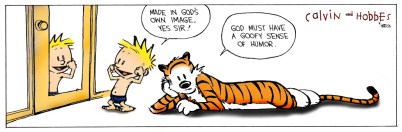
Calvin (in the above comic, not the famous theologian of Geneva) both gets the point and misses it entirely. Yes, we ought to recognize God’s image in ourselves and bear it proudly. The image of God is not, however, something we see best reflected in a mirror, but in one another. I know I am in God’s image in part because you show me–by reflecting God’s image to me, and by respecting God’s image in me. So I pray for the grace to fail less, and to be more like Jesus, today and every day.

For that grace, Deo gratias.

peace be with you

Email presents a challenge. For me, at least, the decision about how to sign off became perplexing. To say ‘best’ or ‘best wishes’…nope, that’s not me. ‘Yours faithfully’–much more authentic, but rather formal. (I use it occasionally.) ‘Cheers’ makes me sound like I want to be British. I love Britain and my British husband, and all my lovely dual-citizen children. But I am an American, like it or not, and I’m not pretending to be otherwise. ‘Warm regards’ or ‘warmly’ does convey the sense of ‘I like you, and I am sending this email fondly’, though ‘fondly’ sounds creepy and won’t do at all. For fellow Christians, ‘yours in Christ’ might be a possibility. It works for plenty of other folks. But, again, it’s just not me.

For a long time I resisted ‘peace’. It’s over-used, and misused. Maybe it’s a bit cold or distant, or seems so. It shouldn’t. Ephesians 2 reminds us that ‘he is our peace.’ Not only that: peace is what I long for, my highest aspiration for myself and the world in which I live. ‘Be at peace with everyone,’ St Paul admonishes us. The most under-appreciated part of the Mass–or at least a contender–is the sharing of the peace. When we share peace, we share Christ. He is our peace. He is the one who brings peace, and when we live in him and he in us, we find peace. Our restless hearts are restless until we rest–peacefully–in him. And so I sign, ‘peace.’ It is the best thing I can wish for anyone to whom I am sending an email. It is a prayer for those email recipients who do not know Christ, and a prayer for this who do. I mean by it always, ‘peace be with you,’ and I could not say anything more sincerely or warmly.

Peace be with you.

just one day

I will restore to you the years
    which the swarming locust has eaten,
the hopper, the destroyer, and the cutter,
    my great army, which I sent among you.

Joel 2: 23

This verse almost comforts me. Almost, because I long to know for certain that the wayward years of my life have not been wasted but I cannot quite believe it. Will the Lord really restore those years it seems were eaten by locusts? Looking back, I think I must just have been too lazy or self-centered to do the good that I might have done. I’m less worried about some of the really stupid things I did as a teenager, actually, and far more worried about the time and talent (such as I have) I fear I have squandered along the way. The locusts that ate my years were misdirection, or fear, or something like that–a failure to extend myself.

The funny thing is that I have long known that I had this kind of relationship with the past. It has always been coupled with a dreamy optimism about possibilities for the future. So, in my high-school scrapbook, I pencilled in, ‘Yesterday is already a dream, and tomorrow only a vision; but today, lived well, can make every yesterday a dream of happiness and every tomorrow a vision of hope.’ I know…but it spoke to the 17-year-old me, and the somewhat (!!) older me still understands why it did. Living in the present is so hard. It’s hard because I wonder what might have happened if I had done better, worked harder, been more patient and less foolish. And so I think about that future time, when I will always do my very best, be more diligent and patient and wise…and live happily ever after, of course.

I knew at 17 that I would be like this. If I had something to say to my 17-year-old self, I would say ‘thank you.’ Thank you for memorizing that sentence. For long years it has worked in my heart, and although I still struggle to live today well, at least I know what I am trying to do. So worry less and laugh more: you will achieve what you set out to do (I have, oddly), and find that the happy ending is still a long, long way off.

The reading from Joel was a reading specially chosen, I think, for the harvest Mass at school, and it was coupled with the gospel reading which concludes with Jesus saying, ‘Let the day’s own trouble be enough for the day.’ Set together, the two readings exhort us not to worry about the future or the past, but to attend to the day at hand. This is so much harder than I realized at 17! Because as the years go by, the past mounts up unchangeably behind us. Mixed in with our milestones are missed chances; achievements mingled with regrets. And the temptation is always there to project into the future: I will do this, not that, and all will be well.

All will be well, but not because we have made it so. All will be well because the One who made it will make it so. Our power, such as it is, is limited: we cannot alter the past or predict the future. What we have in our hands is just one day. Let us live it as well as we can.

Deo gratias.

dying right: a recommendation

It’s true, of course, that my being pro-life is part of the fabric of my Christian faith. At the same time, I tend not to wear the label ‘pro-life’ in a bright neon sign over my head. Not because I am ambivalent about abortion or the death penalty (that’s right: being pro-life means opposing the death penalty with equal vehemence), but because life and death issues are complicated, personal, and touch the deepest part of our soul.

Another reason I tend not to shout about pro-life issues is that the language in which such matters tend to be discussed centers on ‘rights’: right-to-life, right-to-die. As if such moments in our lives were actually about rights. As if life and death were somehow a matter of legislation. If only we could get the laws right, our coming into and going from this world would somehow pass smoothly. No. Of course not. Being born and dying are not like voting rights or equal pay. These latter issues should be the subject of vigorous advocacy–and that is part of being pro-life, too. The struggle for justice on behalf of the oppressed, advocacy on behalf of the weak and voiceless, and giving of our plenty to supply the needs of the poor are all pro-life activities. It’s about much, much more than conception and natural death.

As more states legalize assisted suicide, the conversations we have about death should become more serious and thoroughly honest. And we should talk with everyone, not only those with whom we agree. While I am against the legalization of assisted suicide, I do not oppose it automatically because it is not ‘pro-life.’ Actually, I share the concerns of those who support the bill with some hesitation, those who might well disagree deeply with some of the rest of my convictions regarding life and death and the One who holds both in omnipotent and gentle hands. Just this morning, I had the good fortune to come across a thoughtful and honest piece about death and how we approach it. Clare Bidwell Smith writes lucidly and compellingly about the end of life, not only as a professional but as a person who tended both her parents as they approached death.

‘Let us not leap to the last page without at least skimming the last chapter,’ she counsels. Skipping the ‘last chapter’ might save us a lot of suffering, certainly; but, as she points out, there is often important work to do in that chapter, work that earlier chapters leave out. Her account of the last weeks of her father’s life is both moving and enlightening–and should inform the decisions of any considering assisted suicide as a way out. Perhaps she won’t convince everyone to wait, but she might just show us all what we might be missing.

For Claire Tidwell Smith, and all who treat death with reverence, Deo gratias.

St Therese of the Child Jesus

I can’t say I have ever been a fan of St Therese of Lisieux. Not, that is, until today. I tend to resist the sort of sweetness for which St Therese is known, being suspicious, like so many cynical people, of anyone who seems ‘too nice.’ Jesus, after all, wasn’t ‘too nice.’

That’s the grown-up Jesus, though. What about the child Jesus? St Therese, after all, is St Therese of the Child Jesus. Staying behind in Jerusalem strikes me as a not-nice thing to do–as the parent of an almost-12-year-old boy, I can’t help but think it was a bit vexing for Mary and Joseph. Not having been a great fan of St Therese, I don’t know for certain, but I suspect that it wasn’t the 12-year-old Jesus that she had in mind.sta_thumbSt Francis de Sales, in a series of letters published as Letters to a Wife and Mother, advises his cousin in her endeavor to life a holy and spiritual life in her ordinary, daily tasks. She gets discouraged; St Francis suggests that she go about her work imagining that she does everything as Our Lady might have done: holding the small hand of Jesus. St Francis offers to his cousin the presence of the Lord as a child. And there is something at once gentle and unyielding about that presence. The set of letters is well worth reading, especially if you happen to be a wife and mother. Even if not, St Francis gives advice so kindly that anyone would benefit from it.

It is the sort of advice that fits very well with what I know of St Therese: in the small things, the everyday tasks, there are opportunities for grace, for love, for living in the presence of the Lord Jesus. Tenderness is not the way of our world, but it is required in the proper care for small children. And anyone who spends any time caring for small children will tell you that tenderness can be difficult to muster. Attending to the presence of the child Jesus is not a way out of the hard work of the spiritual life, but is a deepening of it. Not only is the Lord present to us as teacher and savior, but as child–not to be ignored or forgotten, or left in a corner, but taken by the hand and kept by our side.

We have always been taught by the Lord in his vulnerability on the cross. Perhaps it is time for us to allow us to teach him through his vulnerability in those precious years between the presentation and the finding in the temple.

St Therese, pray for us.

you’re having a baby, continued

A couple of weeks ago, I posted about Mark Schrad’s opinion piece in the New York Times. Oddly enough, a friend who is concerned about these same issues saw my comment on the NYT site and got in touch. Like Schrad, she has an 8-year-old child with Down Syndrome. Unlike Schrad, she supports the Ohio legislature and testified in favor of similar legislation in Indiana. A Public Policy Fellow at Notre Dame’s Center for Ethics and Culture, Mary O’Callaghan holds a PhD in developmental psychology and has written a piece for the Witherspoon Institute’s Public Discourse blog.

Her article highlights the dangers in Schrad’s position, in a professional and reasoned tone. I agree wholeheartedly, and tried to make a similar argument myself in that earlier post. I am so grateful that the work of advocacy is not a solo pursuit, that I have friends who are intelligent and determined and articulate. Sometimes the work of parenting, especially parenting a child with disabilities, can be lonely work–parenting in general is pretty tough and usually thankless. But moments like these remind me that we’re not alone. Children with Down Syndrome need the work of all of us parents–Mark Schrad (whose article has sparked necessary conversation) and Mary O’Callaghan, and many others who advocate for their children and others on a daily basis. Articles like Mary’s in particular need to be written and widely read. Knowing how very articulate and incisive my friend is in her advocacy is a great gift.

If you read my earlier post (whether you agreed with it or not), you should really read this article. She concludes with a punch: Despite the increasingly positive data about Down syndrome, somewhere between 70 and 90 percent of parents who receive this diagnosis choose abortion. I testified in Indiana, not because we are on a slippery slope, but because once we accept abortions based solely on disability, we are already at the bottom.

Indeed so. Let’s hope we aren’t there yet.

St Alfonso Rodriguez

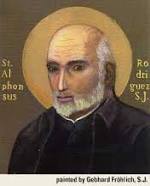
Unknown-3No, it isn’t St Alfonso’s day today. Presumably his memorial is celebrated on 31 October, which is the day he died. Today it’s the memorial of St Peter Claver, a saint remarkable for his service to the enslaved people brought to South America in the early 17th century. (Really, he’s remarkable–if you don’t know about him, check out the universalis entry for today or click the link above to his wikipedia page.)

Unknown-2St Alfonso Rodriguez, who was canonized the same day as St Peter Claver, was only a porter at the university in Mallorca. But he is remembered with St Peter because it was he who recognized St Peter’s vocation to evangelize the new world. (I am indebted to the universalis page for this detail, which I followed up at the New Advent website.) St Alfonso earnestly desired to enter the Jesuits himself, but lacked the requisite education. Eventually he was received as a lay brother, and served as the porter for forty-six years. Doubtless many other young men were encouraged by Br Alfonso, although they may remain nameless.

Once again, the small prevails: we remember St Peter Claver for his noble and heroic, and very public, service to the oppressed. And throughout the church year, we honor many others like him. Let us not forget to thank God for all those whose lives contributed to the upbuilding of the saints, and to ask them to pray for us. For all those holy men and women–Deo gratias.

the nativity of the Blessed Virgin Mary

Perhaps the gospel reading for today might seem a little dull. After all, a genealogy is hardly the liveliest of narratives (if I can even call it a narrative). We find, in Matthew’s gospel, a list of a great many men becoming the fathers of a great many sons, in succession from Abraham to Joseph.

Yet among those declarations that ‘x became the father of y, and y became the father of z‘, there are a few hints that between Abraham and Joseph some extraordinary things happened. Tamar (read about her in Genesis 38!) appears, although the tale is not one that reflects well on Judah. Foreigners Rahab (who hid the spies; see Joshua 2) and Ruth (who has a whole book for her biography) take their place also. And one of the most poignant narratives in the life of David is summed up in the mention of the one who ‘had been Uriah’s wife.’ And it’s not just about the women–though that would be enough to make the genealogy fascinating: Matthew’s gospel does not omit the mention of the long exile in Babylon. Not the most auspicious of lineages for the messiah–too many scandals entirely.

I heard this gospel read out after having arrived at Mass in quite a low mood. Maybe it’s just the woes of a mid-life flutter (not really a crisis): am I really doing anything with this life I have been given? Shouldn’t I somehow be doing more, making more of an impact on this needy and troubled world in which we live? Have I failed to do what I ought to have done with my first 40-odd years? And what can I possibly do in the next decades (God willing) that will make up for the sad lack of world-saving I have been doing? Pathetic, I know. But I suspect not unique.

And there was the answer, right there in the middle of an apparently boring genealogy. There is no failure that can thwart God’s salvation. The world-saving was never up to me, anyway (Deo gratias). It has been done by the one in whose lineage so many mistakes and  disappointments appear. However much the people of God may have gone astray in the years before the coming of Christ, he still came. Nothing I can do or fail to do will undo the work of God’s eternal wisdom, who arranges all things delightfully (Wisdom 8:1). God will be all in all. My place in it must be small, but that does not mean that it has no significance. It just means that its meaning may well be hidden until the end of time.

As St Theresa Benedicta of the Cross wrote in Love of the Cross:

To suffer and to be happy although suffering, to have one’s feet on the earth, to walk on the dirty and rough paths of this earth and yet to be enthroned with Christ at the Father’s right hand, to laugh and cry with the children of this world and ceaselessly to sing the praises of God with the choirs of angels–this is the life of the Christian until the morning of eternity breaks forth.

And so it is. Bring on the dirt.

Deo gratias.