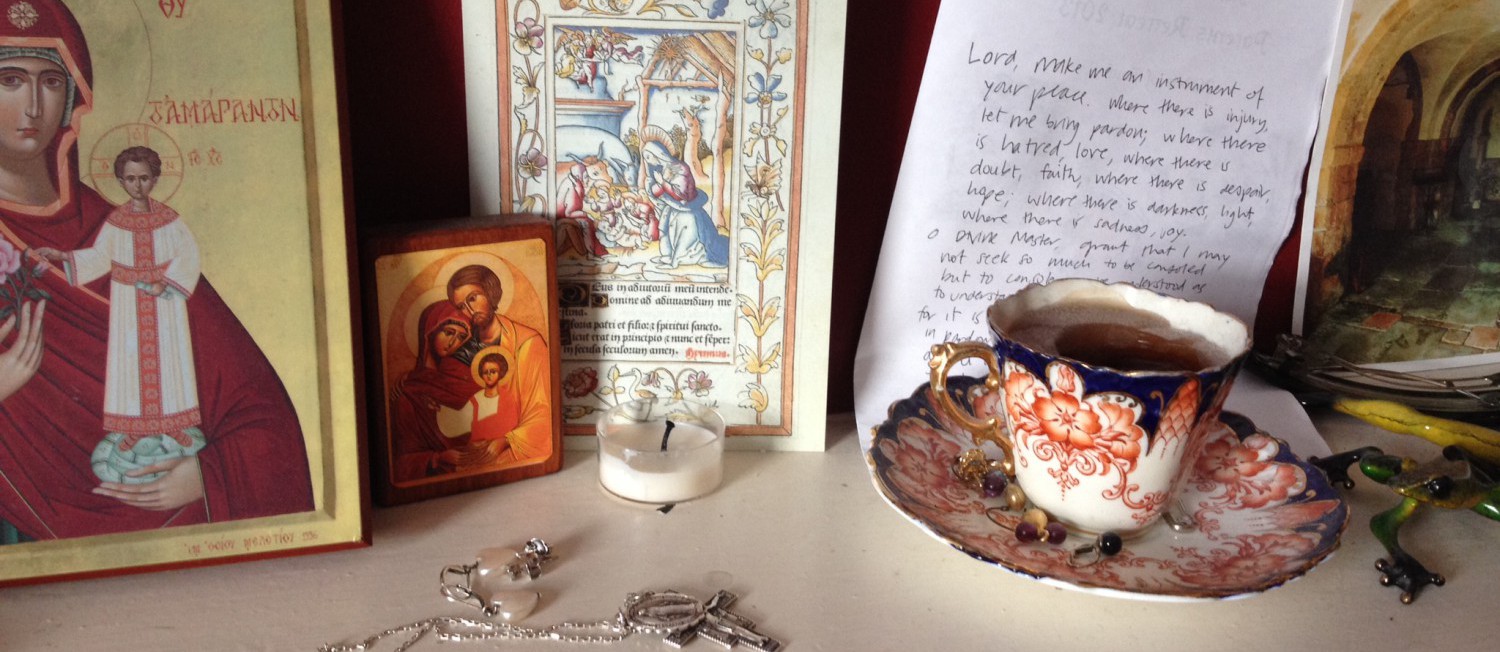
Tuesday of the fourth week in Lent

Cease striving, and know that I am God;
I will be exalted among the nations,
    I will be exalted in the earth.
The Lord of hosts is with us;
    The God of Jacob is our stronghold.
                                           Psalm 46 [45]: 10-11

.        .        .

I admit that these two verses are not among those set for the reading of this psalm today at Mass. But they strike me as particularly apt for this point in Lent. “Cease striving,” the psalmist says (many translations have “be still”). Yet I don’t think about Lent as a time of rest. What place does rest have in a penitential season? Here I am, giving up and taking on (and not doing a stellar job of either, truth be told). Is the psalmist telling me to stop it?

Somehow I don’t think so. I think, rather, that the psalmist is reminding me (in these two verses and those to be read in Mass today) that all the abstinence and action that make up my Lenten observance aim for this end precisely: rest in God. To give up something I enjoy has a double effect: a certain suffering that comes from a want left unsatisfied, and the possibility for refreshment from another source, from God. And what have I taken on, but more time for reflection, more frequent attendance at daily Mass? This is a recipe for resting in God for me.

Because that is, after all, what God desires of us. Cease striving, says the Lord: I am God, I will be God, and I will be exalted. You can sit back and enjoy my strength; you can rely on my saving help. We see our need for that strength and saving help better, perhaps, when our Lenten discipline makes us want. How much more ready, then, will we be to enjoy the good things that God gives us–and to recognise their source–come Easter?

Deo gratias.

Friday of the third week of Lent

This week I have been talking a lot, to anyone who will listen, about liturgical catechesis. More on that later, but if you’re interested, you might have a look at Sacrosantcum Concilium, paragraphs 4-13, and/or the Catechism of the Catholic Church, paragraphs 1066 and following. What does it mean to attend to the liturgy? To participate fully, with understanding? How can we (the laity) be helped in our participation? These are the questions I have been asking myself. I can’t say that the answers are to be found in the day’s Mass readings, but my mediation for the day (from the manuscript, again) is at thinking coram Deo.

Friday of the third week of Lent

What has Ephraim to do with idols any more when it is I who hear his prayer and care for him? I am like a cypress ever green; all your fruitfulness comes from me.
                                                                                                                               Hosea 14
[Abba Apollo said] No one can endure the enemy’s clever attacks, nor quench, nor control the leaping fire natural to the body, unless God’s grace preserves us in our weakness. In all our prayers we should as for his mercy to save us, so that he may turn aside this scourge that is aimed even at you. For he makes a man to grieve, and then lifts him up to salvation; he strikes, and his hand heals; he humbles and exalts; he gives death and then life; he leads to hell and brings back from hell (1 Sam 2:6). So Apollo prayed again, and the hermit was set free from his inner war. Apollo urged him to ask God to give him a wise heart, in order to know how best to speak.
*          *          *
It is somewhat troubling to think that God strikes, humbles, gives death, and the like, even though Abba Apollo assures us that God also gives life and heals, and exalts. It istroubling, but less so when we are reminded that God was willing to undergo the same cycles of humility and exaltation, death and life, and the journey to hell and back again. There is nothing that we experience in the whole of our human life that God’s Word did not take upon himself in his own humanity. Our fruitfulness does indeed come from the one who has made the way for us from death to life.
I am reminded of Jesus’ words about the vine and the branches: we, the branches, cannot bear any fruit without being connected to, and nourished by, the vine. All the contrition and humility of Lent draws us closer to the vine. It is not that we accomplish anything merely by our self-denial, byt that we attend more closely to God, and simplify our lives to make that attention possible. What fruit our practice brings comes not from us, but from God.

Wednesday of the third week in Lent

Reading over the text of the reflection for today, which I wrote a few years back (book production for me is a slow affair–something to do with having four children, maybe), I found myself surprised by my confidence in eternal life. It isn’t that I have to cross my fingers now every time I say the creed. Rather, it is that there is always a sense that we keep using that term, and I am not sure it means what we think it means (to adapt Inigo Montoya’s immortal line from The Princess Bride). I don’t doubt heaven’s existence, but I am certain I don’t have the faintest idea what it will be like. Not really–it’s that whole eternity and time thing, which from where I now stand, is a mystery.

Wednesday of the third week in Lent

Take care, and be earnestly on your guard not to forget
    the things your own eyes have seen,
    nor let them slip from your memory as long as you live,
but teach them to your children and to your children’s children.
                                     Deuteronomy 4:9
Jesus said to his disciples, “Do not think that I have come to abolish the law or the prophets. I have come not to abolish but to fulfill.”
                                    Matthew 5:17
Abba Agathon said, “Unless he keeps the commandments of God, a monk cannot make progress, even in a single virtue.”
*     *     *    *

How on earth are we to keep the commandments? How does remembering help? What does Jesus do that fulfills the law and the prophets? The psalmist reminds us that the law is specially given to Israel: God has not given the law to any other nation. And God’s promise to Abraham was that he and his descendants (innumerable as they were to be) would be a blessing to the nations. Israel’s chosenness was to be for the restoration of the whole world. Memory helps by keeping God’s people in view of God’s promises as well as God’s law, and of the purpose for which God called Abraham and the whole particular people of Israel. A people’s identity (perhaps even more than an individual’s) is bound to their memory, to their ability to narrate the story of God’s wonderful works and God’s saving acts.
Testimony does just that: the witnesses to the Gospel, both in Jesus and the apostles’ days and in our own, serve an important function in preserving the memory of the people. In the earliest days of Christianity, many of those people testified with their lives and are numbered with the saints. The martyrs reveal the path of discipleship in a particular way. Following Christ means having always in mind the whole of his life: his life of love and ministry and preaching the gospel and healing, his agony and passion, his ignominious death on the cross, and his resurrection. Somehow, it is in following that we keep the commandments of God and so make progress in virtue.

Matthew’s gospel suggests that this narrative, this life, death and resurrection story, tells us what it means to satisfy the law and to heed the prophets. For in this One all that God desired for Israel is fulfilled, so that Paul can say of Christ, “All the promises of God find their yes in him.” God keeps his promises through Jesus. Lent is a time of imitatio Christi in which our focus is on the humility, the self-emptying of God in Christ; we obey the tradition and keep days of fasting and abstinence, we pray, we do works of charity, we give. We also, in the midst of all this, hope joyfully as we look forward to Easter. Having put the sinful self to death by our Lenten discipline, we look forward to rising with Christ on the judgement morning. We taste that joy at Easter as we celebrate the resurrection of Christ whom we follow, through suffering and even death, to be raised to life eternal. 

Solemnity of the Anunciation

Mary said, “Behold, I am the handmaiden of the Lord. May it be done to me according to your word.”
. . .
It is the solemnity of the Anunciation. So I went to Mass, and the readings for today have come to me not through my own reading and reflection, but in the context of the liturgy, and a homily. Part of me thinks it’s cheating to begin from someone else’s comments on the readings, and yet it is impossible not to do so.
‘What if Mary had said no?’ The priest reported the question; he didn’t pose it. In fact, he suggested that the speculation about what might have been rested on a mistake about who God is and how God acts. “God doesn’t need a plan B.” True enough. And after Mass, my husband had an exchange with the priest that was about Mary’s will and whether or not it was possible to for her to say no. Turns out the answer to that one depends on how you define words like ‘possible’ and ‘necessary’, though in the end I think they agreed.
The thing is, though, that “no one is ever told what might have been.” This is neither St Thomas Aquinas nor St Augustine, the two thinkers involved in the discussion about Mary’s will. It’s CS Lewis, in The Voyage of the Dawn Treader. Lucy has just asked Aslan a ‘what if’ question. His answer has stayed with me for years, as I have stumbled along trying, and often not trying hard enough, to be a Christian. However often and however badly I fail in my endeavor, ‘what if’ questions after the fact are never fruitful.

God doesn’t need a plan B. In eternity, there is no ‘might have been’ but an everlasting ‘is’, in which everything is in the present tense. From that point of view, wisdom can be seen as arranging all things delightfully, as it says in Wisdom 8: 1. From that point of view, all the crash-and-burn experiences of my life find their way into the tapestry of ‘all things’– arranged delightfully, worked together for the good (Romans 8: 28), having been wrought, however incomprehensibly, in God (John 3: 21).

So the invitatory psalm (Ps 94 [95]) invites us each day anew to ‘listen to his voice’ and to ‘harden not [our] hearts’. It is today that matters, today that affords me the opportunity to do God’s will. That is, more or less, what Aslan says next: anyone can find out what will happen. Let my ears and my heart be open, and my will freely to conform itself to his: and let it be done to me according to His word.

Monday of the third week in Lent

I didn’t think I could do it, today. It has been one of those days–a spiritual and psychological sluggishness has dogged me all day. But the story of Elisha and Naaman inspired me, and reminded me why I am doing this. Hint: it’s not fame or money… See the post at thinking coram Deo

Monday of the third week in Lent

Are not Abanah and Pharpar, the rivers of Damascus, better than all the waters of Israel? Could I not wash in them and be clean?” So he turned and went away in a rage. Then his servants came near and spoke to him and said, “My father, had the prophet told you to do some great thing, would you not have done it? How much more then, when he says to you, ‘Wash, and be clean’?”
2 Kings 5:12, 13
 
. . .

Exactly. Naaman expected something dramatic. If a miraculous cure is sought, the healing ought to amaze. But there isn’t anything too exciting about taking a dip in the river.

This is a great story for me, for Lent–or anytime, really. A suitably astounding miracle (I’m thinking Elijah and the prophets of Ba’al) would go down well, especially if some intense engagement were required on my part. Extreme Christianity: ascetic achievement; big, bold miracles.

Nope. I think it is Abba Sisoes who, when asked for a word, says, ‘go into your cell, and your cell will teach you everything.’ Say your prayers, do the things you are supposed to do, and you will do well. It isn’t the grand gesture, once-in-a-lifetime, but the little things done every day, that mark the path to holiness.

So says St Therese of Lisieux; so also said Mother Teresa. It’s the little things. Being drawn to Benedictine spirituality, I tend to think in terms of the daily office: praying the appointed psalms at the appointed times. Work and pray, rest, repeat.

Simple. Not easy, but simple. And miraculous: this simple rhythm of work and prayer is possible only by grace.

Deo gratias.