St Martin of Tours

…that which holds all things together knows every word that is said.
                                                          Wisdom 1: 7

Before ever a word is on my tongue,
   you know it, O Lord, through and through…
Too wonderful for me, this knowledge,
   too high, beyond my reach.
                                                         Psalm 139: 4, 6

.        .        .

I spend a lot of time thinking about what to say. Maybe I really should spend more time praying. The one who holds all things together (which Colossians 1: 7 echoes) holds all my words already, and knows what I ought to say.

Enough said.

St Martin, pray for us.

Thursday of the thirty-first week in ordinary time

But you, why do you judge your brother? Or you again, why do you regard your brother with contempt? For we will all stand before the judgment seat of God.
Romans 14:10 NASB
 
“In the same way, I tell you, there is joy in the presence of the angels of God over one sinner who repents.”
Luke 15:10 NASB
 
. . .
 
Just one. One matters to God. If God is out looking for the lost, if Jesus spent his time with tax collectors and ‘sinners’, then what possible grounds can any of us have for passing judgment on one another? That person I regard contemptuously matters to God as much as my friends do, as much as I do.
 
It is not new–surely our equality before God is a theological commonplace–but it is sobering. Awhile back, I made a rule for myself. It’s not really a rule of life; I tried all sorts of things and could never quite manage the timetable. Much as I would love to pray the office daily, in solidarity with my ‘home’ abbey in Kent, I can’t. But while I was there I realized that a very simple rule would do: not to speak a harsh word to, or about, anyone, even in my heart. I suppose something like Romans 14: 10 might have been rattling around in the back of my mind as I thought about this rule.
 
I never thought it would be easy. But it has proved a lot more tricky than I thought. Because judging and regarding with contempt (both count as ‘harsh’!) aren’t always conscious. I just don’t ‘warm’ to this person or that person; I am inattentive. Sometimes I suppose that’s fair enough–it’s human to like some people more than others. Sometimes, though, that coldness hides a deeper dislike. Maybe it’s envy, maybe it’s scorn, based on some less-than-conscious judgment about the character of the person, or arising from feelings of insecurity on my part.
 
So of course the whole ‘no harsh words’ has not been a perfect success. I have, not surprisingly, failed. Still, insofar as I have become more aware of my own inclination to judge or to dismiss others, the enterprise has been, and continues to be, worthwhile. And today’s gospel reminded me why the rule is so important. It isn’t because I want everyone to think I am nice. It’s because there is joy in heaven over one who repents. There is no contempt for the sinner in heaven, only joy at her repentance.
 
I still have a long, long way to go.
 
Kyrie eleison.

trying too hard

That is, I find myself trying too hard at the wrong things, sometimes, and not hard enough at the right things. My noviciate in the blogosphere has taught me that I am most emphatically not alone. If I am unique (yes, I know, we all are), it is because I am a unique combination of shared experiences, concerns, ideas, gifts, and needs, each of which I have in common with countless others. This is a Good Thing, though it doesn’t always seem so; and the response to feeling ‘ordinary’ is not always a healthy one.

What worries me about my adventure in this sphere is that it sometimes seems to be about being noticed. So I have been thinking a lot about popularity, and the pitfalls of popularity. I was encouraged and challenged this morning by wise reflections on the Rule of Benedict from Sr Catherine (@Digitalnun): the gifts we have been given must be exercised in humility and love in order to make us, as she says, ‘great’. But even this greatness doesn’t make for popularity. Sometimes gifts are exercised wonderfully well in small places. Sr Catherine drew from Chapter 31 of Benedict’s rule: the instructions to the cellarer, which I have always found inspiring as a parent.

One of my take-away phrases, which I have on the fridge, is ‘fratres non contristet’: do not upset the brethren. (It just looks better in Latin on the fridge.) St Benedict is explaining how to respond to an unreasonable request. Not harshly, he says, but gently. If the request is outrageous, the response should not be so, lest the brother or sister be upset by the refusal. Now this, I submit, is a key element of parenting: seventeen outrageous requests before breakfast, right? At least that’s how it is around here sometimes. The gifts of the cellarer, and those of the parent, are gifts exercised in small spaces, in the house or the car; sometimes in the grocery store or at the park or the library. Parental greatness is a huge, and hugely important quality, but it doesn’t often get recognised beyond the confines of the family. Greatness of this sort doesn’t always get you noticed.

I am not a great parent. I do not always succeed in responding calmly and gently to the most outrageous requests. Sometimes I do ‘great’ things: I find everyone’s PE kit, even the missing shoe, and the ‘lost’ reading book, and all this before the dreaded leaving-for-school time. To do that cheerfully is to exercise the very simple gift of attentiveness in the way I ought to. Although my sons and husband happily repeat after me, ‘mum is awesome’, I’m not winning any medals, not acquiring more followers on twitter, or on this blog. No speaking requests are coming my way because I sent my daughter off to school with everything she needed, and did it with a smile.

It is too easy for me to fall into the trap of thinking that the measure of my success, my ‘greatness’, is somewhere in cyberspace, or on my CV, or in teaching evaluations. And truly there is something to that (especially that last thing, I think): I have gifts to exercise in teaching and writing, and I ought to do what it takes to do well at my job. But if I want somewhere to practice exercising my gifts with humility, in love, I am better off digging in the cupboard for the missing shoe: no pretensions to grandeur there! When I have tried hard enough at the small things, perhaps I will be less prone to try too hard at the ‘big’ ones.

Aristotle on the soul

This morning a strange thing happened: Lewis and I found ourselves in the car alone. No interruptions from the children, and Lewis about to teach on–you guessed it–Aristotle on the soul. I dug into the topic this morning in the car with an unusual sense of having a stake in the question. The question began as 'how is the soul the form of the body, for Aristotle?' That's quite a difficult question to answer, as it happens, and I expect more conversation will take place the next time Lewis and I have a l chance to take it up. If anyone happens to have an answer to hand, I would love to hear it.
 
Fear not: I am not going to rehearse here Aristotle's doctrine of the soul. My hunch is that it loses something in the process of being summarised. Besides, it is full of paradox and warrants a sort of attention I am not able to give it. But I should, and I will, because what I could recognise immediately in Aristotle's account of the soul is the way it shows up in the Questions on the Soul of St Thomas Aquinas. His account of the soul is, not surprisingly, full of paradox and has been the subject of at least one paper I have read recently, and two that I have given at conferences. Surely there was plenty of conversation about the topic last June at a conference on the soul in Oxford (which I was unable to attend, sadly).
 
The question of the soul interests me because I am very anxious to retain soul language in Christian discourse. No, I don't think it is much threatened in mainstream Christianity, but I do think it is widely taken for granted. That means we tend not to teach about the nature of the soul or its function in our Christian life. I think (not without some background, I promise) that 'soul' names an aspect of human life that is inseparable from body and mind, but not coterminous with either. It's important, because sickness in body and mind is not the same as sickness of the soul; weakness in mind or body is not the same as weakness of the soul.
 
It's important because the question 'In what sense do [people with profound cognitive impairment] have a soul?' (which Frances Young raises in Face to Face) needs an answer that is careful and deeply grounded theologically. I would argue strenuously that people with severe developmental and cognitive disabilities have souls, regardless of whether their engagement with the world around them has grown beyond the level of an infant. The soul is not the same as the mind, and not the same as the body. We are too used to thinking about our relationships with one another and with God as somehow dependent on our own agency. But it is not so, not necessarily so. An infant does not yet exercise the kind of agency that sustains the relationship into which he or she has been born; the relationship exists, to begin with, because a parent does the work of relating to and caring for the infant. Of course our relationships with one another can be mutually intellectually stimulating and emotionally satisfying, and such friendships are to be cherished. But if our relationships depended on others when we were tiny infants, so much more does our relationship with God depend on God.
 
I don't pretend to know exactly what the soul is. I cannot tell you in what sense it is the 'form of the body' for Aristotle. But I think that in saying that we have souls–that we are embodied souls, or ensouled bodies–we are affirming that there is a mysterious dimension to human existence. We are saying that God relates to each and every one of us as a parent to a tiny child, in the sense that there is a tremendous inequality between the parent's ability to understand, to care for, to bear with, and to meet the needs of the infant child, and the infant's ability to do anything for the parent. The idea of a 'soul' can remind us that we receive our very life from God, regardless of the capacities of our minds and bodies. The soul's capacity for God is not diminished by mental or physical incapacity, but by sin.
 
But sin is another topic entirely, best left for another day.


Thirty-first Sunday in ordinary time

You can do all things and overlook [people’s] sins so that they can repent.
Wisdom 11: 24
 
. . .
 
Somehow–maybe it was struggling to keep the two-year-old quiet–I didn’t hear this in Mass this morning. Not that it wasn’t read: it was read by the son of my two-year-old’s godmother. But I missed it, and the priest didn’t comment on it in his homily, which focused on the gospel. Fair enough, I suppose. There is a good deal to say about Zacchaeus. Still, the readings in the lectionary are ordered, and combinations occur for a reason. Sometimes that reason is pretty hard to discern, but today it is less puzzling.
 
At least it’s less puzzling if you happen to be a Catholic who has strayed far into Reformed and Evangelical territory. Then the prevenience of grace leaps out of every page of the Bible–even the books of the Bible that only appear in the Catholic editions of the Bible. And here it is in the book of Wisdom. I always associate Wisdom with the key passages in chapters 7-9, about the role of wisdom in creation, including one of my favourites: omnia disponit suaviter, [widsom] arranges all things delightfully. So finding this other theme of the Bible, the grace of God that makes way for the sinner’s return, there in Wisdom is, well, delightful.
 
And it is, of course, this path-breaking grace of God that drives Zacchaeus up the tree. The change has already begun. Can it be anything other than the Holy Spirit that draws Zacchaeus to Jesus? I don’t think so, and I could quote some early church theologians to support that claim. Besides, Jesus does just what the verse in Wisdom says: he “overlooks” Zacchaeus’ sins, so that he can repent. Religious leaders aren’t supposed to hang out with infamous sinners, but Jesus doesn’t seem too worried about that. He sees beyond the sin, sees the person who needs the space to repent. Jesus makes repentance possible.
 
Two things follow from this, for me. First, I am struck by the space-making work of Christ. I have noticed it elsewhere in the gospels (see Mark 5: 30-34, for example), but never connected it to Zacchaeus, to repentance. So also, I realize, Jesus is making space, always, for my repentance. Am I perceiving it? Do I enter into that space, or do I avoid it? (I’m not certain, but I am more determined to get to confession this Saturday!) Second, and this is something that has been tugging at me for a little while, Jesus makes space for pretty unpleasant people. Tax collectors are the bad guys in the first century, not the people the messiah is supposed to befriend. Who are the people around me that Jesus wants to befriend? I’m guessing they’re not the people I would ordinarily find friend-like.
 
No wonder I haven’t seen that space for repentance as space for me: I have just divided the people around me into people like me (friend-like) and people who need space for repentance. The fact that both (1) that Jesus makes space for me to repent and (2) Jesus makes space for “obvious” sinners–the “tax collectors” of our day–to repent means that I am not so different as I might like to think.
 
Luckily, there’s plenty of that prevenient grace to go around.
 
Deo gratias.


All the angels and saints

Late last night, I received a text message from a friend, asking whether I had a meditation for All Saints' Day. No, I had to reply, I didn't. But I felt I should. The saints are essential to my Christian life, and in one way or another always have been. One way or another, I say, because there was a time when I would not have been so eager to ask, as we do when we say the confiteor, for the prayers of 'all the angels and saints'. When I was small, it was the 'ordinary' saints, the living company of the faithful, who guided me. At least they pointed me in the right direction; I didn't always follow their lead. In college, I began to appreciate the 'saints' in Hebrews 11, especially as they form the 'cloud of witnesses' who surround us as we follow Jesus.
 
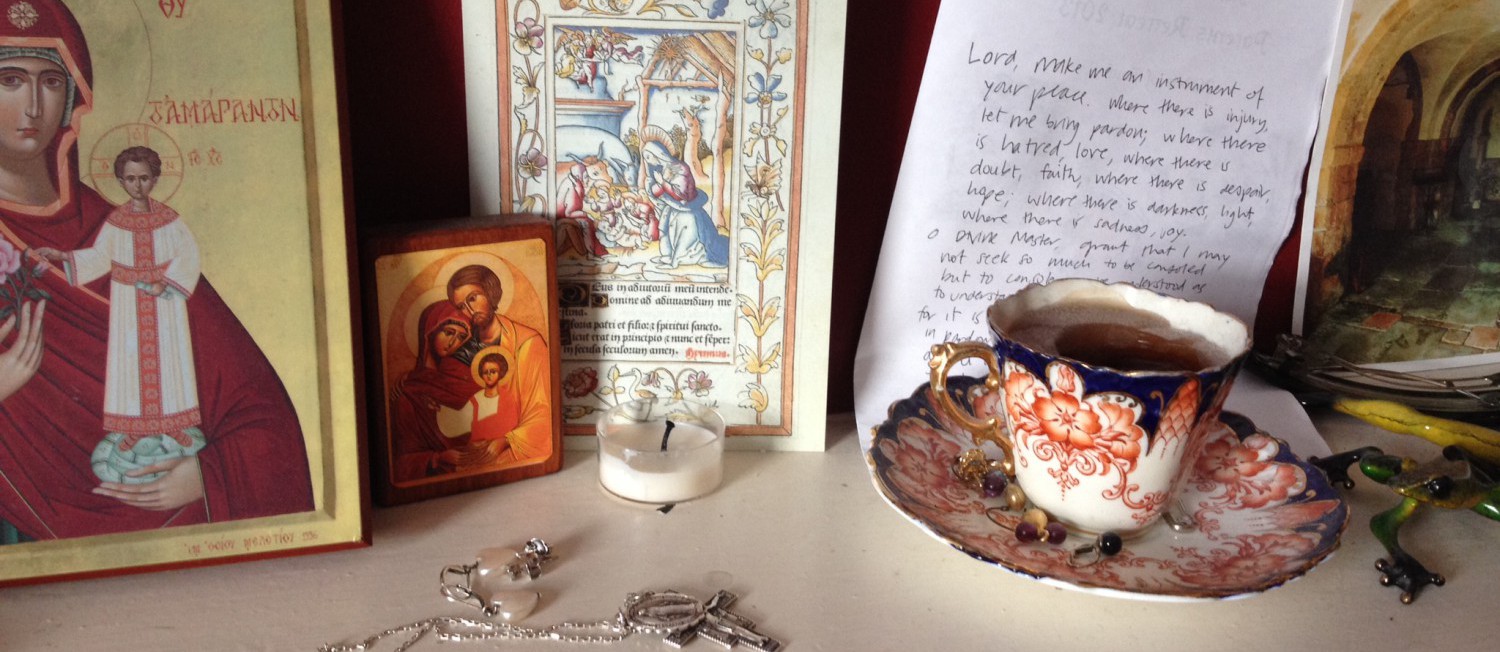
But the picture is bigger than that. The saints–those who have gone before us and stand before the throne of grace–play a vital role in the spirituality of my everyday life. There they are, on the mantelpiece beside my bed: the Blessed Virgin and child, the Holy Family, St Michael the Archangel; there is my San Damiano cross, which I wear everyday to remind myself of St Francis's holy life. When I say 'all the angels and saints' in the confiteor, I mean it. I mean that I need their prayers. And often the invocation of the saints reminds me that I am not alone. There is a whole company on this road, and the company keeps pressing on.
 
The fact that it doesn't depend on me, that the saints are already the church triumphant, liberates me to pray, to worship, to receive forgiveness and to hope that I can live the life of a disciple of Jesus. The life of the church is carried forward by the saints and saints-in-the-making, and all the saints share one vital characteristic (if you can call it that): being made holy by the Spirit of Holiness. Saints don't shine because they're polished; they shine because somehow they let the light of God show through them. I want to be like that, and I realize that there is no formula for getting there. There is no recipe for saint-making, just a Spirit who blows where he wills. 'Fixing our eyes on Jesus' (Hebrews 12) is the main thing. The church depends on him, he is the vine; he is the author and perfecter of our faith; he is the one in whom all things–perhaps most especially the communion of saints–hold together.
 
But that's not all. The communion of saints, the universal church, covers me when I go astray. 'Look not on our sins, but on the faith of your church', the priest prays, and the words always come as such a tonic to my soul. The faith of the church is the faith to which I cling. It is no product of my own heart or my own mind, but it belongs to the communion of saints. In the words of Rich Mullins, 'I did not make it…it is making me.' The faith of the church is something strong, lasting, and perfect.
 
It would be wrong to think, though, that the strength of the church's faith means I can just take a seat and wait for heaven to come to me. No: clinging to the church's creed is sometimes hard work. That's where 'taking every thought captive to the obedience of Christ' and 'working our your salvation' and all those passages in the New Testament that make the Christian life seem like such hard work come into play. It is easy to forget–at least it is easy for me to forget–that holding onto what the gospel says to us in Scripture and tradition does not come naturally to those of us trained and formed by a world that doesn't believe any of it, and hopes in very different directions.
 
Whatever it is that seems to threaten my Christian life, it's not new. The challenges, temptations, and doubts that come my way are not unique to me. Whether I think I have done well or badly, I haven't done anything totally unprecedented. The saints have already been there.
 
And this is a good day on which to be grateful for that.

What my three-year-old taught me about the body’s grace

You know that essay, the famous one by Rowan Williams, 'The Body's Grace.' He wrote it in 1989 and it was first delivered as the 10th Michael Harding memorial address. Then it appeared as a pamphlet, and was reproduced in volumes of essays edited by Charles Hefling and Eugene Rogers. I distinctly remember where I was the first time I read it: in my carrel in the basement of the theology library at Duke. “…that God desires us as God desires God…” Really?
 
At the time, I could not conceive of it. Of course it was appealing, mind-boggling, and changed the way I thought about sex and sexual relationships. When I married Lewis three years later, the light had begun to dawn. Although I had written off the idea of falling in love, and having that be a real thing, not just infatuation, or something that happens in movies (they say 'happily ever after,' but you don't get to see what that looks like), I had to admit that there might be something to it. (I said as much at our wedding reception.)
 
But I still had no idea, really, about this grace. Still, and I think this is the case in Rowan's amazing essay, it was about the sexual meaning of the body. The enjoyment and desire remained in a sexual register. Yet what I learned as I had children was that there is something else–not to say more–that is graced, and grace-filled, about the body. I remember saying to a friend when my first-born was still very small that it was very sensual but not at all sexual.
 
This is hardly surprising, and is probably the testimony of mothers from the beginning of time. I love having children, and I am especially fond of babies. When my son, who is now seven, was three, though, I learned a more significant lesson. One morning I was dressing, and he came into the bedroom. His eyes lit up when he saw me. Now I wasn't keen on what I looked like without too many clothes on, but he was obviously delighted with me. To be close and to touch my skin was a great pleasure for him. It was as if he appreciated the skin, the body, of this person whose body had borne him and fed him (until he was two-and-a-half!), not because of its objective beauty or potential for giving “joy”, as Williams says. No, the skin and the body were desirable because they were mine.
 
I had always had trouble with “God desiring us” because the context in which it was set was so sexual. Sure, sex is good, but it isn't everything. Something about the way my son responded to me (and not just on that one occasion, but for many months) broadened my understanding of the body's grace. Desire comes in lots of forms, and intimacy has many dimensions. I always knew that, sort of, but it has become much more real for me as I have been a mother. My son has a little sister, who, at two-and-a-half, is very much the same way–she likes to curl up next to me on the sofa (or anywhere, really) with her head resting on my bare stomach. If she's in the room with me when I am dressing, it always takes longer. There is a deep mutual affection and intimacy that characterises my relationship with my children, and it is not remotely sexual but equally profound. And I find it much more powerful, actually, to think that God desires us, fragile and fallen human beings, as I desire my children, and–even more–as my children desire me. Their pleasure and uncritical joy in my body has taught me more about the body's grace than anything else I have ever encountered.
 
I was reminded of all this by a video I saw–what our kids see when they see us. As a mother, I felt the same way as those interviewed: I wish I were more patient, attentive and calm. But what the kids said (really, the video is worth watching) brought back to me this truth about the body's grace. And it put into words what my children have said with their gestures and expressions and touch.
 
Is that the way it is with God? Is that what mercy means? Is it my children's uncritical joy that erupts in heaven over the repentant sinner?
 
I sure hope so.
 

More grace

I picked up Frances Young’s book, Face to Face, recently. For the past few years now I have been working in the area of theology and intellectual disability. Now I have come to see that in a very real sense, my way forward has been trodden already. She writes:

…the other trouble is that most of us do not have our eyes open to see he miracles of grace. They are to be found in such ordinary, unremarkable, simple things that we do not even notice. We think our worship is dull, and miss the movement of the Spirit in the secret places, the everyday saints, who are there among us by we dismiss them as ‘old so-and-so’. In my experience the church is capable of transcending the divisions in our society, it is capable of integrating the odd and unacceptable, it is more sensitive to basic human values than wider society. It can act as leaven, and we should not disparage this. Maybe we all need to go on a voyage of exploration into unlikely places to meet unlikely people — not the great ones of the world but the marginalised and afflicted who will teach us what true human values are. Certainly it is Jean Vanier, the founder of the l’Arche communities where Christians live with handicapped people, who writes with the greatest depth these days about community life. But the purpose of such a journey would be to open our eyes, so that we can return to the places where we belong and begin to discern those values where we are (1985, pp. 84-85).

My next book project focuses on the church, specifically the life of the church as Christ’s body. John Swinton asked me in April whether this ecclesiology I hoped to develop would touch on the issues in intellectual disability we’d been discussing. Then, I said yes, but was conscious in my explanation of stretching the project I had envisioned to include these concerns. Now–thanks to Frances Young’s book–I am beginning to see where to start: with the things I struggled to include, the people we as a church struggle to include. I wanted to think about Christ’s body active in the world, reaching out in love. But before I can do that, I have to reckon with Christ’s body broken and rejected, for that is the source of the church’s life.

I am going to need a lot (and I mean a lot) of grace.

What worries me

Well, honestly, a lot of things worry me. Stupid things and little things and big things and almost impossible things. But Rowan Williams names precisely what worries me about what I do as a theologian: “[the desert fathers and mothers] seem very well aware that one of the great temptations of religious living is to intrude between God and other people. We love to think that we know more of God than other people…” (Silence and Honey Cakes).

That worries me. It probably worries me more because I am not the smartest theologian I know. Not nearly. (Since you asked, I would certainly rank Rowan Williams as one of the two or three smartest theologians I know.) I spent an awfully long time trying to write a Very Clever conclusion to my book, Rethinking Christian Identity, and eventually realized that in trying to write a sexy and theoretical finale, I was trying to be someone I am not. Yes, I read the necessary books by de Certeau. But in the end I didn't write about that stuff. I wrote about discipleship, because that's what seemed to me to be the heart of Christian identity. It's about following Jesus. This is not a Clever and Original idea. It's a commonplace in Christian theology from the gospels onward.
 
So where does that leave me, as a teacher of theology? Well, the book was published, and the only review I have seen so far didn't write it off as just repeating stuff everyone already knows. I'm grateful for that, and for the reviewer's practical response to the book, which was to read Gregory of Nyssa. But I am never going to be a person who trades in cleverness. I know how much I don't know, and I would far rather start with cards on the table. I know what I do know, and I have confidence that I can teach the subject. I also know that I am not going to win arguments with John Milbank about Plato or political theory. (By the way, he's in that small group with Rowan Williams.)
 
I would, however, be perfectly happy talking with John, even arguing, about Jesus. Not about Christology, certainly, but about Jesus. And that's what worries me. Because not trading in cleverness all these years, first as a graduate student, and then as a teacher, has meant that I put a great deal of emphasis on faithfulness to the gospel and on spiritual discipline; I say that it is more important to be faithful than clever, if you are a theologian. It isn't knowing about God that makes good theology; it's knowing God. (It is both, of course, and you can't just have one or the other, as Andrew Louth suggested a great many years ago in an essay about theology and spirituality. And he's another theologian I would place on the top of the smart list.)
 
But do I thereby imply that I know God better than my students or my colleagues? Good heavens, no. Teaching theology to people who are training for ministry is an awesome privilege and a serious charge. What qualifies me to stand in front is formal and academic knowledge; it's having practiced talking about the God we all know in particular ways, ways that are faithful to the Bible and the Church's memory of Jesus preserved through the ages in its sacred doctrine. I certainly can make no claim to “know more of God” than my students. Faithfulness is a shared enterprise, and spiritual discipline is for the Church and not solely (or even primarily) for individuals.
 
A lot of the things that worry me are petty, even ridiculous. But not this one. I take Rowan Williams' words to heart. This should worry me. I don't have any formula for getting it right, for teaching sound doctrine intelligently to intelligent people, and simultaneously bearing in mind that it's not all about intelligence; or for bearing in mind that in the classroom faith does actively seek understanding, that the exercise of the intellect is a part of faithful discipleship. It is enough that I worry about it, I think, so long as the 'worry' always becomes 'pray.' This work I do is like the rest of my life before God: possible only by his grace.