Tuesday of the sixteenth week of the year

They tempted God in their hearts
by demanding the food they craved.
Yes, they spoke against God, saying,
“Can God spread a table in the desert?”


Yet he commanded the skies above
and the doors of heaven he opened;
He rained manna upon them for food
and gave them heavenly bread. 


Psalm 78 (77 LXX)

.      .      .


The psalm for the day recounts the story related in the first reading, from Exodus. The people complain, and God provides. I owe this observation and its connection to the gospel for today to a friend who is a priest. In his homily he pointed out that the parable of the sower is about the sower–it’s not a parable about the different types of soil. The sower goes out to sow, and sows the seed generously: he gives. I insist that my children ask politely, say please, and don’t demand things. But God, my friend observed, complies with the demands of the people and responds to their complaining by more abundant generosity. 


Now that’s what I call preaching the good news: he came that we might have life, and have it abundantly. And we didn’t even say ‘please.’

Our Lady of Mount Carmel

Inspired by the Carmelite Order, the Feast of Our Lady of Mount Carmel invites reflection on the life  of prayer and devotion to Mary that characterizes the Order. Although we may remember St Teresa of Avila and St John of the Cross for their mystical experiences, their lives were spent in obedience and prayer. The remarkable sense of God’s presence is the fruit of a disciplined attention, and, for St John, followed a long ‘dark night of the soul’. May his life continue to inspire us as we walk through the valley of the shadow.

.    .    .

…for his steadfast love endures forever.

.    .    .

So goes the line, repeated in all 26 verses of Psalm 136 (135 LXX). Every saving act of God recounted in today’s psalm should remind us (it seems to say) that God’s steadfast love endures forever. The psalm concludes with a stanza that makes me wish I could drop everything and go to Mass immediately:

It is he who remembered us in our low estate,
   for his steadfast love endures forever;
and rescued us from our foes,
   for his love endures forever;
he who gives food to all flesh,
   for his love endures forever.

O give thanks to the God of heaven,
   for his love endures forever.

I am reminded of the ultimate saving act of God, in which God remembered us in our low estate and came to join us. The Son of God came down, so that we might be raised with him, delivered from sin and death, and given new life. And that life, that deliverance, is remembered, celebrated and received anew in the sacrament of Christ’s body and blood. No matter how steep the mountain or how stormy the skies, the Lord gives himself as our food, our strength for the journey, for his steadfast love endures forever.

St Bonaventure

St Bonaventure (from the short description on universalis) ‘wrote extensively on philosophy and theology, making a permanent mark on intellectual history; but he always insisted that the simple and uneducated could have a clearer knowledge of God than the wise’. Amen to that: the only thing that keeps me doing theology is the belief that it is more important for a theologian to be faithful than to be clever. I pray that I will be faithful, by God’s grace.

.    .    .


How shall I make a return to the LORD
for all the good he has done for me?
The cup of salvation I will take up,
and I will call upon the name of the LORD.


Precious in the eyes of the LORD
is the death of his faithful ones.
I am your servant, the son of your handmaid;
you have loosed my bonds.


To you will I offer sacrifice of thanksgiving,
and I will call upon the name of the LORD.
My vows to the LORD I will pay
in the presence of all his people.


                                        Psalm 115 (LXX)

.    .    .  


Today a friend posted a video to facebook, a song by Casting Crowns (not in my repertoire) called ‘Praise you in the storm’. I clicked the link, as the verse from ‘On Christ the solid rock I stand’ started in my head: ‘When darkness veils his lovely face/ I rest on his unchanging grace; / beneath the high and stormy gale/ my anchor holds within the veil’. 


It’s been storming for a while now, eighteen months at least, and I (like the writer of ‘Praise you in the storm’), think it could well be time for the storm to end. The clouds do have their silver linings, to be sure, but I am more than ready for a season of fair skies.  I am not asking for happily ever after, of course, just a season of smooth sailing in the sunshine, or an easy walk through a meadow. 


That’s my plan, but it doesn’t seem to be God’s plan. And so I understand why thanksgiving is a sacrifice: to give thanks for what I don’t want, trusting that I have what I need, and that however hard the road, and however I may stumble along it, I am never beyond the reach of the one who has loosed my bonds. 


     On Christ the solid rock I stand;
     all other ground is sinking sand.
     All other ground is sinking sand. 

Tuesday of the fifteenth week of the year

See, you lowly ones, and be glad;
you who seek God, may your hearts revive.
For the Lord hears the poor,
and his own who are in bonds he spurns not.
                                   Psalm 33 (LXX)

. . . .

‘…his own who are in bonds he spurns not.’ Would anyone familiar with the hymn ‘And Can It Be’ not be reminded immediately of the penultimate verse?

Long my imprisoned spirit lay,
Fast-bound in sin and nature’s night.
Thine eye diffused a quick’ning ray;
I woke, the dungeon flamed with light.
My chains fell off, my heart was free;
I rose, went forth, and followed thee.

It is the lesson I forget most often, I think: that God rescues us because we need it, not because we deserve it; Christ came not to call the righteous, but sinners to repentance. Thus the last line: ‘I rose, went forth, and followed thee.’ And, as I am reminded often by theologians I read (Rowan Williams comes to mind particularly), the rising and going forth is not a once-and-for-all repentance. Again and again, I ind myself ‘in bonds’: I need rescuing more often than I like to admit.

But not more often than God is willing to save.

St William of York (8 June)

They are not of the world, even as I am not of the world. Sanctify them in the truth; thy word is truth. As thou didst send me into the world, so I have sent them into the world. And for their sake I consecrate myself, that they also may be consecrated in truth.

John 17. 16-19

.      .      .

Not of this world? Gregory of Nyssa wrote about his sister Macrina’s life and death, and throughout his description tells us what it meant for her to be in the world, but not of it. What stands out about Macrina’s life, most of all, is the hope that characterized her every word and act.

To live in the ‘not-yet’ and be of the ‘already’ is the challenge of Christian life. The only requirement, it seems to me, for answering that call, is hope. Macrina had it, and the saints through the ages shared it. Fortunately, her hope and ours comes not from a grim determination to set our sights on heaven, but by the gift of the Holy Spirit. Hope is ours for the asking, given by God to all of us who are on the journey.

Poor in spirit

I never got beyond ‘poor in spirit’ during Lent: it isn’t a starting place, from which we grow to become spiritually rich. It is, rather, an acknowledgment that we are earthen vessels, waiting to be filled by the Spirit. Acknowledging weakness does not set us on the path to becoming strong, but turns us toward the Source of all strength.

Jean Vanier reminded me this morning of the revelation of God in our weakness, in his reflection on his participation in the Pope’s pilgrimage to Lourdes in 2004:

During that time I walked close to John Paul II. I was moved by the seriousness of his disability, his speech difficulties due to Parkinson’s disease. One person told me after the pilgrimage, ‘It was too hard to watch him on the television. He should retire–or die–soon!’ How many times I have heard that said about people with disabilities. It is an attitude that humanly speaking is understandable! It is hard to see and be close to people in pain. Through his physical poverty, the Pope reveals a mystery; he is a living symbol of the presence of God in weakness. Even more than by his words, through his fragile body he is teaching us now the value of each human life; he is showing us a path towards holiness. I was also touched by his humility and courage, the spark of life in his eyes, the way he accepts the humiliating reality of his condition today and his extreme tenderness. His is a sign of the glory of God who is manifested in and through his poverty and vulnerability (Our Life Together, p 520).

Ash Wednesday

Not, I think, that anyone is paying any attention (which is not why I keep this online journal-of-sorts), but this Lent I am shifting from reflection on the Mass readings to considering the Beatitudes. A few weeks ago (shortly after my last post), I spent a few days on retreat, and did a lot of reading of Jean Vanier. Had I not already decided to spend the next 40 days with the Beatitudes, I might well have been convinced to do so by Vanier’s writings.

Today I read through the Beatitudes, not knowing what to expect. What struck me as I did so was ‘blessed are those who hunger and thirst for righteousness, for they shall be satisfied’. Not the righteous, but those who hunger and thirst for righteousness, are blessed. And Lent, at least it seems to me, is a time when all our self-denial should intensify our hunger and thirst for God, and God’s righteousness.

Let it begin.

Saints Cyril & Methodius

Genesis 4:1-15,25; Psalm 49:1,8,16-17, 20-21(LXX); Mark 8:11-13


The Mighty One, God the Lord, 
  speaks and summons the earth from the rising of the sun to its setting. 


‘Hear, O my people, and I will speak, 
  O Israel, I will testify against you, 
  I am God, your God.
I do not reprove you for your sacrifices; 
  your burnt offerings are continually before me.
I will accept no bull from your house, 
  nor he-goat from your folds. 
For every beast of the forest is mine, 
  the cattle on a thousand hills. 
I know all the birds of the air, 
  and all that moves in the field is mine.


‘If I were hungry, I would not tell you; 
  for the world and all that is in it is mine.
Do I eat the flesh of bulls, 
  or drink the blood of goats?
Offer to God a sacrifice of thanksgiving, 
  and pay your vows to the Most High; 
and call upon me in the day of trouble;
  I will deliver you, and you shall glorify me.


‘Mark this, then, you who forget God,
  lest I rend, and there be none to deliver!
He who brings thanksgiving as his sacrifice honors me; 
  to him who orders his way aright
  I will show the salvation of God!’
                           (Ps 49.1, 7-15, 22-23)

.  .  .


Psalm 49 (50) articulates clearly the sometimes hidden heart of all God’s dealings with God’s people: the all-sufficiency of God, to whom creatures can give nothing except praise and thanksgiving. Although throughout the Pentateuch and the psalms, it seems obvious that God requires obedience from God’s people, there is a still deeper desire in the heart of God: to give creatures everything.


How easy it is for me to forget that what God wants most in a creature is openness to receive the love for which we were created: God did not bring us into being to serve God’s own needs. In perfect self-sufficiency and in perfect freedom, God created all that is to reflect God’s glory and to delight in God’s love. God loves without needing anything in return; God’s love continues to flow, uninterrupted by rejection; God knows unrequited love better than any of us, because that is so often the fate of divine love in this fallen world. 


Today’s psalm is followed up perfectly by David’s anguished plea for forgiveness in the next: 
‘Have mercy on me, O God, according to thy steadfast love; according to thy abundant mercy, blot out my transgressions’. And David recognized precisely what was required of him at that moment: ‘thou hast no delight in sacrifice; were I to give a burnt offering, thou wouldst not be pleased. The sacrifice acceptable to God is a broken spirit; a broken and a contrite heart, O God, thou wilt not despise’. So also I make his prayer my own today: 


Create in me a clean heart, O God, 
  and put a new and right spirit within me.
Cast me not away from thy presence,
  and take not thy Holy Spirit from me.
Restore to me the joy of thy salvation,
  and uphold me with a willing spirit. 


Our Lady of Lourdes

Genesis 3. 1-8; Psalm 31:1-2,5-7 (LXX); Mark 7:31-37

 The serpent was the most subtle of all the wild beasts that the Lord God had made. It asked the woman, ‘Did God really say you were not to eat from any of the trees in the garden?’ The woman answered the serpent, ‘We may eat the fruit of the trees in the garden. But of the fruit of the tree in the middle of the garden God said, “You must not eat it, nor touch it, under pain of death.” ‘ Then the serpent said to the woman, ‘No! You will not die! God knows in fact that on the day you eat it your eyes will be opened and you will be like gods, knowing good and evil.’ The woman saw that the tree was good to eat and pleasing to the eye, and that it was desirable for the knowledge that it could give. So she took some of its fruit and ate it. She gave some also to her husband who was with her, and he ate it. Then the eyes of both of them were opened and they realised that they were naked. So they sewed fig-leaves together to make themselves loin-cloths.
  The man and his wife heard the sound of the Lord God walking in the garden in the cool of the day, and they hid from the Lord God among the trees of the garden. (Gen 3.1-8)
. . . 
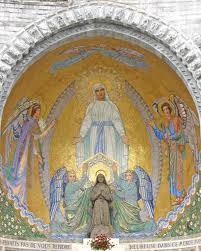
If I were really clever, I would be able to link the reading from Genesis 3 with Bernadette’s vision at Lourdes. Since I am not that clever, all I am able to do is offer some reflections on original sin, and be grateful for the intercession of the Blessed Virgin Mary.
The most striking thing about the passage, as often as I read it or hear it read, is that it doesn’t seem to follow from what went before. Creation is pure gift, and not only is all of creation given to the pair in the garden, but they enjoy perfect communion with God and one another. It is like watching a film in which the main character is just about to do something really stupid. I always want to intervene, to stop the absurd and unnecessary pain that will result–and much more so here. And, of course, that raises the question, why didn’t God intervene? After all, God certainly could have done so.
Good question. But not one to which we get a clear answer. We have inherited a fallen nature, and a fallen creation, and things go wrong with us and the world around us. I suppose the connection between Our Lady of Lourdes and the fall might just be redemption: if Eve is the first person to taste sin, Mary is the first person to experience redemption.
So what does it mean to live as one redeemed by Christ? I do not claim to know, but it seems to me that a good place to start is with Mary’s response to Gabriel, ‘Let it be done unto me according to your word’.
Our Lady of Lourdes


Genesis 3:1-8; Psalm 31:1-2,5-7(LXX); Mark 7:31-37

The serpent was the most subtle of all the wild beasts that the Lord God had made. It asked the woman, ‘Did God really say you were not to eat from any of the trees in the garden?’ The woman answered the serpent, ‘We may eat the fruit of the trees in the garden. But of the fruit of the tree in the middle of the garden God said, “You must not eat it, nor touch it, under pain of death.” ‘ Then the serpent said to the woman, ‘No! You will not die! God knows in fact that on the day you eat it your eyes will be opened and you will be like gods, knowing good and evil.’ The woman saw that the tree was good to eat and pleasing to the eye, and that it was desirable for the knowledge that it could give. So she took some of its fruit and ate it. She gave some also to her husband who was with her, and he ate it. Then the eyes of both of them were opened and they realised that they were naked. So they sewed fig-leaves together to make themselves loin-cloths.
  The man and his wife heard the sound of the Lord God walking in the garden in the cool of the day, and they hid from the Lord God among the trees of the garden.
.  .  .

If I were really clever, I would be able to link the reading from Genesis 3 with Bernadette’s vision at Lourdes. Since I am not that clever, all I am able to do is offer some reflections on original sin, and be grateful for the intercession of the Blessed Virgin Mary.

The most striking thing about the passage, as often as I read it or hear it read, is that it doesn’t seem to follow from what went before. Creation is pure gift, and not only is all of creation given to the pair in the garden, but they enjoy perfect communion with God and one another. It is like watching a film in which the main character is just about to do something really stupid. I always want to intervene, to stop the absurd and unnecessary pain that will result–and much more so here. And, of course, that raises the question, why didn’t God intervene? After all, God certainly could have done so.

Good question. But not one to which we get a clear answer. We have inherited a fallen nature, and a fallen creation, and things go wrong with us and the world around us. I suppose the connection between Our Lady of Lourdes and the fall might just be redemption: if Eve is the first person to taste sin, Mary is the first person to experience redemption.

So what does it mean to live as one redeemed by Christ? I do not claim to know, but it seems to me that a good place to start is with Mary’s response to Gabriel, ‘Let it be done unto me according to your word’.