I suck at everything. No one will miss me.
Or so I think, more often than is good for me. And when I think it, I am sure beyond all doubt that it is true and real and final.
I take a walk, long after dark, almost always in my slippers, and care not what might go wrong with this stupid trek. Except sometimes I hope the neighbours don’t spot me and decide I am crazy. Eventually I decide not to go into the woods, because I have begun to think that maybe someone will notice that I am gone. Then who knows who might come looking for me and what unwelcome chain of events might be set in train. However much I suck at everything, and however sure I am that no one will miss me, I am not (that) crazy. (Still, I’ll step into the road and glare at the car approaching, as if to say, ‘You’re going too fast. If you don’t slow down, you’ll hit me and it will suck for you. I really don’t care.’ The car slows and I move on like a cocky 5-year-old who has chased away some seagulls.) Dejectedly, I turn for home. Like Lucy Pevensie, I find I’ve not been gone long enough. I guess time in my own private anti-Narnia passes at a different rate from ordinary clock-time, too.
The thing is, there is a dark narrative that flows deep beneath the surface of my ordinary, everyday life. In this story, I am no good. Against every possible measure to which my paltry achievements might be set, I am a failure. I’ll spare you the litany, for it is depressing for me and would be boring and ridiculous to anyone else. This storyline runs alongside a stream of peace and sense of place in the universe, one that is entirely disconnected from the notion of my usefulness. So mostly I walk in the narrow space between these two opposing accounts of who I am and what my life is about. Sometimes I wade happily in the latter stream, feeling, well, invincible.
And then something nudges me, and I stumble. I fall into the waters of the dark and dangerous stream, somehow at once turbulent and deep. I am pulled down, as if by a heavy stone, by the sense that I suck at everything, and nobody will miss me. Fortunately, I am too stubborn a swimmer and too petrified of drowning to go under. After thrashing around for a while in the murky water, I crash back onto my slim patch of ground soaking, feeling like the Hulk in the film—the one in which he has that countdown since his last ‘hulking’. I’ve probably smashed some things, emotionally and psychologically speaking, as I tumbled through the current. I’ll spend the next few days muttering apologies shamefacedly.
This is my life as I know it. As I have always known it. Ever since I can remember. Sometimes it doesn’t suck. And the greatest gift I have is being able to forget how awful thrashing around in the churning and murky water was, for stretches long and short in between my plunges. I am grateful for that. I’d like to be able to remember just a little bit better, when I am clutching at fast-moving branches, that it isn’t always like that, it’s not always dark and terrifying and desperate. For the time being, I’ll take my persistent and stubborn refusal to drown as good enough. After all, it’s worked so far.
And for that, in the grey light of morning, I say: Deo gratias.
 I have a friend who is so deeply connected with God that he can see joy where I expect only sadness. He travels much and meets countless people. When he returns home, I always expect him to tell me about the difficult economic situation of the countries he visited, about the great injustices he heard about, and the pain he has seen. But even though he is very aware of the great upheaval of the world, he seldom speaks of it. When he shares his experiences, he tells about the hidden joys he has discovered. He tells about a man, a woman, or a child who brought him hope and peace. He tells about little groups of people who are faithful to each other in the midst of all the turmoil. He tells about the small wonders of God. At times I realize that I am disappointed because I want to hear “newspaper news,” exciting and exhilarating stories that can be talked about among friends. But he never responds to my need for sensationalism. He keeps saying: “I saw something very small and very beautiful, something that gave me much joy.”
 About twenty years later, I received Jean Vanier’s memoir, Our Life Together, a volume comprised of his letters to the growing network of L’Arche communities and the friends of L’Arche. As I read the unfolding story of L’Arche, the ‘little groups of people who are faithful to each other’ came into focus: L’Arche communities–especially those in regions torn apart by violence and the threat of war. From Tegucigalpa to Belfast to the West Bank, Vanier traveled, giving retreats and meeting people. He never makes the retreats central to the letters, though; rather he tells just the sorts of stories Nouwen reported. The letters are not about Jean. They are about Lita and Marcia, Rafaelito and Aravindo. He writes about spending time with people who are learning to love each other, to be family. Here is the man that Nouwen held up as an example of becoming like the Father.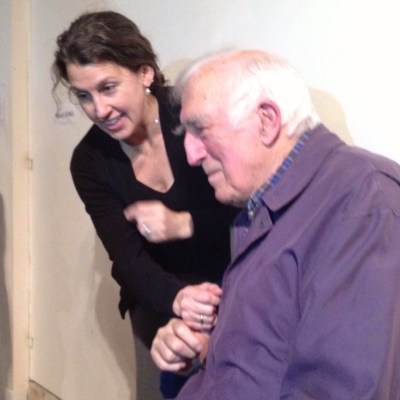
 a theologian in the family