‘the time that is given to us’

Eight years and (almost) three months ago, a friend posted on Facebook that he thought Sauron had acquired the ring. That was November 4th, 2008. I made light of it, as I recall, and we had a brief exchange in which he reminded me how important politics is, and I reminded him that no person is evil through and through in the way Sauron is.

I have thought a lot about that exchange since November 2016. My utter failure to understand how anyone so like me could think so differently about Barack Obama has come back to me. Here we were, two people with quite similar backgrounds and formed in Christian faith during our college years by some of the same people. And yet, I was celebrating and he was thinking the world was ending. The shoe is on the other foot now.

Not only that, but I have spent the last eight years abroad, for the most part, living in England. Brexit was as much of a shock as the election in November. My only observation regarding the similarity of the two events is that the remain campaign and HRC’s campaign each had an element of “don’t be ridiculous” about them. I’m no pundit, though, and I haven’t much further comment to make on that. In both cases, I was persuaded by what would end up being the losing side, and I quite honestly failed (once again) to see what good anyone really believed would come from leaving the EU or electing Trump. I’ve never been one for politics, so maybe it’s just me. But the unthinkable happened on both occasions, so maybe my ignorance is not unusual.

All that to say, I am certainly not a person to offer some astute comment on the situation. Still less can I predict what will happen, or give reasons for hope (or despair). What I can do is return to Tolkien, to a moment very near the beginning of the story of the destruction of the ring.

“But last night I told you of Sauron the Great, the Dark Lord [says Gandalf]. The rumours that you have heard are true: he has indeed arisen again and left his hold in Mirkwood and returned to his ancient fastness in the Dark Tower of Mordor. That name even you hobbits have heard of, like a shadow on the borders of old stories. Always after a defeat and a respite, the Shadow takes another shape and grows again.”

“I wish it need not have happened in my time,” said Frodo.

“So do I,” said Gandalf, “and so do all who live to see such times. But that is not for them to decide. All we have to decide is what to do with the time that is given us…”

This is perhaps the hardest thing of all: not having any say about what time is given to us. We cannot decide what we live through, nor how long the times will last, nor what good our little work may do. Later in the story (in a passage I’ve not yet come to in my  re-reading), Gandalf says that the small acts of courage and faithfulness are the ones that save the world. Of course it’s more eloquent and nuanced in Tolkien’s rendering. I’ve no gift at all, can barely string together a sentence, compared to Tolkien. But it is true nonetheless, that the small acts of kindness and love that shape mere moments do not disappear into some vast ocean of darkness and cruelty–much as it often seems to me in my despairing moods. No, Tolkien is right: the small acts of goodness, those that seem insignificant and powerless, do something.

These are the times that are given to us, whether we believe that Sauron is closing his fist on the one ring, or whether we think that the Shadow has been (for now) defeated. If there is to be any “growing good” of the world (as George Eliot puts it in Middlemarch), it will depend on the most hidden acts of love, hope and courage.

March. Protest. File writs. Or take the other side, if you must. But in all that you do, in all for which you strive in these times, do not forget the kindness to a neighbour, or to a stranger, that makes an imperceptible but no less important difference.

For the truth is, as I have said here before (I’m sure), that the world is constantly changing, in every moment, with every action. Hidden self-sacrifice and quiet integrity resist the forces of darkness and cruelty just as surely as public acts that look good on social media. And kindness costs nothing. We don’t have to pass the bar, we don’t even have to be having a particularly good day. We can still be kind. This is the time that has been given us. Right now.

All we have to decide is what to do with it.
Gender in trouble?

I read John Milbank’s piece (published last week), What liberal intellectuals get wrong about transgenderism. As expected, I found that some of what he says expresses (rather more forcefully) my own concerns. I hesitate to enter into a public conversation about these issues, both because I am a Catholic moral theologian who takes the magisterium seriously, and also because I sometimes suspect that my first reactions (which I’ve hardly got beyond) are likely to be visceral rather than intellectual. And nobody wants to hear what my viscera have got to say. So, I’ll let Milbank speak a bit.

What is more, it is possible that liberals have too easily assumed that there exists a new consensus over abortion rights, gay marriage, transgender issues and positive discrimination (as opposed to formal equal access) for women and racial minorities. In reality, it may well be that a large number of people either reject or have doubts about these things, but feel that it is no longer acceptable to say so. Their real views perhaps emerged anonymously as one aspect of the votes for Brexit and for Trump.

The only person I know personally who voted for Trump would cite dissent from that imagined consensus as one factor in his decision.

In what follows I am not denying that there are some people with confused bodies who deserve our every help toward a viable individual solution. Nor that there are others with unfathomable psychological conditions estranging them from their own corporeal manifestation. Perhaps, in extremis, surgery is the only solution for them.

But many people rightly sense that the liberal obsession with the transgender issue has gone beyond merely wanting to help this minority. It has become a whole movement to change our notions of gender. And its preoccupations come across as irrelevant to most people, unjustified in its conclusions, and apparently condemnatory of the normal with which most people identify.

My shaping by the academic lunacy Milbank later decries makes me cringe at ‘most people.’ Not because I don’t think it’s true. The majority of people don’t feel they’re in the ‘wrong body’ (though, given the choice, I would trade mine for Halle Berry’s or Angelina Jolie’s in a heartbeat), and are attracted to the ‘other’ body. From a purely evolutionary standpoint, this is what you’d expect. I’m just worried about the way that ‘most people’ have made life very difficult in the past for people who are ‘different.’ I am, after all, the mother of a teenage girl with Down Syndrome. Milbank again urges compassion, though:

I repeat that there are some people who really do have a psychic disparity with their gendered body. They may be a very small minority, but they should be listened to — and liberalism has certainly helped us to treat them with understanding and compassion.

But we should still consider irremediably psychic disparity with one’s gendered body to be a highly rare exception, and normatively one should assume (with the sensus communis of all ages) that gender indeed follows upon biological sex. Otherwise, one is embracing a most bizarre dualism of mind and body or soul and body.

True. And I would add that nobody who thinks s/he is in the wrong body wants one that is biologically, sexually ambiguous. Which makes me wonder whether it is not the oppressive ways in which ‘normal’ gender performance has been enforced that are to blame here. Listening, as Milbank recommends, seems indispensable here.

And without bodily sexual difference, there would of course be no prompting to the social imagination of gender. This is the very simple point that is naïvely overlooked as too naïve by the Butlerian thinkers. It is dangerous to suggest that any and every claim to be in the wrong body requires the expenditure of scarce health resources, rather than some form of guidance. If we treat gender identity as so easily laid aside, we could lose our bedrock understanding of what human nature is. 

Gender is, of course, not so easily laid aside: the Butlerians have got that wrong (if Milbank has got them right). One of the key points of Gender Trouble is that the social construction of gender does not negate its power. That’s one of the things structuralism tells us, rightly: that we are shaped by constructions like gender.

Sexual difference is a fundamental aspect of our humanity. As Genesis has it, ‘male and female [God] created them.’ While I am willing to fight for a flexible understanding of what ‘male and female’ means, I think that to give it up entirely is neither possible nor wise. And to do so would be to reject entirely one of the other beliefs that Judith Butler and this Catholic moral theologian share: bodies do matter.

Bodies matter so much that gender dysphoria drives young people to suicide. Whatever I might say, once I get beyond my visceral reaction to these issues, it will never lose sight of that.

on weakness

These days are dark days, the days when Job’s lament (which I read out, in part, to a class on Monday) seems to voice the despair of my own soul–I, who have lost nothing and have healthy children. My darkness is of a different kind, and is heedless of all the good (and lack of it) in the world. So I have little to say. Luckily teaching means reading and re-reading, and today I find comfort and inspiration in the words of an encyclical more than six decades old.

For as the Apostle with good reason admonishes us: “Those that seem the more feeble members of the body are more necessary; and those that we think the less honourable members of the body, we surround with more abundant honour.” Conscious of the obligations of our high office, we deem it necessary to reiterate this grave statement today, when to our profound grief we see at times the deformed, the insane, and those suffering from hereditary disease deprived of their lives, as thought they were a useless burden to society; and this procedure is hailed by some as a manifestation of human progress, and as something that is entirely in accordance with the common good. Yet who that is possessed of sound judgement does not recognize that this not only violates the nature and the divine law written in the heart of every man, but that it outrages the noblest instincts of humanity? the blood of these unfortunate victims who are all the dearer to our Redeemed because thy are deserving of greater pity, “cries to God from the earth.”*

In all those who suffer or are in need, in all those who are small and weak, we ought to see Christ. Why is this so hard? We long to see Jesus–and here he is, right here. If only we had eyes to see him, we would find our heart’s desire.


*Pius XII, Mystici corporis (1943), 94

death of a princess

Early in the year, I was thinking about death. In January, the opinion piece that recommended living the year as if it were your last and the deaths of David Bowie and Alan Rickman put mortality front and center. Sixty-nine years seemed too short a time for a life in the 21st century. Zsa-zsa Gabor, fine–she was supposedly 99; and Richard Adams (the author of Watership Down) was 96. But Prince was in his fifties, like George Michael; and Carrie Fisher was just 60. And that list leaves out a good number of the celebrities we lost in 2016, to say nothing of the friends and family members.

This morning, after seeing the news about Princess Leia, I mean, Carrie Fisher, I stayed a little longer in bed, curled up with my five-year-old daughter. My youngest, my little ‘outlier’–a surprise in my forty-second year, she brought light into my life in a time when things seemed pretty dark. (If only ‘partly cloudy‘ were the worst of it…) If I only live to 60, I thought, she’ll be 18 when I die. If I only make it to 53, though–George Michael’s age–she will be 11. Just 11. It seems so unfair. And unthinkable. But it happens: a friend, a fellow mum from the schoolyard, died this March. She was in her early fifties; her youngest child just 10 years old.

In January, living as though you were in your final year seemed like a kind of New Year’s resolution, to pay attention and remain mindful of your mortality. Because people can and do live longer now, because we (in the US and the UK and the rest of the developed world) are so good at preventing childhood diseases and curing those that used to take young lives, it seems reasonable to expect that we’ll make it to our nineties, anyway. So living in awareness of our mortality takes concentration, focus. Or it did. Before 2016.

Nothing is guaranteed. After a year in which the Cubs won the world series, Leicester won the Premier League, Donald Trump was elected president, and Britain voted to leave the EU; after the deaths of so many people we considered too young to die, we ought to expect the unexpected, the unthinkable.

Something tells me that living 2017 in the persistent awareness of the shadow of death will be more difficult not to do.


Partly cloudy

It often happens at bedtime: so tired, and yet awake. I think, I ought to do something if I am awake. There’s always so much to do. What’s wrong with me? I wonder.

Probably nothing. Nothing, that is, but the ordinary out-of-stepness that is the state of human life lived in too-close cooperation with the fallenness of the world. There is another world, but it is the same as this one, indeed, as has been said by more than one poet and quoted by Rowan Williams. And being between worlds sometimes seems like the state I’m in: finding the ‘other’ in the world doesn’t come easily, when it comes at all.

And who knows how the voice of the Other World will break through? Maybe through something I read, a chance comment somewhere (on social media, even!), in the quiet, or on a walk…I can’t predict. Some days it is as though someone added Felix Felicis to my coffee. The worlds seem to come together. Coming and going, the ordinary things, all seem to lead to a great openness and peace. Other days, not so much.

Like clouds block the sun, sometimes the light that illumines my soul dims. Who knows what ‘clouds’ might float along, stopping the brightness of the sun’s rays? And who knows how long the shadows will cover me? Not I. My only gift, the only thing I have learned to do in this partly cloudy existence is to enjoy the warm sun, to be grateful for the beauty of the clouds, and to find comfort in the sound of heavy rain.


No safe paths

‘There are no safe paths in this part of the world.’

So says Gandalf, as he prepares to leave Bilbo and the dwarves, who are about to enter Mirkwood. Bilbo wished for another way, a way around the dark and sinister-looking forest. But even the very long way around the forest–hundreds of miles out of the way–isn’t safe. And so it seems for us,  in a time of political uncertainty, social unrest and moral conflict–not to mention the constant threat of terrorism: there are no safe paths.

So little of our world is like the Shire and so much of it is like Mirkwood. But few are the Gandalfs in our world, warning us not to leave the path. It seems to me that we have forgotten what the real dangers are. Suffering and death are not the real dangers: they will come anyway; they are a part of life. The real danger is that of spending all our time and effort in avoiding suffering and keeping death at a distance. In so doing, I think we miss so much of what life is about. Too much concern with safety and comfort is perilous.

Gandalf understood this, perhaps. Tolkien seems to have grasped it, anyway. I am afraid, however, that we who live without hunger and fear are too easily persuaded to prize safety and comfort unduly. It is hard, when we are concerned for our children and our way of life, not to believe that safety and comfort are of the utmost importance. Two things ought to be said, though. The first is that I believe in safety: I make my children sit in car seats and wear seat belts, I don’t let them wander, and I probably protect and comfort them to a fault. Even so,  I cannot protect them from skinned knees and broken bones, or from disappointments or failures. And even the comfort a mother can offer does not take the pain away. But they are remarkably resilient. They recover. And they’re not afraid of trying again when the first time was painful or even disastrous. I think of my 5-year-old daughter’s constant cartwheeling. She improves gradually. Sometimes she bangs a foot or ankle, or her arms give way and she crumples to the mat. But she gets up, always, and tries again.

So–and this is the second thing–there’s nothing wrong with valuing safety and comfort. The danger is that the concern for our own safety and comfort, so natural and understandable, begins to shape our attention to the world in ways we are no longer able to see. Then, we fail to move beyond the confines of our safe, comfortable world. We become blinded to the way in which our safety and comfort come at the expense of others’ basic needs. It doesn’t have to be so, obviously. But it’s pretty hard to know how far my comfortable life, and the products and privileges that make it so, would not be possible without the unevenness of the distribution of wealth and power that keeps millions of people in poverty. My having more than enough cannot be completely unrelated to others’ lack.

Let me be clear, though: I am not inviting you to join me on a guilt trip. I eat meat. I drive a car, even sometimes for pretty short trips. I buy snacks for the children that are packaged in too much plastic film. I don’t always recycle everything I should. I drink coffee from Starbucks and even occasionally let the kids eat McDonald’s. I live in the middle-class world and I won’t pretend I don’t like my safety and comfort as much as the next person.

What frightens me, though, is the idolization of safety and comfort. Comfort is no longer a privilege, but a right, and safety as basic a need as hunger. None of us are wholly safe, and we don’t even realize the dangers that threaten us. What we will pay for safety or false security–that worries me. And the expectation of comfort so common in the children of the middle class (like mine)–that worries me.

It’s the lights of the fire and the smell of elvish food that ultimately lure Bilbo and the dwarves from the path through Mirkwood. Were they enticed by safety and comfort? Perhaps. And they almost get eaten by spiders, and they’re captured by the elven king, and they nearly lose their way entirely. Staying on the path is hard, and you don’t even have to believe that it’s the “narrow path” of being a disciple of Jesus to know that that’s true.

Our lives are a journey. There is a path. It leads through dark forests. We will not always be safe. We will not always be comfortable. But what we need is not more cushion and more protection. We need courage. We need hope. Because, really, there are no safe paths in this part of the world.

living with Down Syndrome

It happened again this morning: someone referred to folks considered ‘odd’ as perhaps being able to benefit from ‘treatment.’ I don’t know how parents of kids diagnosed with autism take the use of ‘on the spectrum’ to describe someone whose personality or behavior seems persistently at odds with some social conventions. (I’d be interested to hear.) But as a parent of a teenage girl with Down Syndrome, I find the comments worrying. Not because I  oppose the treatment; early intervention really helped Anna. My worry is that we’re narrowing the range of what counts as human and increasingly expecting that whatever goes wrong can be set to rights with the help of such interventions. It can’t. Not everything has a cure.

At the other end of today, I tuned in to a BBC 2 programme, ‘A world without Down’s Syndrome?’ Sally Phillips’ documentary highlights the wonderful possibilities for people with Down Syndrome. Articulate and accomplished people have overcome so much to get so far, and it is amazing. Eighty percent can learn to read; very many will hold jobs and live independently. We meet an actor, an advocate (Karen Gaffney; check out her TED talk), and an Icelandic woman who became famous after writing an article defending her right to life in a context where 100% of pre-natal diagnoses of Down Syndrome lead to terminations. Not every story is like theirs, but the message is clear: having Down Syndrome does not necessarily stop someone from having a fulfilling life. And it certainly doesn’t stop someone bringing joy to others.

The most awkward moment of the documentary, though, comes when a researcher in London asks Sally about what she wants for Olly, her son, should he outlive her. It wasn’t really a fair question. For the parent of a child (of any age) with a serious developmental delay, it can be an utterly terrifying question. Because we stand between our children and the world that would rather they not exist. Because not all of our children will achieve independence. Because we know that, however difficult it may sometimes be to care for children (including grown children) with special needs, they are not simply a ‘burden’. The unpredictable magic that our children bring to our lives happens because of the relationship we have with them. Without a relationship of love, commitment and understanding, the needs cease to be special: needs are simply a drain on the limited resources of our society. The implication of the question is clear: it’s all well and good for you to have this lovely time with your child now, but who will take care of him when you’re not around?

As long as that is the basic attitude, it’s not surprising that the two possibilities, when faced with a diagnosis are cure or elimination. If we can’t cure it, then we ought to get rid of it. But that all depends, I think, on what it is. What does it mean to be human? As long as the answer to that question consists chiefly of capacities and achievements, we will not be able to find a place for people with developmental disabilities in the world. But if we realise that being human means living with what comes our way, we might just find that they have a lot to teach us about our common humanity. Not everything we encounter in life will submit to our will, whether accident, illness, disaster or loss. For so much that ails us, there is no cure, no solution. Life’s for walking through, not for getting around. Let’s do it together.


Our Lady of Sorrows

pietaI confess to a certain amount of bitterness, when faced with images of a beautiful young madonna and her cherubic child. One such statue stands in a Lady Chapel which is otherwise one of my favourite places on earth. But before that very young woman I feel deeply sad: sad that my own babies are no longer babies, that the magical days of their toddlerhood are behind me. Not that those times weren’t exhausting and often vexatious. But amidst the thousand small things that the littlest ones need doing for them, there was magic. I didn’t need anyone to tell me that I would miss those days, difficult as they sometimes were: I knew it.

Fortunately we have Mary rendered for us in a number of different ways (particularly in iconography), and she was not always the young mother delighting in her baby child. Motherhood also involves loss. Each new stage of development, while (usually) welcome, involves leaving behind traits of childhood–aspects of that precious way of being in the world that is unique to children. And when our children suffer, we suffer with them.

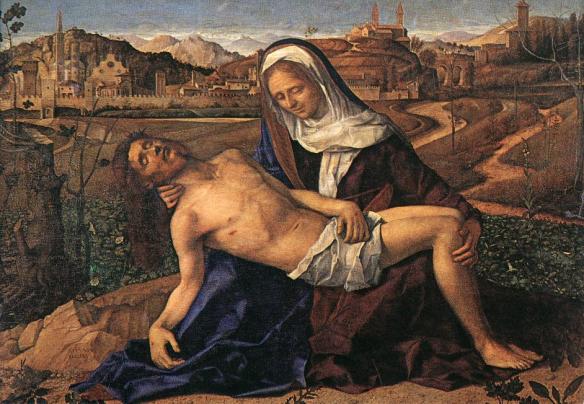
Looking at the pietà (by Giovanni Bellini, 1505), I see myself. The lines in her forehead show the passing of time, the work of motherhood, and decades of letting go. This, also, is motherhood. The painting invites me to join in this sorrow, this tremendous grief, to feel Mary’s sadness. Later, when small losses seem overwhelming, and the longing for my little ones bites deeply, I will turn to Mary, Our Lady of Sorrows, and know that I am not alone.

A blessing and a curse

When I was about 7 years old, I was deeply troubled about the people I heard about in Africa. I still remember distinctly the conversation I had with my mother. (Probably, I’ve written about it before, and if you’ve heard it already, I apologize.) I wanted to send food. No, she said: it would not be let in the country. I wanted to send money. No, she said: it would end up in the hands of the wrong people, and would not help the people I longed to help. But, she said, you know what you can do? You want to be a doctor. When you grow up, and you’re a doctor, you can go and provide medical care, which is something much-needed.

Sure. But I wanted to do something NOW. (For the record, I never made it to med school, but still support Doctors without Borders.) Anything I could have done would have made my little heart happy. Now, I read about kids who do these incredible things to raise money for charity, and I’m so glad for them. And  little envious, of course: would that I had been able to get outside of the box my mother unwittingly set me in that day.

Even as a grown-up, I’m still struggling with that box. The desire to do something has never left me, and I wonder what on earth a theologian struggling to make ends meet can possibly do in a world whose needs are cavernous, seemingly infinite. I pray, of course. It’s free, and it’s in my skill-set, if you can call it a skill. But I still want to do that thing, that big thing that will make a real, tangible, visible difference in the life of someone, somewhere. I want to see some obvious change. I want results.

This is both blessing and curse. I can’t wish away the gift of a desire to make a difference, the gift of caring about the world and all the people in it. It’s the way I have borne that desire through the years that makes it a curse. Because I am a huge fan of George Eliot, and of the very end of Middlemarch, in which she observes that things are not so bad for you and I because of people like Dorothea, who ‘lived faithfully a hidden life, and rest in unvisited tombs.’ It’s not the big things. It’s the little things. But these things make no obvious change, they seem to be very tiny drops in a vast, empty bucket. In everyday life, I can carry no more than an eye-dropper full of difference-making, and the bucket is bigger than I am.

So usually I find myself frustrated that I am not making headway. In fact, many, many days, I seem not to be doing anything to make the world a better place. Even the little things, the small kindnesses to those in my household and neighborhood…some days I fail to do. And then the curse comes at me, full force, cursing: you’ll never make a difference. Why try? It’s pointless. How can you imagine that the world will ever be any better because of anything you’ve done? You can’t even be nice to your family!

Maybe not. At least not unfailingly. And yet, failing doesn’t have to mean I ought to give up. I have to remember I am still the kid who kept asking: but couldn’t we do this? couldn’t we do that? The blessing isn’t the ability to change the world (for the better) in big, obvious ways. The blessing is the ability to get up, when yesterday I failed utterly to do anything kind or encouraging, and to think that today, I still might.

glad to hear it

I don’t do politics. My British husband knows far more about American politics in the last 50 years than I do. (Before that, I have a slight advantage, having done far more American history, and having studied American religious history. But still.) But today I read a couple of articles about Mrs Clinton’s running mate, Tim Kaine.

Now I know that there’s much I don’t know. And I know that I don’t even know what I don’t know. And I am sure that the New York Times is likely to paint him in a good light. Still, I am finally less despondent about the presidential race. Maybe Mr Kaine is just as ambitious as Mrs Clinton (though I can’t imagine ‘more ambitious’ than Hillary). Certainly he’s flawed.  Of course he’s not perfect.

But usually I complete those online questionnaires during election seasons and find that only the crazies (you know, the people who still believe in the Marxist revolution or want to settle on Mars) fit my particular constellation of what matters. Years ago, my father lamented that I was a bleeding-heart liberal. I thought I might have a T-shirt made with that emblazoned on it, along with the Sacred Heart of Jesus. So I am happy about  a Roman Catholic who opposes abortion (yes, I know he isn’t overturning Roe v. Wade; neither am I–not because I think abortion is ok for other people, but because I think we are stuck with Roe v. Wade and the battle needs to be fought elsewhere) and the death penalty (yes, I know about his record in VA). I don’t know much, but I know enough to know that he’s not crazy, and we’re on the same side.

Maybe I will send away for my absentee ballot after all.