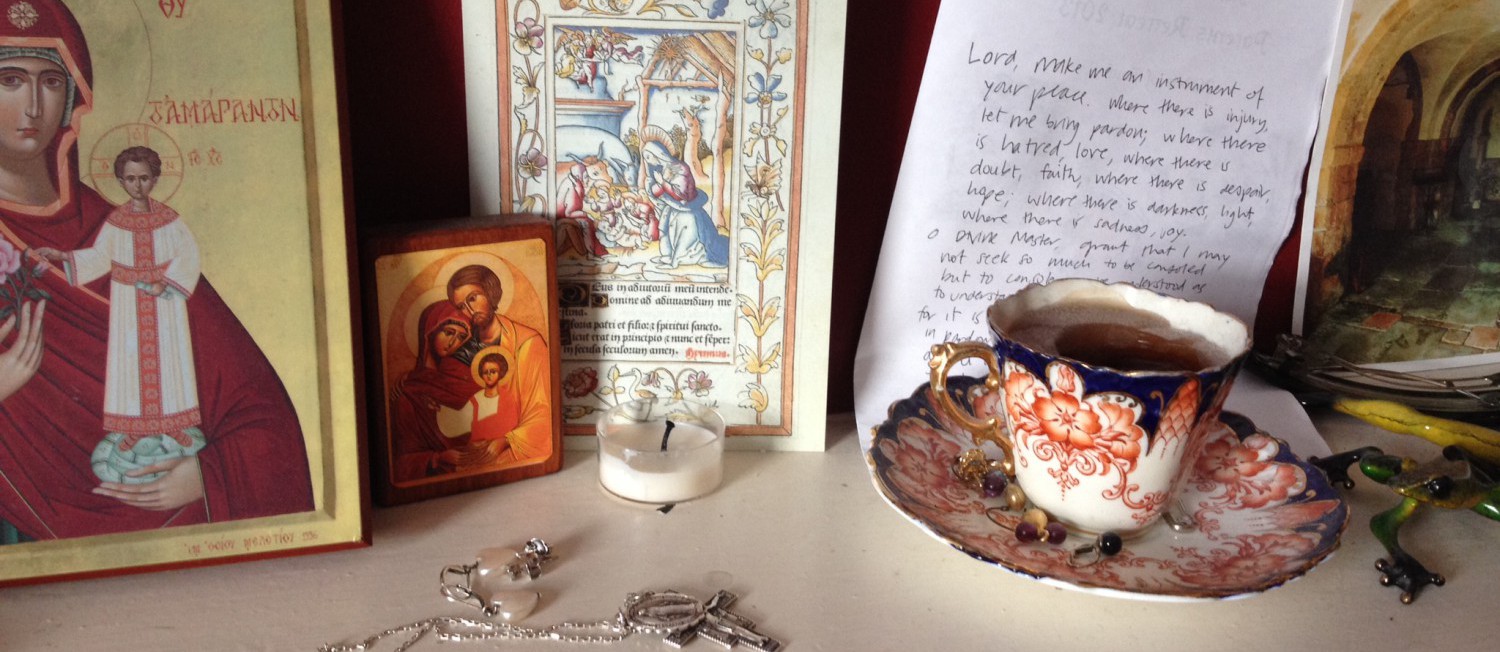
I was inspired, ironically, by a post listing 19 things to give up for Lent that aren’t chocolate.  The list includes fear, envy, doubt, pride and worry. Now, I would love to give up worrying, and not just for Lent. These nineteen habits of the heart (which is what they mainly are) should be the target of our asceticism; that is, whatever it is we give up for Lent, it ought to be with a view to strengthening ourselves for the daily struggle against the attitudes that lead us into sin and away from God.
Don’t get me wrong: I love to do a Big Thing for Lent. One year I wrote a devotional, reflecting each day on the Mass readings and pairing them with a saying from the desert fathers and mothers. Another year, I tried to give up losing my temper with the children, with some success. And once I tried to work out deep-seated resentment and unforgiveness, taking Lent as a time for a kind of spring-cleaning of the soul. That wasn’t my most successful Lent ever.
What I have found, actually, especially thanks to a helpful priest and the book he recommended, Spiritual Combat Revisited, is that the opportunities for small acts of self-denial are ever-present, and usually sufficient to my needs for ascetic exercise. Letting go of impatience as I wait in a long line at the supermarket, for example; or resisting the impulse to snap at one of the children, as s/he does that thing for the seventeenth time, having been told sixteen times to stop, please. There is no shortage in my life of opportunities to put another’s needs before my own. 
So why give up anything at all? One might say (and not unjustifiably) that the Church offers an ascetic programme of sorts for Lent: days of fasting and abstinence, extended hours for confession (and an obligation to go), and the liturgical fast from the Gloria and from all alleluias. Isn’t that sufficient? Perhaps. Giving up something more is a way of taking Lent to heart, of keeping the season in mind more consistently. I put more effort in, and my observance of the season deepens.
Chocolate does seem like the most boring possible thing to give up for Lent. I mean, couldn’t I find something more inventive, something more impressive? Everyone gives up chocolate for Lent. But does that make it any less effective for me? I think not. Remember Naaman, who suffered from leprosy? Elisha sent him to wash seven times in the Jordan, and Naaman had a tantrum. He expected something different, something more fitting for a person of his rank and distinction, perhaps. Luckily, one of Naaman’s servants kept his head, and suggested that ‘if the prophet had told you to do some great thing, would you not have done it?’ Well, then, why not do this small thing. And Naaman does, and is healed.
Giving up something for Lent is like that: it isn’t about thinking up something cool to take on, or something huge to give up. It’s about humility. As Christ humbled himself and suffered for us–in both very cruel and very ordinary ways–so we take this opportunity to grow in humility and expose ourselves to suffering. So I am giving up chocolate for Lent, as are a number of other people in the parish. I admit that this is enough for me; I hope that it will keep me mindful of other small opportunities for self-denial in my daily life, during Lent and all the days that follow.
 It may have been watching Goldfinger that made me alert to the three articles in one newspaper (the New York Times) this morning, all touching on the situation of women in the contemporary Western world. I was slightly shocked by the behaviour of our favourite spy towards women–obviously it has been a while since I watched the Sean Connery films. Fortunately, two of the articles today suggest that the reason I find his behaviour inappropriate is that things have changed for women, not only in the US, but also, finally, in
  The article about women on Wall Street makes
 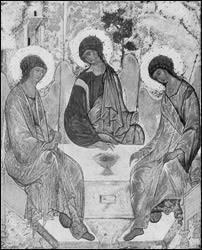 Now, maybe you’re wondering what the Trinity and the whole business of feminism have in common. No, I am not going to go in the direction of feminist theology. Yesterday, in that terrifying experience of trying to say something to children about the Trinity, a beautiful thing happened. There we were, talking about the Glory be, and listening to the gospel (John 16:12-15), and trying to make sense of it all (without actually using the word Trinity, which seemed extraneous), and the children somehow managed it. Why don’t we hear ‘Son’ in the gospel, we wondered. Because Jesus is the Son, and he’s speaking, offered one of the children. We wondered how God was present with us now. ‘In our hearts,’ offered another child; and ‘by the Spirit,’ said a third. But the best of all was in their free drawing time. One of the girls came up to show me her drawing afterward. Below the text of the Glory be, she had drawn a circle with a series of arrows to indicate the circle’s direction. ‘Because it continues,’ she explained.
 a theologian in the family