I first met Jean Vanier in the mid 1990’s, only I didn’t know it yet. There was just this person, described by Henri Nouwen in The Return of the Prodigal Son:
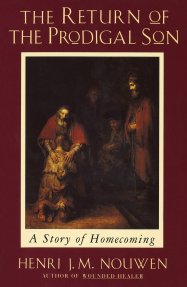 I have a friend who is so deeply connected with God that he can see joy where I expect only sadness. He travels much and meets countless people. When he returns home, I always expect him to tell me about the difficult economic situation of the countries he visited, about the great injustices he heard about, and the pain he has seen. But even though he is very aware of the great upheaval of the world, he seldom speaks of it. When he shares his experiences, he tells about the hidden joys he has discovered. He tells about a man, a woman, or a child who brought him hope and peace. He tells about little groups of people who are faithful to each other in the midst of all the turmoil. He tells about the small wonders of God. At times I realize that I am disappointed because I want to hear “newspaper news,” exciting and exhilarating stories that can be talked about among friends. But he never responds to my need for sensationalism. He keeps saying: “I saw something very small and very beautiful, something that gave me much joy.”
At the time, I had no idea who Nouwen might be talking about. I could not imagine what kind of person would be able to travel the world and not inclined to talk about the ‘newspaper news’, as Nouwen puts it, but I admired his friend. My new, nameless hero took up residence in my soul, pointing the direction to hope and wholeness.
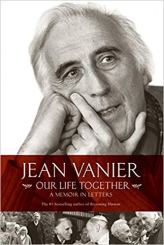 About twenty years later, I received Jean Vanier’s memoir, Our Life Together, a volume comprised of his letters to the growing network of L’Arche communities and the friends of L’Arche. As I read the unfolding story of L’Arche, the ‘little groups of people who are faithful to each other’ came into focus: L’Arche communities–especially those in regions torn apart by violence and the threat of war. From Tegucigalpa to Belfast to the West Bank, Vanier traveled, giving retreats and meeting people. He never makes the retreats central to the letters, though; rather he tells just the sorts of stories Nouwen reported. The letters are not about Jean. They are about Lita and Marcia, Rafaelito and Aravindo. He writes about spending time with people who are learning to love each other, to be family. Here is the man that Nouwen held up as an example of becoming like the Father.
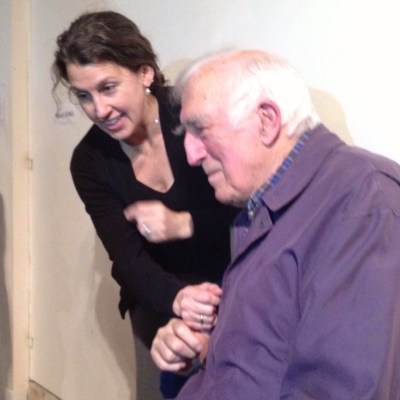
Not long after I read the memoir and connected the dots, I found myself in Trosly, at La Ferme.
A group of academics (myself among them) were wrapping up a three-day conference with a visit to the heart of L’Arche, where we would have the opportunity to meet Jean Vanier. I couldn’t resist asking him whether the passage in Nouwen’s book was about him. Of course he wouldn’t admit it, and I wondered whether maybe Nouwen had someone else in mind. But there he is, smiling, like he knows how gullible I am, and he’s made me doubt!
A few years later, on my second retreat at La Ferme, I was asked to give a word of thanks at our final meal together with Jean. But I didn’t just thank him for the retreat; I thanked him for being that nameless hero I’d found in Nouwen’s book all those years ago. I was certain it was he, and he couldn’t deny it. Everybody knew that Nouwen was writing about Jean. I will always be grateful for that chance: it was the last time I saw Jean.
There have been tributes and obituaries (in the New York Times and in The Tablet already), and there will be more: his story will be told, and I am glad. He finished the race well. His own courage and peace in the face of death should come as no surprise. He concluded Our Life Together with a reflection on death and life:
The poet Tagore said that “Death is not a lamp that is extinguished; it is the coming of dawn.” Weakness, crises and death are never an end but are new beginnings. L’Arche and Faith and Light were founded on weakness, they will continue to grow in their mission in and through their fragility, and God will continue to be present. God works through our communities, and I am happy to see it. Life continues to flow.
Indeed, ‘life continues to flow’–and our lives are so much richer for having been touched by Jean’s extraordinary vision, courage, and love. Thank you, Jean. Rest in peace.
Deo gratias.
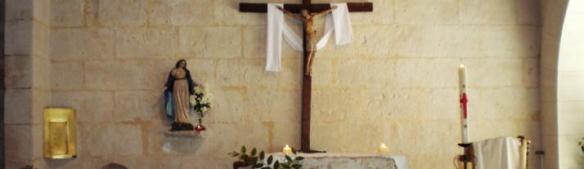
The chapel at La Ferme, Trosly
*The obituaries keep appearing. Even before I finished this post, there were many more than I was able to mention. Here are the celebrations of Jean’s life and work that I have encountered so far (please let me know about those I have surely missed):
L’Arche UK (and see the L’Arche website)
BBC (https://www.bbc.co.uk/news/world-europe-48186136)
The Guardian (https://www.theguardian.com/society/2019/may/07/jean-vanier-obituary)
Catholic News Agency (https://www.catholicnewsagency.com/news/jean-vanier-friend-of-the-intellectually-disabled-and-founder-of-larche-dies-at-90-67007)
Christian Century (https://www.christiancentury.org/article/people/jean-vanier-and-gift-l-arche)
Religion News Service (https://religionnews.com/2019/05/07/jean-vanier-catholic-hero-to-developmentally-disabled-dies/)
Faith and Leadership (Stanley Hauerwas remembers Jean Vanier: https://www.faithandleadership.com/stanley-hauerwas-jean-vanier-was-dear-friend-me-and-many-others?fbclid=IwAR19KvQSiP7H-Lm1nBha_5f1eTifAZTZWA1neO-lLn5_w-DW30xEeAWPps8)

 Second, and more importantly, my daughter has an incredible gift to give me and all those who take the time to listen to her and go at her pace for a bit. What the video doesn’t help us see is the way that I have to slow down and look at the world differently when I am with my daughter. Every day–when I am paying attention properly, anyway–my daughter reminds me that life is not about rushing from one thing to the next. Life is not about what I can achieve. Being human is not about being utterly self-sufficient and autonomous. All the practical things that I can do, my capacity for self-direction, and my ability to interact with the world in an abstract and reflective way have their place in the way that I live my life. Indeed, these things enable me to care for my daughter and to see her for who she is. But very easily I forget that who I am and what I can do are not coextensive. I am more than a bundle of capacities, more than a cache of memories and ideas. My daughter reminds me that the time I have been given is first and foremost for love. Without that, my capacities would have no direction and my memories and ideas would lack the principle that integrates them. I love. The rest is only really about how I express that love, how I live it out in the world.
 a theologian in the family