the saintly ordinary

stmartindetours I enjoyed reading the article about St Martin of Tours in the Catholic encyclopaedia online. Not only is his life story interesting and full of the vignettes that make hagiography what it is; he is also the patron saint of soldiers, appropriate for today. If I were cleverer, I might say something about that. 

What struck me, however, is a phrase near the end of the article: ‘recover your ordinary firmness’, says the angel to a brooding St Martin. He regretted bitterly a mistake he had made, and the angel warned him not to dwell on it. So you got that wrong, and you are rightly sorry for it. Move on. ‘Recover your ordinary firmness.’

I’m afraid I can be a bit like the brooding St Martin, in need of an angel to remind me not to dwell on those things for which I am rightly sorry. Unlike St Martin, though, I have no history of ‘ordinary firmness’ to recover. My life story is not one of courageous stands, self-sacrifice, and miracles. Just a girl-grown-up, having meandered from childhood and somehow ended up here. A theologian. A Roman Catholic. A mother and wife. A teacher, a writer, a friend. Not, I am sad to say, a saint.

I can learn something, though, from St Martin’s mistake and the angel’s counsel. The heart and soul of St Martin’s story is his quest for Christ-likeness. His ordinary firmness is not as a worker of miracles or a doer of extravagantly self-sacrificial deeds. His ordinary firmness comes from his being in Christ, and the stuff that makes his story so interesting is just details. The details attest to the saintliness, but they are not its substance. Recover your faith in the One who saves you, who covers over all your blunders, however stupid you feel about them.

It is the firmness, I think, of knowing a ‘blameless way’, not because one has never missed a step, but because the way has been made blameless:

…who is a rock, except our God?                                                                                           the God who girds me with strength,                                                                                     and makes my way blameless.                                                                                           He makes my feet like hinds’ feet,                                                                                       and sets me upon my high places.                                                                                      Psalm 18: 31-33 (NASB)

Earlier in the psalm, the psalmist seems to boast of his blamelessness. ‘I was also blameless with him’ (23), he says: with clean hands; without iniquity. Like God, whose ‘way is blameless'(30). And just when I feared I would never be able to pray this psalm, along comes verse 33: the blameless way, the firm ground, is made so by God (the One who has prepared those good works for us to walk in!).

The secret to imitating the saints in their imitato Christi is an imitation of the heart. It is not a backward-looking, self-reproaching endeavour, but a forgiveness-receiving and moving-forward adventure. All right, a journey, anyway! The path of discipleship is the ‘blameless way’, the way of ‘ordinary firmness’ made so by Christ’s own footsteps. The history on which I can look back and recover that strength of soul is Christ’s history, not my own.

Deo gratias.


trying too hard

That is, I find myself trying too hard at the wrong things, sometimes, and not hard enough at the right things. My noviciate in the blogosphere has taught me that I am most emphatically not alone. If I am unique (yes, I know, we all are), it is because I am a unique combination of shared experiences, concerns, ideas, gifts, and needs, each of which I have in common with countless others. This is a Good Thing, though it doesn’t always seem so; and the response to feeling ‘ordinary’ is not always a healthy one.

What worries me about my adventure in this sphere is that it sometimes seems to be about being noticed. So I have been thinking a lot about popularity, and the pitfalls of popularity. I was encouraged and challenged this morning by wise reflections on the Rule of Benedict from Sr Catherine (@Digitalnun): the gifts we have been given must be exercised in humility and love in order to make us, as she says, ‘great’. But even this greatness doesn’t make for popularity. Sometimes gifts are exercised wonderfully well in small places. Sr Catherine drew from Chapter 31 of Benedict’s rule: the instructions to the cellarer, which I have always found inspiring as a parent.

One of my take-away phrases, which I have on the fridge, is ‘fratres non contristet’: do not upset the brethren. (It just looks better in Latin on the fridge.) St Benedict is explaining how to respond to an unreasonable request. Not harshly, he says, but gently. If the request is outrageous, the response should not be so, lest the brother or sister be upset by the refusal. Now this, I submit, is a key element of parenting: seventeen outrageous requests before breakfast, right? At least that’s how it is around here sometimes. The gifts of the cellarer, and those of the parent, are gifts exercised in small spaces, in the house or the car; sometimes in the grocery store or at the park or the library. Parental greatness is a huge, and hugely important quality, but it doesn’t often get recognised beyond the confines of the family. Greatness of this sort doesn’t always get you noticed.

I am not a great parent. I do not always succeed in responding calmly and gently to the most outrageous requests. Sometimes I do ‘great’ things: I find everyone’s PE kit, even the missing shoe, and the ‘lost’ reading book, and all this before the dreaded leaving-for-school time. To do that cheerfully is to exercise the very simple gift of attentiveness in the way I ought to. Although my sons and husband happily repeat after me, ‘mum is awesome’, I’m not winning any medals, not acquiring more followers on twitter, or on this blog. No speaking requests are coming my way because I sent my daughter off to school with everything she needed, and did it with a smile.

It is too easy for me to fall into the trap of thinking that the measure of my success, my ‘greatness’, is somewhere in cyberspace, or on my CV, or in teaching evaluations. And truly there is something to that (especially that last thing, I think): I have gifts to exercise in teaching and writing, and I ought to do what it takes to do well at my job. But if I want somewhere to practice exercising my gifts with humility, in love, I am better off digging in the cupboard for the missing shoe: no pretensions to grandeur there! When I have tried hard enough at the small things, perhaps I will be less prone to try too hard at the ‘big’ ones.

All the angels and saints

Late last night, I received a text message from a friend, asking whether I had a meditation for All Saints' Day. No, I had to reply, I didn't. But I felt I should. The saints are essential to my Christian life, and in one way or another always have been. One way or another, I say, because there was a time when I would not have been so eager to ask, as we do when we say the confiteor, for the prayers of 'all the angels and saints'. When I was small, it was the 'ordinary' saints, the living company of the faithful, who guided me. At least they pointed me in the right direction; I didn't always follow their lead. In college, I began to appreciate the 'saints' in Hebrews 11, especially as they form the 'cloud of witnesses' who surround us as we follow Jesus.
 
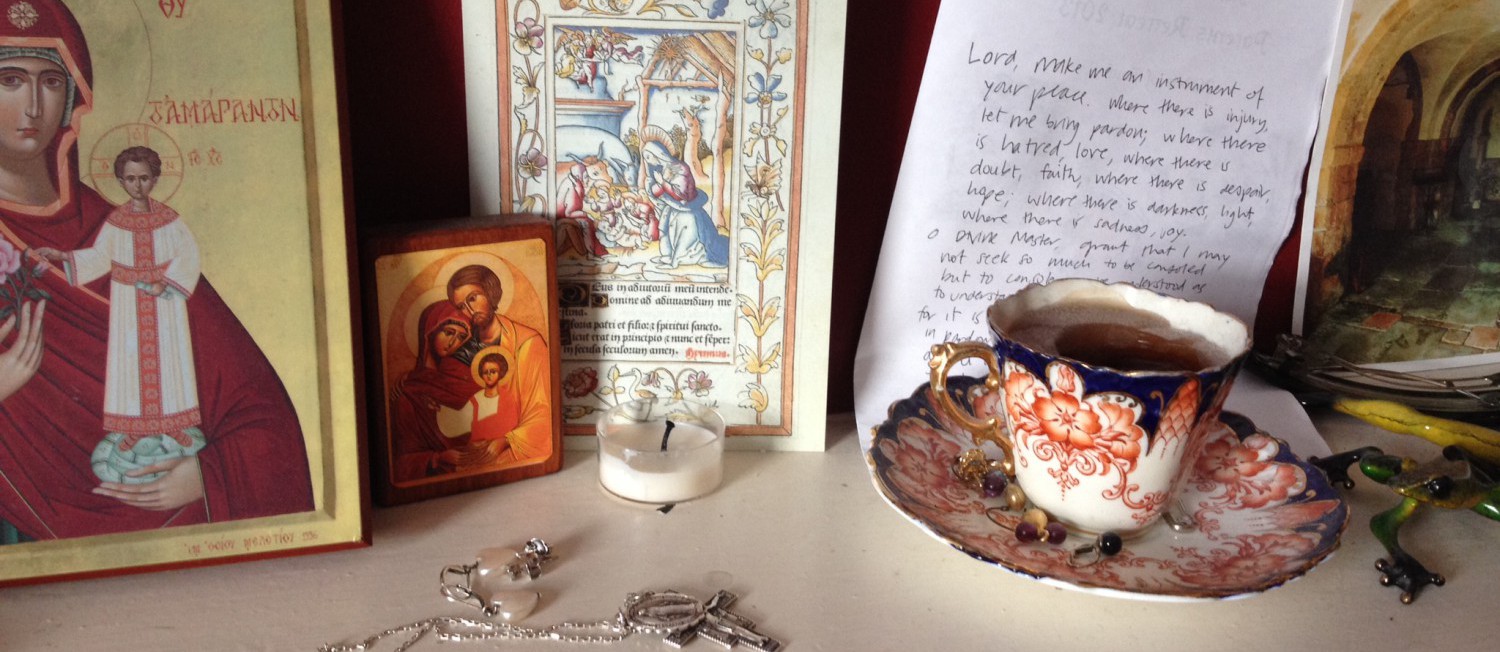
But the picture is bigger than that. The saints–those who have gone before us and stand before the throne of grace–play a vital role in the spirituality of my everyday life. There they are, on the mantelpiece beside my bed: the Blessed Virgin and child, the Holy Family, St Michael the Archangel; there is my San Damiano cross, which I wear everyday to remind myself of St Francis's holy life. When I say 'all the angels and saints' in the confiteor, I mean it. I mean that I need their prayers. And often the invocation of the saints reminds me that I am not alone. There is a whole company on this road, and the company keeps pressing on.
 
The fact that it doesn't depend on me, that the saints are already the church triumphant, liberates me to pray, to worship, to receive forgiveness and to hope that I can live the life of a disciple of Jesus. The life of the church is carried forward by the saints and saints-in-the-making, and all the saints share one vital characteristic (if you can call it that): being made holy by the Spirit of Holiness. Saints don't shine because they're polished; they shine because somehow they let the light of God show through them. I want to be like that, and I realize that there is no formula for getting there. There is no recipe for saint-making, just a Spirit who blows where he wills. 'Fixing our eyes on Jesus' (Hebrews 12) is the main thing. The church depends on him, he is the vine; he is the author and perfecter of our faith; he is the one in whom all things–perhaps most especially the communion of saints–hold together.
 
But that's not all. The communion of saints, the universal church, covers me when I go astray. 'Look not on our sins, but on the faith of your church', the priest prays, and the words always come as such a tonic to my soul. The faith of the church is the faith to which I cling. It is no product of my own heart or my own mind, but it belongs to the communion of saints. In the words of Rich Mullins, 'I did not make it…it is making me.' The faith of the church is something strong, lasting, and perfect.
 
It would be wrong to think, though, that the strength of the church's faith means I can just take a seat and wait for heaven to come to me. No: clinging to the church's creed is sometimes hard work. That's where 'taking every thought captive to the obedience of Christ' and 'working our your salvation' and all those passages in the New Testament that make the Christian life seem like such hard work come into play. It is easy to forget–at least it is easy for me to forget–that holding onto what the gospel says to us in Scripture and tradition does not come naturally to those of us trained and formed by a world that doesn't believe any of it, and hopes in very different directions.
 
Whatever it is that seems to threaten my Christian life, it's not new. The challenges, temptations, and doubts that come my way are not unique to me. Whether I think I have done well or badly, I haven't done anything totally unprecedented. The saints have already been there.
 
And this is a good day on which to be grateful for that.

with angels and archangels

We never had a plan for taking the children to Mass, beyond taking them to Mass. I've read the strategies of really organized parents, in awe of their attention to detail and advance preparation. I am not that organized, and I take full responsibility for that. If walking around outside with the toddler is what it takes, then that's what we do. And we have had some pretty unpleasant moments with the children during Mass.
 
I remember going to church with my mom when I was a child. We always sat in the front row (effective, I think–at least there you're bound to notice something, as my kids sometimes do). She gave me lifesavers, tropical fruit flavor, which were really quite effective. (Banana and coconut were my favorite.) My kids don't particularly like sweets (which is otherwise great), so that's not really an option for me.
 
As they get older, the still-and-quiet routine gets easier. Getting them really to attend to what's happening, though–that's another story. One Sunday recently Iain (just before he turned 7) dug my iPhone out of my bag and started playing can knockdown during the liturgy of the Eucharist. However displeased I was, I wasn't willing to incite loud and angry protest in the front row. So he might have looked like he was kneeling piously….but no.
 
That's not to say I don't have certain hard-and-fast rules. Everyone stands and says the Our Father. And that makes me happy. (Honestly, it does.) I am always trying to strike a balance: on the one hand, I want the children to begin to grasp the significance of what's happening; on the other hand, I don't want to make the experience of going to Mass into an hour-long prison sentence every Sunday. And I find myself holding in tension the need to express my own spirituality by engaging with the Mass, and the need to attend to the children, who are engaging on a very different level.
 
Sometimes I fail. (Shocking, I know.) But those moment are the moments when I am most grateful for the liturgy of the Catholic Church. Last Sunday, between policing Iain on the iPhone and discouraging Anna from trying to engage the kids behind us in conversation, I completely lost track of where we were…until suddenly my attention was grabbed again, just in time to join in the Sanctus: '…with angels and archangels…'
 
Joining in. That's what it is about. It is about taking part in the ongoing praise of God that happens in eternity, for eternity. Not about perfectly behaved children, or about the quality of my singing (I'm terrible). I think some weeks I depend completely on the angels and archangels to glorify God, as I am working to keep my children from storming the sanctuary. 'Look not on our sins, but on the faith of your Church…' indeed: the faith of the Church, like the liturgy, does not depend on me. It is. However focused or distracted I am, the worship happens, the Mass happens. Knowing that is incredibly humbling as it is freeing.
 
In his 1947 encyclical Mediator Dei, Pope Pius XII wrote:
Jesus Christ burned with zeal for the divine glory; and the offering of His blood upon the cross rose to heaven in an odor of sweetness. To perpetuate this praise, the members of the Mystical Body are united with their divine Head in the Eucharistic sacrifice, and with Him, together with Angels and Archangels, they sing immortal praise to God and give all honor and glory to the Father Almighty (71).
 
'Zeal for the divine glory' seems pretty far from many of my Sunday experiences. If I am burning with anything, it is probably way less holy than that. But I know that's what it is about: participating in the self-offering of the Son to the Father, in the Holy Spirit. All we do is respond to the love of God as it comes to us through Jesus. And even our response is helped by the Spirit (my attention just happened to be drawn back to the liturgy at the Sanctus…).
 
Deo gratias.
 

Remembering why I like Karl Barth

Karl Barth

Barth writes:

Revelation itself is needed for knowing that God is hidden and man blind. Revelation and it alone really and finally separates God and man by bringing them together. For my bringing them together it informs man about God and about himself, it reveals God as the Lord of eternity, as the Creator, Reconciler and Redeemer, and characterises man as a creature, as a sinner, as one devoted to death. It does that by telling him that God is free for us, that God has created and sustains him, that He forgives his sin, that He saves him from death. But it tells him that this God (no other) is free for this man (no other). If that is heard, then and not till then the boundary between God and man becomes really visible, of which the most radical sceptic and atheist cannot even dream, for all his doubts and negations. Since the boundary is visible, revelation, which crosses this boundary, is also visible as a mystery, a miracle, an exception. The man who listens here, sees himself standing at the boundary where all is at an end. Whichever way I look, God is hidden for me and I am blind to Him. The revelation that crosses this boundary and the togetherness of God and man which takes place in revelation in spite of this boundary, make the boundary visible to him in an unprecedented way. No longer need he yield to deceptions regarding the cosmos of realities that otherwise encounter him. This cosmos will lose the power to prepare for him either illusions or disillusionments. He knows all about it. Not because he has supplied himself with information about it by intuitive or analytico-synthetic means, but because he has been informed about it. But this information is, that among the realities of this cosmos there is not one in which God would be free for man. In this cosmos God is hidden and man blind. Once more, it is God’s revleation which gives him this information. That it does so is its critical significance. By that very fact, however, the further question is thrust at us: how far is God free for us in revelation?  No less than everything, i.e., no less that the whole of man’s cosmos, seems to speak against this possibility taking place. Even if it is ever so great and rich, as it actually is, how could one of its realities have the power to be God’s revelation to man? Once again, man would have to leave the real revelation of God out of account; he would have to forget that he is informed about God and about himself, if he is to assert boldly the presence of such a power as one of the realities of his cosmos…

If he were looking steadily at the cross and the resurrection of Jesus Christ, he could not look in any other direction, neither could he any longer allow talk about such possibilities to pass his lips or to flow from his pen.

-II/1, pp. 29-30

I admit that I haven’t missed the lack of inclusive language, which distracts somewhat (for me, at least) from the text. But I love the way that Barth characterizes revelation: it hides as much as it reveals. As I am preparing to teach on the Incarnation (not till February, I confess), I have been looking for the right passage(s) from Barth, in which he makes explicit this reality of the Incarnation. All is revealed truly, and at the same time all is hidden in Christ. It’s no wonder Barth kept repeating himself (as he himself says elsewhere in the volume): again and again he returns to this center of theological reflection, this singularity, because he knows there is only one place from which we can do theology, and that is the foot of the cross.

Syria and St Augustine

A few weeks ago, my heart turned toward the situation in Syria in a new way. I thought: I don’t know very much about Syria, and I am neither politically nor militarily savvy. But I know that if my kids were fighting, and the stronger one(s) hurt the weaker one(s), my first move would be to attend to those who were hurt and keep the others away from them until I could sort it out. I was really worried about the prospects of a US military strike. On the same day, which just happened to be the feast of St Augustine, Lewis (who is much more knowledgeable about such things) offered the following: ‘…if we were prepared to do the dirty and get lots of boots on the ground and establish protected areas for civilian refugees with decent medical care inside Syria, I would say ‘great’. But this, no boots just bombing the bad guys so the bad guys can take over don’t seem wise. Damn, this is enough politics on facebook for about a year! As you know my attitude toward Turks and the French leaves much to be desired, but let’s hear a word for the Ottomans and for the French mandate after WWI. {Admitting that he isn’t against bombing in every case, he added:]  I’ll own up to the campaign in 2001 in Afghanistan and the 1999 NATO bombing of Serbia as examples where (horrific as it of course was) it seemed to do the job. It’s a fallen world folks: Saint Augustine, pray for us.’

I was encouraged: if it isn’t just the mama in me talking, if this ‘looking after the injured’ is something that makes sense to someone like Lewis, well, maybe there is hope. But as the US moved towards a military strike, I faltered. What will become of Syria? and what will happen to the world? Even Jean Vanier, with whom a (nun) friend of mine had spoken last November, echoed what Lewis said: it’s a fallen world; these things happen.

In the most technical and articulate language: bummer.

So when Pope Francis called for prayer and fasting for Syria on the 7th of September, my heart leapt. Yes, I am that sort of person. I thought prayer (St Augustine’s and ours) was a clear and practical step in the right direction. I happened to be on retreat last weekend, which afforded me far greater opportunities for prayer than a Saturday at home would have, from vigils to compline, with an extra hour of adoration after vespers. I’ve no idea what I thought would happen; indeed I had no idea of what would count as an ‘answer’ to prayer.

On Monday, Lewis was in the kitchen criticizing Obama, for having had to change course in the face of Putin’s intervention. Stepping back made Obama look weak. I didn’t say anything at the time, but I did wonder: ‘But doesn’t it make God look strong?’

Maybe it is to the credit of Christians everywhere, who’ve prayed for Syria, and who joined the worldwide prayer vigil last Saturday, that no one is celebrating the triumph of our God. I’ve not heard a soul claiming that this change in the situation is an answer to prayer. But I see hope where before there seemed to be no hope, and in my experience, only God can do that.

I will keep praying for Syria and for the middle east, with hope in my heart, and giving thanks to God.

Deo gratias!

On not attending the conference

 I missed a good paper yesterday: “The Word Answering the Word: Opening the Space of Biblical Interpretation” at the Edinburgh Dogmatics Conference. Fortunately I have a copy of the paper to hand, and have read it sitting in bed to the sound of Lucy’s breathing as she sleeps next to me. No small talk, no feeling inadequate because I haven’t read that book, or that one either…or published a raft of peer-reviewed articles. This is the best–the very best–of both my little worlds. And I will even get a chance at some Q & A with the author of said paper: Lucy’s daddy.
My first question: “Don’t I remember you talking about Joseph Ratzinger’s concept of tradition in our kitchen in Atlanta?” Really. That’s my opening question, partly because I found the paper thought-provoking and not suspicion-arousing. But, more importantly, I will ask that question (probably in the kitchen) because it tells me something really important about scholarship. I think sometimes that my husband devours books and churns out essays. That’s true, but the essay-churning–if I am right about the conversation at least four years ago in our kitchen in Atlanta–lags significantly behind the book-devouring. Percolating happens.
That’s hopeful. Really hopeful. I don’t devour books, I glide over them like a glacier. And I only churn out to-do lists these days…and Christmas cards, when the time comes. Essays? Not so much. I think about things; I dream of papers I’d like to publish, books I’d like to write. Sometimes I make lists of those, too… But I find all the small spaces in which Lewis seems to get so much done completely occupied. My interstitial spaces, those odd moments in which I might read a few pages or jot down notes, are the spaces in which school uniform is ordered, birthday parties are planned, online Christmas shopping begins, a chore chart is devised, school supplies are organized, and Lucy’s clothes are sorted–she’s grown out of that and that and that…what does she need now? I store information about shoe sizes and coat sizes, teachers’ names and school holidays, doctor appointments and childcare arrangements. Neither in my head nor in my weekly schedule do I find time to divert to scholarship. I know, because I tried for several weeks to take an idea and make it into an essay, using those in-between times. The number of balls I would have had to drop was completely unacceptable.
That’s neither a complaint nor an excuse. It just is. So the idea that percolating is a part of the process for everyone does give me hope. Because one day I won’t have to choose between reading the paper next to my sleeping toddler, or going to the conference to hear it. I will have more time to read slowly and write slightly less slowly. But I won’t get to choose between my 2-year-old (and my 11-year-old, my 9-year-old, and my 6-year-old, for that matter) and some conference or other. Conferences will come again, year after year. But that little sigh I just heard will not be the same the next time the Edinburgh Dogmatics Conference comes around.
All the same, I am glad I had a chance to read the paper. It really is quite good.

the ordinary

I’ll tell you what my novitiate in the blogosphere has taught me: I’m ordinary. My experience is just human, and my reflection on that experience is just as human. I knew that, or at least I sort of knew that. And I don’t even really have anything peculiar to say about it. As Matt Jones put it so eloquently today, ‘being human is crazy.’ And it’s not easy. My favorite David Foster Wallace sentence (from the commencement address I blogged about a couple of weeks ago) is:

The really important kind of freedom involves attention, and awareness, and discipline, and being able truly to care about other people, and to sacrifice for them over and over in myriad, petty little unsexy ways every day.

Yep. And he didn’t even have children. The daily routine he describes in that commencement address doesn’t involve a 9-year-old shouting that it’s all your fault, or a 2-year-old clamoring ‘up! uppppyyyy!’ while you’re trying to peel carrots or help the 6-year-old with his reading. I listened to his address again while my girls were in the tub, and heard this sentence in the middle of the dreaded hair-washing, I think. Definitely having an unsexy moment, there.

My real hero, though, isn’t David Foster Wallace, as insightful as he was, God rest his soul. More than just about anyone, I admire Jean Vanier. Although he’s a renowned person now, having been nominated for the Nobel Peace Prize, among other things, he didn’t set out to create an international network. L’Arche was his home, and he shared it–at the beginning–with two young men who required unsexy sacrifices every day. I don’t admire him because he was successful, or because he’s a wise and caring person. I admire him because it has always been about being faithful to the teachings of Jesus.

Jean Vanier makes the ordinary radiant with the love of God. Would that I had an ounce of his spirit of tenderness and faithfulness. I want to escape the ordinary, the ‘crazy’ that is being human every day. But freedom and faithfulness are not in the heroic acts–or the brilliant and widely-read books-that make me say, ‘wow’. Nope. Freedom–the ‘most precious’ freedom–and faithfulness are in the power to stay, to stay calm…not to shout back at the 9-year-old or lose patience with the 2-year-old, but to persevere in tenderness.

That’s the hard, hard work of being ordinary. I’m glad I am not alone in doing it.

David Foster Wallace, commencement address to the graduating class at Kenyon College (2005)

Video

I listened. Somehow I missed this on the first go-round, probably because at the time I was madly trying to finish a dissertation while being the best possible mom to my two little ones. And I was going through a very dark patch. So my awareness of David Foster Wallace has been dawning over the last couple of months.

He had my full attention. I have about a million things I should be doing, but I stopped, and listened. After the conclusion of the speech, I googled him (as you do) to refresh my memory, and connected the dots. Oh, this is that guy. Wait, he committed suicide? I knew that. Right.

But I wasn’t nearly as sad when I first heard it.

like that

It says something about me, and about where I am these weeks and months, that my last two posts begin with ‘some days are like that.’ Like what? These days are full of beauty that I can’t quite appreciate, joy that I know is there but just can’t feel, and love that knocks quietly but insistently on the door of my heart as I struggle with the lock.

I had this dream several nights ago in which I was insisting to a couple of colleagues that going through the motions is important. Developing habits consistent with the hope you ought to have, even when you don’t have that hope, is not a bad thing. What do you do, I asked, when the love of your life doesn’t feel like it did at the first? You do what you would do if it did, and maybe, if you’re lucky, you find that it is still there.

What I didn’t say in the dream, of course, because it was (after all) a dream, was how difficult it is to do. It is incredibly soul-wrenching work. I write about the character of Christian identity, in my life as an ‘academic’ theologian (whatever that is); I say that John Milbank is right: the heart of our Christian practice, our being and believing and acting Christianly in the world, is receiving life, and love, and our very being from God. Apart from God, we cannot persist. (See Colossians 1: 17, or listen to Rich Mullins’ song ‘All the way to kingdom come’ if you don’t believe me.) Feeling like we are apart, but acting on the certainty that we’re not…well, you get the picture.

These days are like that. I wonder, is this accedia? Is it depression? Or is it the ordinary bumps in the road, jarring me and knocking me off balance? Does it really matter what it is? What it does is make me irritable, jumpy, tired and inconsiderate. My dad might call me ‘temperamental’, as he used to when I was a teenager, by which he mostly meant ‘grumpy.’ I find the laundry exhausting and am driven to despair by wooden train track on the floor. Everything that happens seems to upset me, and everything that might happen worries me.

So why am I sharing my misery? I hate complaining. I usually take it as a sign that disappointment has won, and stands over me, triumphantly smug. That may be. That was certainly true when I got up this morning, because yesterday I was frustrated that the activity of resting in God was not available to me in the noise and commotion and mess of my cluttered house. Janet Martin Soskice came to me this morning, though (not in person, of course, though I would dearly love to meet her someday):

Most Christian women…think that what they do around the home is worthy in God’s service–they do not think, they have not been taught to think, of it as spiritual. And here, monastic figures who, apparently, found God over the washing up or sweeping the floor will be called to mind; but these are not really to the point, since servile tasks were recommended because they left the mind free to contemplate. What we want is a monk who finds God while cooking a meal with one child clamouring for a drink, another who needs a bottom wiped, and a baby throwing up over his shoulder (The Kindness of God, pp. 22-23).

That’s my failure. I think that because receptivity is active, that the sort of activity I should seek is quiet contemplation. No, no, no! It works both ways: the activity that is typical, ordinary, and ‘mindless’ is also–or can be–a form of receptivity. This is what the prescribed movements of Benedictine prayer should teach me. It is not that I need to do something different (‘you are in the right place NOW’–thanks Sr Catherine Wybourne), but I need grace to re-frame what I am doing. I need God to reveal himself to me in the wiping of noses and bottoms, and in the picking up of toys and clothes off of the floor.

For the moment, though, I am just going through those motions. But just a little, tiny bit of hope peeks out from beneath a pile of things to be sorted. And for that I am immensely grateful.