calm before the storm

Thinking about Elijah today: how does he know (in 1 Kings 18:41) that the rain is coming? (See thinking coram Deo for more on that.) I recongize that I am in a strangely quiet space: no blog posts, almost no tweets, hardly any writing even in my own journal–when pen and paper have so often been my tools for navigating difficult times. But the quiet isn’t peace–it’s like the eerie calm before the storm. I am just waiting to see whether this storm will be a violent thunderstorm or the soft summer rain.  

All I really know about the future, really know, is that God is there. That has to be enough.

Thursday of the tenth week in ordinary time

Elijah said to Ahab, ‘Go back, eat and drink; for I hear the sound of rain.’ While Ahab went back…Elijah climbed to the top of Carmel and bowed down to the earth, putting his face between his knees. ‘Now go up’, he told his servant, ‘and look out to the sea.’ He went up and looked. ‘There is nothing at all’ he said. ‘Go back seven times’ Elijah said. The seventh time, the servant said, ‘Now there is a cloud, small as a man’s hand, rising from the sea.’
                                                                                                  1 Kings 18: 41-44

.  .  .

I imagine I am not the first person to notice that Elijah says he hears the sound of rain long before the cloud appears over the horizon. Does he say he hears it because he’s confident that it will come? Or does he have super-hearing? (I admit I am thinking of the bionic woman, which dates me.)

My question is really whether Elijah hears the sound of rain by faith. I can’t think of another way to read it–though that may just be a failure of my imagination. The failure is easily explained: about to embark on a major transition (moving back to the US for a year), I yearn for some prophetic reasurrance that the promised ‘rain’ will come. The psalm set for today (at least the passage to be read in Mass) ends: ‘The hills are girded with joy.’ I want to know that the rain will come, that the hills (not that I expect to see many hills roundabout us in Indiana) will be ‘girded with joy.’

There is a kind of blankness ahead, bare hills and sky color of diffuse light, as it is well before dawn. I suppose this is what the promise looks like: a clean white page of time, waiting for its ‘potentate’ to fill it with his brightness and colors. And so I must wait, too: go back and eat and drink, and wait for the rain to fall.

random acts of unkindness

Let me apologize in advance: this is not a carefully crafted post. I am deeply disturbed by something I saw (over my son’s shoulder) on youtube this morning. The boys were watching a series of clips of people who were the victims of pranks. Mostly, these were the usual sorts of thing–someone opens a cupboard door only to find another person inside, who yells ‘Boo’, or something like that.

But there was one set that showed people playing a computer game, where the object was to solve a maze. At the end, a hideous and frightening face appeared on the screen and made horror-film terrifying sounds. If my kids tricked me with something like that, it might be funny. Not in the case of the last clip we saw. In that clip, a young man was playing the game. As he looked up over his left shoulder inquiringly, I saw that he had an intellectual disability. He hesitated, then continued, reassured by the person holding the camera. I thought: this is not going to end well.

It did not end well. On seeing the horrible face and hearing the associated sounds, the man shrieked, put his fist through the screen, and leapt back howling. As he stood facing the person holding the camera, the camera panned downwards to show that he had wet himself, then back up to his shocked and sad face. Crying, he said, ‘it’s not funny!’

Most certainly not. Not remotely funny. Now, you might say that this is just one of those things. Maybe the jokester didn’t think (I hope not) that it would be such an awful shock for the man. But if that were so, he or she would have put the camera down at once and apologised, and offered some comfort. To keep filming, to make a spectacle of the man so upset by the experience, and then to post it to youtube as if it is just another clip, like the others in the set… well. I don’t even have words for that.

It has haunted me all day long, and will continue to haunt me for a good while, I think. The person behind that camera has a lot to learn from the man in front of it. We are all vulnerable, and to use someone’s vulnerability against him or her is a violation of our basic humanity. My thoughts about this are still in a jumble–but I think there is something to be said here, or somewhere, about how we are in the image of God, all of us, and to disregard that feature of another’s humanity obscures it in us.

Please pray.

worth pondering

Why I love George Eliot:

‘The human mind has at no period accepted a moral chaos; and so preposterous a result was not strictly conceivable. But we are frightened at much that is not strictly conceivable’ (Middlemarch). 

I wonder if we are any closer to a period in which ‘a moral chaos’ might be regarded as acceptable, or whether we are no longer certain what constitutes moral order, so that a moral chaos might just appear as ‘business as usual’? I wonder.


nice guys finish last

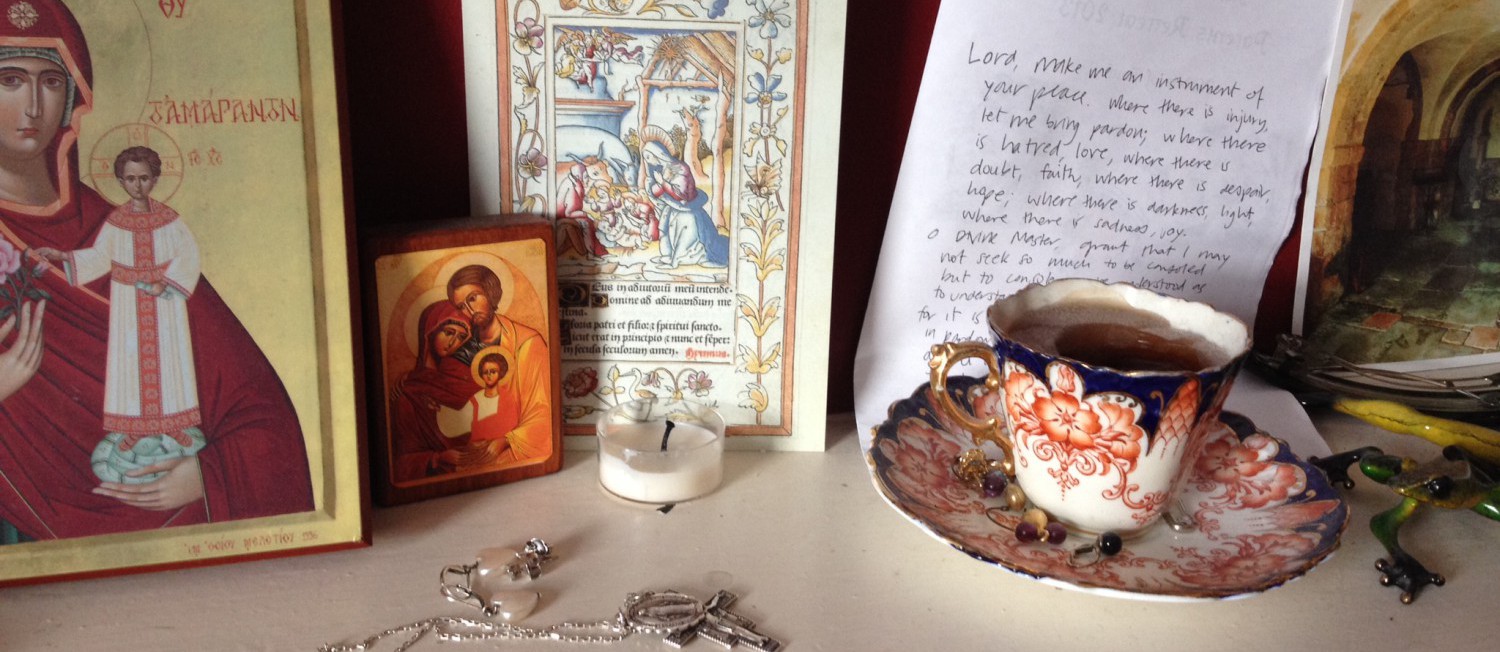
IMG_0001A few ordinary things: my miraculous medal, and my St Damian cross; the icon of the Holy Family I brought back from a very good weekend retreat in Minster…and the ‘peace prayer’ attributed to St Francis of Assisi.

Last September, I was on retreat in Minster with other parents of children with special needs. At the beginning of the retreat, we each received a word and a picture. My word seemed perfect: hope. But the picture, not so much–a photo of an arctic scene, icebergs in a dark blue sea, and two deer standing nose-to-nose on the frozen shore. Although the scene itself was austerely beautiful, I would have liked it better without the deer. Really. It’s the sort of thing meant to make you say, ‘Awwww…’ Cute. Not spiritually substantial. Still, I don’t believe in coincidence, so I hung onto my photo and filed the image in the back of my mind.

The next afternoon, feeling a bit directionless, I wandered into the library, and the name Manning leapt out at me. ‘Ah, Brennan Manning,’ I thought. ‘This ought to be good. Gritty, spiritually rich without being lofty or sweet.’ I read through to a lovely bit about the Christian journey. ‘Living in the wisdom of accepted tenderness is an unending adventure in trust and dependence!’ That’s my spirituality all right–it’s the inner journey that marks our deeds as having been ‘wrought in God.’

Encouraged, I skimmed on. During the retreat I was reminded of the rule I felt I needed to take on the last time I had been to the monastery: ‘never speak a harsh word to or about anyone, even internally.’ As you might imagine, I had failed miserably, and prior to the retreat had even failed to keep it in mind, much less obey it. Still, a wise priest once said in a homily that such commitments to God are not like New Year’s resolutions, which go forgotten once we’ve failed to keep them up. No, these promises we make to the Lord are meant to try us, and so we are likely to slip up, even to fail completely, as I had done.

The wisdom of accepted tenderness thus appealed to me. Tenderness is the opposite of harshness. I was resolving to take this up, this tenderness, as I read. The Lord is tender and compassionate, full of compassion and bottomless forgiveness. Discipleship means nothing less to me than the imitation of the Lord’s own tenderness.

Then I came across this passage:

‘Before finishing this book, the Christian who is serious about growing in the wisdom of accepted tenderness might do well to take the peace prayer of St Francis off the wall and hang it in [her] heart, make it the wisdom by which [she] lives:

Lord, make me an instrument of your peace. / Where there is injury, let me bring pardon; / where there is hatred, love; / where there is doubt, faith; /  where there is despair, hope; /  where there is darkness, light; / where there is sadness, joy. /    O divine Master, grant that I may not seek so much to be consoled as to console,  / to be understood as to understand,  / to be loved as to love;  / for it is in giving that we receive, / in pardoning that we are pardoned,  / and it is in dying that we are born again to eternal life.’

The peace prayer of St Francis? That saying that crops up everywhere?

Then two things clicked in my head, and the penny dropped. First, I already have a mini-devotion to St Francis, so more St Francis makes perfect sense. Each morning, as I put on my cross, I ask, ‘St Francis, pray for us.’ Well, this is his prayer. Maybe I ought to pray it with him. And I also–the second thing–remembered my photo: those cute deer, in what looks like a tender moment. Ah, well, yes. I was dismissive of the cute, of the ordinary, of the common. And the Lord is reminding me that it is in the ordinary and the common that my ‘rich spirituality’ is to be lived.

I confess that I do not always receive this well. I know that humility and obedience are the marks of Christian discipleship, but that always sounds so much better as an idea than it feels in lived experience. I can’t stop wanting to be someone, you know, significant. To be satisfied with the significance I have, to those in my little circle of family and friends, seems so small. And to go on in tenderness in daily life, well, it doesn’t really get you any respect, does it? I struggle with this. So one morning recently, I was struggling with exactly this, thinking about being not-harsh, about being nice, and something a friend used to say all the time came to mind: ‘Nice guys finish last.’

Yeah, I thought. See? See where it gets you? And then I did see, finally: that’s where you’re supposed to be. For many that are first will be last, and the last first. It’s a hard word. But I am grateful for it, anyway: Deo gratias.
 

Easter Saturday

Give thanks to the Lord,
 for he is good,
for his love has no end.

The Lord’s right hand
 has triumphed;
his right hand raised me up.
I shall not die,
 I shall live
and recount his deeds.
                           Psalm 117

.       .      .

Some days this is the heart’s cry: God has triumphed, and the soul rejoices. The evidence of God’s goodness is obvious and close at hand. Even the senses seem to attest to God’s goodness, as the psalmist elsewhere exclaims, ‘Taste and see that the Lord is good!’

And then there are those other days. On those days, the objective truth of God’s goodness remains. It is, after all, Easter week. The triumph of the Lord is–or should be–obvious and close. But, though even the heart knows the truth of God’s victory and the extent of God’s goodness, the joy and gladness do not seem to follow.

On those latter days–I admit that today is one of those–I am grateful for liturgical seasons and appointed feast days. Holy days of obligation are a gift to me, and the psalms set for Mass and for the daily office make way for me to give thanks to the God of heaven, the One who raised Christ Jesus from the dead.

I am not blessed with a constant experience of the joy of my salvation. Would that I were, that the happy praise of the Lord were always on my lips and in my heart. But I am low some days, downright glum. But that doesn’t change anything about who God is, or how right and just it is to praise the Lord ‘always and everywhere.’ Tomorrow, I will join the rest of the congregation in the alleluias and amens, and happily so: for the company of the faithful supports me (however little they may be aware of it) simply by offering that praise and inviting me to join in. By their presence, they testify to the truth I know, that the Lord has called us all out of darkness and into his marvellous light.

For that, I am glad–truly and deeply glad–indeed.

Deo gratias.

Good Friday

The Easter triduum has begun: last night we went (as a family!) to the Mass of the Lord’s Supper. Although the liturgy is not ideally suited for toddlers, the foot washing was fascinating. What on earth was fr Ben doing? The children were intrigued. Even the little one–restless as she often was–managed to be quieter than usual. But the most astonishing performance among the children was Thomas’s. Serving on the altar during Holy Week for the first time, he was more still and attentive than ever before. The book, resting against his head, barely moved–even during the intercessions. His eyes were frequently fixed, wide with wonder, on what was going on in front of him. Maybe it was in part because he was the only kid up there, serving with two liturgically-minded adults, and with lots to do.

Today’s liturgical event will be of a very different character: our Faith and Light group organise the Stations of the Cross. Now it will be Anna’s turn to take part in the action as we move around the church this morning. The liturgy is abbreviated, and simplified; there is that tinge of joy even in the midst of a solemn occasion, which is one of the hallmarks of Faith and Light as it is of L’Arche. We will remember the cross of Christ and be aware of our own brokenness, and in the midst of it will be aware that sorrow does not have the final word. My reflection on the Good Friday readings centres on the cry of Jesus from the cross, as Mark’s gospel has it–a more traditional, I suppose, Good Friday meditation.

But now my toddler calls, and it is time to go.

Good Friday

Surely he has borne our griefs and carried our sorrows;
yet we esteemed him stricken, smitten by God, and afflicted.
                          (Isaiah 53: 4)
…my kingship is not from this world.
                           (John 18.36)
Abba Hyperichus said, “The watchful monk works night and day to pray continually: but if his heart is broken and lets tears flow, that calls God down from heaven to have mercy.”
*            *           *
That’s what today is about: he has “carried our sorrows.”  On the cross, Jesus takes on all the sorrows of the fallen creation, of fallen human creatures. And Mark’s gospel records Jesus’ call from the cross, “My God, my God, why have you forsaken me?” So cries the broken heart for the God who alone can heal. But Jesus’ broken heart calls God down from heaven to have mercy on us all. His heart is the one heart that can break for the whole world and so heal the whole world.
When we are broken hearted over our own sins, when we feel that grief, we participate in Jesus’ grief on the cross: he took our sorrows, our grief, and now we only experience it properly as we participate in him.