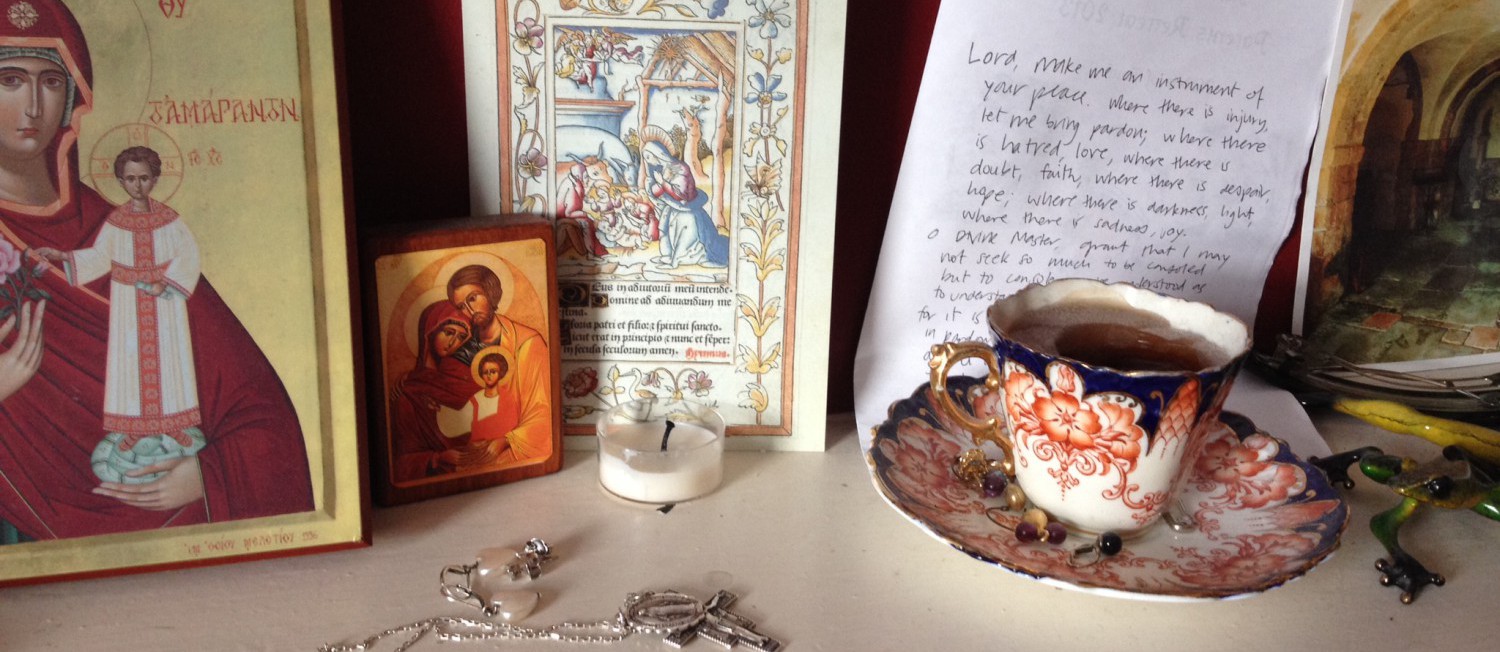
Tuesday of the 29th week in ordinary time / Blessed John Paul II

You do not ask for sacrifice and offerings,
     but an open ear.
You do not ask for holocaust and victim.
     Instead, here am I.

                                             Psalm 39 [40]: 7

.        .       .

‘Instead, here am I.’

Just letting that sink in… I often find it quite easy to get caught up in the complicated and flashy things I think I ought to do as a Christian theologian. You know, books and articles I ought to write, and the spiritual and mental toughness I ought to develop in order to be the person who can write books and articles, and give lectures, and still remain as humble as St Benedict says I should be.

Yeah, right. There is something completely naked and vulnerable about that statement: ‘here am I.’ Just me, nothing fancy. No extravagant sacrifice, no spectacular holocaust, just the handmaid of the Lord. I always liked the spectacular holocaust: Elijah vs the prophets of Ba’al (I Kings 18) has always been one of my favorite Bible stories, since I was a child. It’s like fireworks from heaven, and the good guy wins in a show of light and power. But that’s not what it is about at all. It is about the open ear that the Psalmist identifies as the real sacrifice, the real offering to God. God requires of us nothing more and nothing less than our attention, wholly fixed on him.

The bit about Elijah’s showdown with the prophets of Ba’al in I Kings 18 that my mother didn’t relate to me when I was little, is the part where the prophets of Ba’al entreat their god, who doesn’t seem to be listening. “So they cried with a loud voice and cut themselves according to their custom with swords and lances until the blood gushed out on them” (18: 28). Not only do they harm themselves in their endeavor to get Ba’al to respond to them, but they do so in vain. There is no response. Elijah, on the other hand, calls on God to answer, “that this people [Israel] may know that you, O Lord, are God, and that you have turned their heart back again’ (18: 37). The return of God’s people originates with God: God responds with fire to demonstrate that he has already rekindled the hearts of his people. It is not what the people do to get God’s attention that is the heart of the drama, but what God does to get their attention, to get our attention.

When I present myself, fragile and fallen as I am, God does not ask for my blood. When I come before God having done the wrong thing, or the right thing for the wrong reasons, or having done nothing when I ought to have acted, God doesn’t ask for my blood. God has already acted; it is only by the Spirit’s encouragement that I return at all. When I say “here am I,” it is because God has called me first, and even as I ask for forgiveness and the strength to walk in it, I do so because that grace has already been extended to me. That grace alone makes me the handmaid of the Lord, ready to do his will.

God does ask for my life, to be sure, but that is only so that he can give it back to me, in abundance. And then when I say the “I” in “here am I,” it is no longer I who live and speak, but Christ who lives and speaks in me, giving my life as he gave his, to the Father for the sake of the world’s salvation.

And that is an extravagant gift indeed.

Deo gratias.

The Trinity for toddlers, part 2

Teaching theology affords an incredible opportunity to see how people cope with a doctrine that resists the intellect's instinctive attempts to solve it. It is not, as theologians like Rowan Williams and Thomas Weinandy (two very different thinkers, to say the least) have observed, a puzzle to be solved, but a mystery to be pondered. It's a mystery. Rowan Williams says, drawing on the resources of Eastern Orthodox theology, that 'the doctrine of the Trinity is a crucifixion of the intellect.' So it isn't surprising that students of theology, whether giving the lectures or hearing them, find it difficult.
 
But it doesn't crucify the intellect to no purpose, nor is it the most difficult of the mysteries of the faith. We might think that Jesus is the answer, but he raised a whole lot of questions for a few hundred years. The incarnation and the atonement present us with mystery just as irreducible as the Trinity. The intellectual life of the believing soul involves contemplating the truths of the faith while holding fast to the knowledge of God's ultimate incomprehensibilty. And nowhere is this more true than in that most difficult, deal-breaking area of theological reflection that we call theodicy. The problem of evil is not, like the Trinity might be, a stumbling block just for the intellect. It confronts us when inexplicable and unjust things happen to us or to those we love, things that make us turn to God in confusion, wondering how a God who is omnipotent and perfectly, completely good, could allow such things to happen. I understand how it ends up being a deal-breaker.
 
I used to wonder why I still had my faith, after all I did to lose it, and after it was challenged by my experience of life. Eventually I came to see that it wasn't 'mine' to lose, really: it is the faith of the Church, and I participate in it, I don't possess it. But that doesn't explain why I am still hanging around. Probably I owe that to my mother, who taught me lots of songs about Jesus when I was small. They're not the sorts of songs that survived the 1980's, but they impressed upon me a certain understanding of Jesus, one that stayed with me. The core of what I think about Jesus was formed before I was old enough really to be puzzled about how someone could be fully God and fully human.
 
So I am really glad that when my small son asked me, 'Who is God?' I answered with reference to the Trinity, with the sign of the cross, with the name of the Father and the Son and the Holy Spirit. I could have answered, as I supposed might be more practical, with something about God as the creator, or God as love. These would have been good. But at age three, my son never asked how the one I called God could also be called the Father, the Son, and the Holy Spirit. It isn't like we grow up and suddenly the penny drops, and we grasp how three can be one, how one can be three; we don't mature intellectually such that if we wait long enough to introduce these difficult concepts, we will be able to understand them. Better to get used to a name that names something we don't understand from the get-go, and grow into appreciation of the mystery as we develop intellectually and spiritually.
 
Now I can imagine lots of objections to that, but they will have to wait for another day.

The Trinity for toddlers

When my son (who is now 10) was about three and a half, we were having one of those conversations that consisted mostly of his questions and my answers. 'Where was I when…?' he would ask. Eventually, he got around to asking about something (I can't remember what) that happened well before he was born. 'You weren't born yet,' I said. 'Was I in your tummy?' he asked. 'No,' I replied–though I suppose technically he was half there, potentially, or something like that. But he wasn't really interested in the physiological details. 'Well,' he said, maybe a bit impatiently, 'where was I, then?'
 
Good question. I thought for a moment, and did a mental heresy check. What do you say about the pre-existence of souls? He's only three, but still… 'If you were anywhere,' I said, hoping he wouldn't press too hard about that particular question, 'you were with God.' I was thinking that the tough question was about the pre-existence of souls, and worried that I didn't have as good an answer as I would have liked to the possible follow-up question. I didn't. But it wasn't about the pre-existence of his soul or anyone else's.
 
'Who's God?' he asked.
 
Not the question I was expecting. And I was completely unprepared for it. In a split second, I thought, I teach theology. I ought to have a ready answer to this one, and it should be pretty good, too. I had no ready answer, no good answer; in fact, I had no answer that I could give to my three and a half year old. Fortunately, though, the Spirit not only intercedes but also inspires. Without any hesitation that might betray my total lack of preparedness for the question, I said, 'You know in Mass, when we say, “in the name of the Father, and of the Son, and of the Holy Spirit”?' as I made the sign of the cross. 'Yeah,' he said, in a way that communicated a certain suspicion about what that might have to do with where he was sometime prior to January 2003. 'Well,' I said, 'that's God.'
 
And he just nodded. I have never been more relieved not to be pressed in a q & a in my life. No 'so, are you saying that…?' or 'but what about…?' Somehow the answer I gave, which seemed to me to answer the question in a pretty abstract and not very kid-friendly way, worked for him. It worked for me, too. I was really glad I had given an answer that was Trinitarian and personal rather than functional. I didn't say that God was the one who did this or that; I didn't even say anything about Jesus. My son asked me 'Who is…?' and I gave him three names, and he was ok with that. He didn't ask how the three were God, or whether I was saying that there were really three gods, or anything like that.
 
Now, I imagine that this isn't what Sunday school, vacation Bible school, or any sort of catechetical materials suggests for this particular age group. Jesus probably plays better to this audience, and probably so does the God who created everything that is. Probably. But maybe that's just me. Obviously my son couldn't have explained how 'Father, Son and Holy Spirit' named 'God', but then I find it challenging as a grown-up explaining it to other grown-ups. And my job title (for which I have the requisite qualification) is Lecturer in Theology and Ethics.
 
Maybe toddlers are more ready for the Trinity than I thought.


Wednesday of the 27th week in ordinary time

Happy indeed is the one
     who follows not the counsel of the wicked;
nor lingers in the way of sinners
     nor sits in the company of scorners,
but whose delight is in the law of the Lord
     and who ponders his law day and night.

She is like a tree that is planted
     beside the flowing waters,
that yields its fruit in season
     and whose leaves shall never fade;
     and all that he does shall prosper.*

                                              Psalm 1

.          .          .

Nobody hangs out in the company of sinners, at least not ‘sinners’ as the psalmist imagines them. We can admit that we are all sinners, all fallen short of the glory of God. But the active, really-bad-stuff-doers are rarely our regular dinner companions. Maybe they should be.

But scorn? Is that really as bad as the real-bad-stuff (whatever you or I imagine that to be)? My mind stuck on that word this morning, probably partly because I had just read a blog post that included a bit of advice about gossip: don’t do it. (Shock and dismay! Reading facebook updates and blog posts before the Holy Scripture! Provdential, I call it.) I thought about the numerous ways in which I am complicit with scorners, even when I am not actively scornful.

I know I am guilty of this. As deeply as I want to be gentle and encouraging, I know that I am easily amused by a derisive remark. I find contemptible all sorts of things and situations, whether or not I say so. And I am dismissive, too dismissive, of that which I regard as unworthy of my notice. I do not just sit in the company of scorners–I should be numbered among them.

And it really is as bad, just as bad, as the content we give to the (really reprehensible) sinners. I miss things I should see and hear, I avoid that which deserves my attention, just because it doesn’t come in the package in which I expect to find it. All those things that are said to be ‘trite but…’ Never mind: I stopped listening at ‘trite’.

Half of me still protests: you’re not that bad; really this is not such a big deal; you’re making something out of nothing. That may be so, but only because too often I make nothing out of something. Or, worse, I make nobody out of somebody–somebody who deserves my attention, not because she’s pretty or intelligent, not because he’s clever or spiritually astute.

I saw this on facebook this morning and smiled. Shared it. Seeing Jesus behind the hat, playing the accordion, raising money to go to Africa, selling the Big Issue–done. But there are a whole lot more places I ought to see Jesus, and don’t: in the head teacher, the driver in front (or behind), the neighbor who shouted at me, the person who just said something I thought was obvious, obnoxious, silly, self-promoting.

Fortunately, Jesus lingered in the way of sinners, and did not shun the company of scorners (though they seem not to have sought his company much)–even this one.

Deo gratias.

*Yes, I played with the translation a bit: ‘the man’ became ‘one’; the first ‘he’ became ‘she’, and I left the last ‘he’ on purpose.

with angels and archangels

We never had a plan for taking the children to Mass, beyond taking them to Mass. I've read the strategies of really organized parents, in awe of their attention to detail and advance preparation. I am not that organized, and I take full responsibility for that. If walking around outside with the toddler is what it takes, then that's what we do. And we have had some pretty unpleasant moments with the children during Mass.
 
I remember going to church with my mom when I was a child. We always sat in the front row (effective, I think–at least there you're bound to notice something, as my kids sometimes do). She gave me lifesavers, tropical fruit flavor, which were really quite effective. (Banana and coconut were my favorite.) My kids don't particularly like sweets (which is otherwise great), so that's not really an option for me.
 
As they get older, the still-and-quiet routine gets easier. Getting them really to attend to what's happening, though–that's another story. One Sunday recently Iain (just before he turned 7) dug my iPhone out of my bag and started playing can knockdown during the liturgy of the Eucharist. However displeased I was, I wasn't willing to incite loud and angry protest in the front row. So he might have looked like he was kneeling piously….but no.
 
That's not to say I don't have certain hard-and-fast rules. Everyone stands and says the Our Father. And that makes me happy. (Honestly, it does.) I am always trying to strike a balance: on the one hand, I want the children to begin to grasp the significance of what's happening; on the other hand, I don't want to make the experience of going to Mass into an hour-long prison sentence every Sunday. And I find myself holding in tension the need to express my own spirituality by engaging with the Mass, and the need to attend to the children, who are engaging on a very different level.
 
Sometimes I fail. (Shocking, I know.) But those moment are the moments when I am most grateful for the liturgy of the Catholic Church. Last Sunday, between policing Iain on the iPhone and discouraging Anna from trying to engage the kids behind us in conversation, I completely lost track of where we were…until suddenly my attention was grabbed again, just in time to join in the Sanctus: '…with angels and archangels…'
 
Joining in. That's what it is about. It is about taking part in the ongoing praise of God that happens in eternity, for eternity. Not about perfectly behaved children, or about the quality of my singing (I'm terrible). I think some weeks I depend completely on the angels and archangels to glorify God, as I am working to keep my children from storming the sanctuary. 'Look not on our sins, but on the faith of your Church…' indeed: the faith of the Church, like the liturgy, does not depend on me. It is. However focused or distracted I am, the worship happens, the Mass happens. Knowing that is incredibly humbling as it is freeing.
 
In his 1947 encyclical Mediator Dei, Pope Pius XII wrote:
Jesus Christ burned with zeal for the divine glory; and the offering of His blood upon the cross rose to heaven in an odor of sweetness. To perpetuate this praise, the members of the Mystical Body are united with their divine Head in the Eucharistic sacrifice, and with Him, together with Angels and Archangels, they sing immortal praise to God and give all honor and glory to the Father Almighty (71).
 
'Zeal for the divine glory' seems pretty far from many of my Sunday experiences. If I am burning with anything, it is probably way less holy than that. But I know that's what it is about: participating in the self-offering of the Son to the Father, in the Holy Spirit. All we do is respond to the love of God as it comes to us through Jesus. And even our response is helped by the Spirit (my attention just happened to be drawn back to the liturgy at the Sanctus…).
 
Deo gratias.
 

St Vincent de Paul

O send out your light and your truth,
    let them lead me;
Let them bring me to your holy hill,
And to your dwelling places.
                                              Psalm 42 [43]: 3

This is one of a set of two psalms, which, with their refrain (“Hope in God, for again I shall praise him, the help of my countenance and my God” [NASB]) ,were the core of my spiritual life for a large part of my twenties. Despair often settled on me, and I found myself asking “Why are you downcast, O my soul, and why so disquieted within me?” along with the psalmist. “Disquieted” seemed like the perfect adjective to describe my soul a lot of the time. I was grateful for the psalmist’s response to his own soul, and repeated it to mine: “Hope in God…” Honestly, this psalm and a handful of others kept me going when things seemed bleak.

During those years, I was too unsettled to see the direction of the psalm, beyond my soul’s hope, to the hope of the whole world. The psalmist cries out, “O send out your light and your truth, let them lead me,” and so he has. His Light and his Truth came to dwell among us in Jesus. And that holy hill, where God dwells, is also the mount of crucifixion. God is there, too, even as God was there–closer to me than my own soul–during the darkest and most difficult times. It was not for nothing that I encouraged my soul to “hope in God.”

Twenty years ago, I was helped by the psalms; now I am also helped by the saints, those who have followed God’s Light and Truth before me. Today we remember St Vincent de Paul, who devoted his life to helping the poor, and reminds us that “the Lord takes delight in his people; he crowns the poor with salvation,”and that God’s Light and Truth became poor for our sake, that again we might praise him.

Deo gratias.

Wednesday in ordinary time

I give him thanks in the land of my captivity, 
     and I show his power and majesty to a nation of sinners.
                                                                           Tobit 13: 6

.          .         . 
There is a video that has been making its way around the internet: “Scientists discover one of the greatest contributing factors to happiness.” I was curious about the thing that increases happiness (despite the slightly awkwardly-placed modifier)–who wouldn’t want to find out what she could do to be happier? Laughter, I thought, maybe.
I was surprised to find that (in case you haven’t seen the video) what increases happiness (between 4 and 19%, according to the guy in the lab coat) is expressing gratitude. Immediately, I thought of a verse from one of my favorite psalms:
I know all the birds of the air,
    and all that moves in the field is mine.
 “If I were hungry, I would not tell you;

    for the world and all that is in it is mine.
Do I eat the flesh of bulls,

    or drink the blood of goats?
Offer to God a sacrifice of thanksgiving,
   and pay your vows to the Most High;
and call upon me in the day of trouble;
   I will deliver you, and you shall glorify me.”
                                               Psalm 49 [50]: 11-15

So the ‘science’ reminded me of something I already knew: giving thanks is a balm for the heart. And Tobit seems to have known it, too. He doesn’t say, “I give thanks because God has rescued me from captivity”; he gives thanks in the land of captivity. Some days I get stuck between the joys and duties of motherhood and the joys and duties of my life as a (sort of) academic theologian. I love what I do in both roles. I am living two dreams, really, doing what I always wanted to do. So on those days when the tension between motherhood and career seems like captivity, I know what to do: give thanks. 

Deo gratias, Deo gratias. 

Remembering why I like Karl Barth

Karl Barth

Barth writes:

Revelation itself is needed for knowing that God is hidden and man blind. Revelation and it alone really and finally separates God and man by bringing them together. For my bringing them together it informs man about God and about himself, it reveals God as the Lord of eternity, as the Creator, Reconciler and Redeemer, and characterises man as a creature, as a sinner, as one devoted to death. It does that by telling him that God is free for us, that God has created and sustains him, that He forgives his sin, that He saves him from death. But it tells him that this God (no other) is free for this man (no other). If that is heard, then and not till then the boundary between God and man becomes really visible, of which the most radical sceptic and atheist cannot even dream, for all his doubts and negations. Since the boundary is visible, revelation, which crosses this boundary, is also visible as a mystery, a miracle, an exception. The man who listens here, sees himself standing at the boundary where all is at an end. Whichever way I look, God is hidden for me and I am blind to Him. The revelation that crosses this boundary and the togetherness of God and man which takes place in revelation in spite of this boundary, make the boundary visible to him in an unprecedented way. No longer need he yield to deceptions regarding the cosmos of realities that otherwise encounter him. This cosmos will lose the power to prepare for him either illusions or disillusionments. He knows all about it. Not because he has supplied himself with information about it by intuitive or analytico-synthetic means, but because he has been informed about it. But this information is, that among the realities of this cosmos there is not one in which God would be free for man. In this cosmos God is hidden and man blind. Once more, it is God’s revleation which gives him this information. That it does so is its critical significance. By that very fact, however, the further question is thrust at us: how far is God free for us in revelation?  No less than everything, i.e., no less that the whole of man’s cosmos, seems to speak against this possibility taking place. Even if it is ever so great and rich, as it actually is, how could one of its realities have the power to be God’s revelation to man? Once again, man would have to leave the real revelation of God out of account; he would have to forget that he is informed about God and about himself, if he is to assert boldly the presence of such a power as one of the realities of his cosmos…

If he were looking steadily at the cross and the resurrection of Jesus Christ, he could not look in any other direction, neither could he any longer allow talk about such possibilities to pass his lips or to flow from his pen.

-II/1, pp. 29-30

I admit that I haven’t missed the lack of inclusive language, which distracts somewhat (for me, at least) from the text. But I love the way that Barth characterizes revelation: it hides as much as it reveals. As I am preparing to teach on the Incarnation (not till February, I confess), I have been looking for the right passage(s) from Barth, in which he makes explicit this reality of the Incarnation. All is revealed truly, and at the same time all is hidden in Christ. It’s no wonder Barth kept repeating himself (as he himself says elsewhere in the volume): again and again he returns to this center of theological reflection, this singularity, because he knows there is only one place from which we can do theology, and that is the foot of the cross.

Syria and St Augustine

A few weeks ago, my heart turned toward the situation in Syria in a new way. I thought: I don’t know very much about Syria, and I am neither politically nor militarily savvy. But I know that if my kids were fighting, and the stronger one(s) hurt the weaker one(s), my first move would be to attend to those who were hurt and keep the others away from them until I could sort it out. I was really worried about the prospects of a US military strike. On the same day, which just happened to be the feast of St Augustine, Lewis (who is much more knowledgeable about such things) offered the following: ‘…if we were prepared to do the dirty and get lots of boots on the ground and establish protected areas for civilian refugees with decent medical care inside Syria, I would say ‘great’. But this, no boots just bombing the bad guys so the bad guys can take over don’t seem wise. Damn, this is enough politics on facebook for about a year! As you know my attitude toward Turks and the French leaves much to be desired, but let’s hear a word for the Ottomans and for the French mandate after WWI. {Admitting that he isn’t against bombing in every case, he added:]  I’ll own up to the campaign in 2001 in Afghanistan and the 1999 NATO bombing of Serbia as examples where (horrific as it of course was) it seemed to do the job. It’s a fallen world folks: Saint Augustine, pray for us.’

I was encouraged: if it isn’t just the mama in me talking, if this ‘looking after the injured’ is something that makes sense to someone like Lewis, well, maybe there is hope. But as the US moved towards a military strike, I faltered. What will become of Syria? and what will happen to the world? Even Jean Vanier, with whom a (nun) friend of mine had spoken last November, echoed what Lewis said: it’s a fallen world; these things happen.

In the most technical and articulate language: bummer.

So when Pope Francis called for prayer and fasting for Syria on the 7th of September, my heart leapt. Yes, I am that sort of person. I thought prayer (St Augustine’s and ours) was a clear and practical step in the right direction. I happened to be on retreat last weekend, which afforded me far greater opportunities for prayer than a Saturday at home would have, from vigils to compline, with an extra hour of adoration after vespers. I’ve no idea what I thought would happen; indeed I had no idea of what would count as an ‘answer’ to prayer.

On Monday, Lewis was in the kitchen criticizing Obama, for having had to change course in the face of Putin’s intervention. Stepping back made Obama look weak. I didn’t say anything at the time, but I did wonder: ‘But doesn’t it make God look strong?’

Maybe it is to the credit of Christians everywhere, who’ve prayed for Syria, and who joined the worldwide prayer vigil last Saturday, that no one is celebrating the triumph of our God. I’ve not heard a soul claiming that this change in the situation is an answer to prayer. But I see hope where before there seemed to be no hope, and in my experience, only God can do that.

I will keep praying for Syria and for the middle east, with hope in my heart, and giving thanks to God.

Deo gratias!

On not attending the conference

 I missed a good paper yesterday: “The Word Answering the Word: Opening the Space of Biblical Interpretation” at the Edinburgh Dogmatics Conference. Fortunately I have a copy of the paper to hand, and have read it sitting in bed to the sound of Lucy’s breathing as she sleeps next to me. No small talk, no feeling inadequate because I haven’t read that book, or that one either…or published a raft of peer-reviewed articles. This is the best–the very best–of both my little worlds. And I will even get a chance at some Q & A with the author of said paper: Lucy’s daddy.
My first question: “Don’t I remember you talking about Joseph Ratzinger’s concept of tradition in our kitchen in Atlanta?” Really. That’s my opening question, partly because I found the paper thought-provoking and not suspicion-arousing. But, more importantly, I will ask that question (probably in the kitchen) because it tells me something really important about scholarship. I think sometimes that my husband devours books and churns out essays. That’s true, but the essay-churning–if I am right about the conversation at least four years ago in our kitchen in Atlanta–lags significantly behind the book-devouring. Percolating happens.
That’s hopeful. Really hopeful. I don’t devour books, I glide over them like a glacier. And I only churn out to-do lists these days…and Christmas cards, when the time comes. Essays? Not so much. I think about things; I dream of papers I’d like to publish, books I’d like to write. Sometimes I make lists of those, too… But I find all the small spaces in which Lewis seems to get so much done completely occupied. My interstitial spaces, those odd moments in which I might read a few pages or jot down notes, are the spaces in which school uniform is ordered, birthday parties are planned, online Christmas shopping begins, a chore chart is devised, school supplies are organized, and Lucy’s clothes are sorted–she’s grown out of that and that and that…what does she need now? I store information about shoe sizes and coat sizes, teachers’ names and school holidays, doctor appointments and childcare arrangements. Neither in my head nor in my weekly schedule do I find time to divert to scholarship. I know, because I tried for several weeks to take an idea and make it into an essay, using those in-between times. The number of balls I would have had to drop was completely unacceptable.
That’s neither a complaint nor an excuse. It just is. So the idea that percolating is a part of the process for everyone does give me hope. Because one day I won’t have to choose between reading the paper next to my sleeping toddler, or going to the conference to hear it. I will have more time to read slowly and write slightly less slowly. But I won’t get to choose between my 2-year-old (and my 11-year-old, my 9-year-old, and my 6-year-old, for that matter) and some conference or other. Conferences will come again, year after year. But that little sigh I just heard will not be the same the next time the Edinburgh Dogmatics Conference comes around.
All the same, I am glad I had a chance to read the paper. It really is quite good.