the holiness of the Lord

(from the second Sunday in Lent: I am catching up…)

Isaiah6

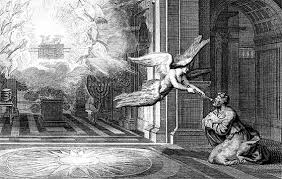
The scene that follows the announcement ‘holy, holy, holy’ is dramatic: ‘the foundations of the thresholds shook at the voice of him who called, and the house was filled with smoke’. Isaiah’s response is not worship, as we might expect. Instead, he exclaims, ‘Woe is me!’ Seeing the holiness of the Lord makes Isaiah aware of his own lack of holiness, and fearful: ‘a man of unclean lips’ should not (he thinks) behold ‘the King, the Lord of hosts’. God’s glory shows up all that is unworthy about us. Similarly Peter, in the gospel reading from a few weeks ago, responds to the miraculous catch of fish: ‘Depart from me, O Lord, for I am a sinful man’. Beholding the greatness of the Lord brings about a new, and unsettling, revelation of our own lack of sanctity. The response from on high is not judgment, however, but comfort. One of the seraphim brings a burning coal from the altar, touches Isaiah’s lips with it, and announces, ‘Behold…your guilt has been taken away, and your sin forgiven’. Likewise Jesus reassures Peter (in the same words the angel used to put Mary at ease): ‘Do not be afraid.’

Contemplating the holiness of God ought to make us mindful of the ways we have sinned and fallen short of the glory of God. This is not the way into condemnation, though, but the door to forgiveness and new life. For both Isaiah and Peter, the recognition of his own unworthiness marks the beginning of a career (if we may call it that) in the service of God. Isaiah accepts the invitation to take God’s word to the people of Israel, and Peter becomes that rock on which the Church is built. Our own careers of discipleship may be less dramatic, but God nevertheless promises to draw us near and involve us in the real drama—the drama of our redemption and that of the whole world. We need not ask whether we are worthy; we need only allow God to make us so.

With angels and archangels

This Lent, I am writing a series on the Sanctus for my parish newsletter. Although I do sometimes wonder whether anyone reads the back of the bulletin, a few people have been kind enough to remark on the short pieces. (I did a series on the creed in the autumn.) Here is the first installment (printed for the first Sunday in Lent):

During Lent, we direct our attention to the holiness of God more than at any other time of year. Not only that: we strive to imitate that holiness. One of the ways the Church has called the holiness of God to our minds comes from the sixth chapter of Isaiah: the prophet sees the seraphim, who call out to one another: ‘holy, holy, holy is the Lord of hosts; the whole earth is full of his glory.’

The acclamation has been a part of the Church’s liturgy since the early part of the fifth century, though it was probably in use from even earlier times. (The ‘Benedictus qui venit…’ was attached to the acclamation very early, and in future weeks we will look more closely at it.) For example, St Augustine would recognize the Latin text we sing, although the traditional Gregorian plainchant would not have been familiar to him. (What we rightly consider ancient—dating from the 8th century and widespread by the 11th—had not yet been developed in Augustine’s day!)

It is not just the antiquity of the text that ought to inspire us, however. The inclusion of the Sanctus in the Roman canon in the 5th century brought in the idea ‘that by joining the angels in their song we participate in the heavenly liturgy’ (Enrico Mazza, The Eucharistic Prayers of the Roman Rite, p. 48).  And this provides an important clue to the means by which we imitate the Lord’s holiness; by participation. All our Lenten practices—prayer and giving, and giving up—do not work magic on their own. Rather, by them we join ourselves to the Lord’s suffering. It is his passion and death that worked for our salvation, and in his resurrection that we are raised to new life. So in all that we do this Lent, our aim is to make more space for our Lord, so that we can say with the apostle Paul, ‘it is no longer I who live, but he who lives in me.’ When we attend to the presence of God among us and in us, and we participate in him as he dwells in us, holiness will be ours as well.


Not making sense

One of the things I’ve written about a bit is ‘making sense.’ It is, or so I argue, one of the themes of the theology of Rowan Williams. Theology isn’t in the business of giving definitive answers to difficult questions about life and death and God, but about making sense of ourselves and God in the light of Christ and in the situation in which we find ourselves. We do the best we can–theologians and non-theologians alike.

Sometimes the best we can do falls short of ‘sense,’ insofar as sense means finding the ‘reason’ implied in the saying, “everything happens for a reason.” (By the way, the most convincing reason I have ever seen is “physics.”) To say I enjoyed reading a piece by Kate Bowler in the New York Times today is perhaps not quite right. In “Death, the Prosperity Gospel, and Me,” she talks about the intersection of her life experience (being diagnosed with stage 4 cancer) and her academic work (on the history of the prosperity Gospel). Her husband’s response a neighbor’s suggestion that “everything happens for a reason” cuts right to the heart of the problem. “I’d love to hear it.”

Of course, the neighbor had no response to that. Who would? Some things don’t make sense. When, as a (somewhat idealistic) 24-year-old, I suggested that there might be a way of solving the problem of evil, my professor asked me, “If there were a reason for the holocaust, would you want to know it?” That professor was Miroslav Volf, who inducted me into theology. I’ll always be grateful for that question, though of course at the time I didn’t realize how long it would stay with me. When a woman in her thirties is diagnosed with Stage 4 cancer, there is no reason that would be reason enough. There can be, this side of our final redemption, no justification for the pain and loss.

The temptation is always to make sense of things that refuse to submit to our powers of interpretation. We long for the answer to our plaintive, ‘why?’ And it doesn’t come. I hate that. But I would hate the answer even more, I think. Why does my daughter have Down Syndrome? Plenty of good has come of it, yet none of that justifies the difficulties she has faced and will face in her life. There is no reason that is reason enough. 

I wish I knew what to say–for I have a friend, a bit older than Kate, who is also dying of cancer. Maybe more slowly, but certainly. A former student, only 30, died last year. I know just one thing, and that is that I am grateful for Kate and all those who narrate some piece of the journey, because that is the way I too am going. I may be a little behind or a lot, but I am on the same road. Death is a part of life, and we cannot live fully without it.

Thank you, Kate. Thank you, Jess. Thank you.


Being human, part 3: the spiritual life

I’ve been thinking a lot about the spiritual life lately. Not, of course, that it’s ever too far from my mind. As a teacher of those preparing for ordained ministry, I always considered the pastoral and spiritual implications of the theology and ethics I taught. And as a person of faith, I have found the spiritual life an integrative force in my life, which often seems like a patchwork of roles and responsibilities and hopes and disappointments. Woven through the various scraps of fabric, there is this sense of purpose that draws in everything–yes, everything–and orients it toward a bigger-than-I reality.

Although my recent thinking about spirituality has been inspired by the situation of women in colleges and universities and the challenges facing them, I’ve been struck deeply by the universality of our need for spiritual well-being. An article by David Morstad, over at The Larger Table, points out that people with significant intellectual disabilities have as great a desire and need for spiritual nourishment and community–if not greater–than those with greater cognitive abilities.

A sense of spirituality–which might be as simple as the notion that there is a reality bigger than we are, that holds us and draws us forward–seems fairly standard and unobjectionable. The category of folks who consider themselves ‘spiritual, but not religious’ attests, I think, to this foundational place of spirituality in our lives. But that isn’t to say that ‘spirituality’ is somehow what religion is really about, or that the practice of any sort of religion or spirituality is the same.

What our various approaches to religion and the spiritual life should teach us, I believe, is not that religions are all the same, or even that ‘religion’ is a thing that means the same thing to people who practice different religions. Rather, our continuing openness to faith and spirituality, and the persistence of faith-based values within our society, ought to remind us that, however much divides us, there is much that we nonetheless share. Being human involves forming a view (insofar as our capacities allow us to do so) about what it is to be human, and this is a task that involves a great many of us in spiritual reflection in addition to philosophical and scientific study.

As Lent begins, Christians around the world pay renewed attention to the life of the spirit.  I hope that this Lent will be a time when the universality of our need for grace also awakens in me a deeper awareness of the unity of the human family. After all, Jesus’s prayer for us as he entered into his suffering was that we might all be one. May it be so.

Deo gratias.


a natural death?

Pro-life, a label I wear with some hesitation sometimes, means treating human beings as sacred from conception to ‘natural death’. Conception is pretty straightforward. But ‘natural death’? What, in a world in which our lives can be prolonged by a host of machines, counts as ‘natural’ with regard to our death? This is not a post in which I am going to say what I know. I don’t know very much. Once again, I have been reading the account of someone who has been there: Dr Louis Profeta. He questions the methods and machines employed to keep someone alive merely to push death back a bit: ‘while we are developing more and more ways to extend life, we are also providing water and nutrients to a forest of unrealistic expectations that have real-time consequences for those whose frail bodies have been entrusted to us,’ he writes.

My hunch is that partly this phenomenon arises from the same set of circumstances that inspires and sustains the movement to fight death, to keep death as far away from ourselves as possible, for as long as possible. Death has become to us anything but natural. We have forgotten death’s intrinsic place in human life. It is the end, and absolutely belongs together with the beginning in our imaginations: life has both, and we should work to understand and embrace the end as much as we have considered how to identify and protect the beginning.

Human beings may have figured out ways to prevent life’s beginning (whether we use them or not). But we are not going to prevent its end. We may as well make friends with death, and so recognize it as a familiar face when it comes to claim us for its own–whether we think of it as the end or as a new beginning.


Dying right? another look

Several weeks ago, I reflected on a moving and thought-provoking account of a woman’s experience of her father’s suffering and death. End-of-life issues are difficult–I recently wondered aloud to a colleague about what we have lost in the advances that medicine has made against illness and tragedy. Death is pushed farther from us, out of our everyday experience, at least in the well-fed and comfortably housed regions of the developed world. Do we not begin to think of death as the opposite of life, rather than a part of life? My colleague, a sociologist who studies religion and death (among other things), nodded.

Having been thinking about death–not for any morbid reason, I think (though who really knows her own mind that well?)–I was drawn to another account of accompanying the dying. Sunita Puri writes engagingly about the challenges facing those patients who are dying at home, but without adequate care. Those who opt to die at home require a certain level of help, not only from family members, but from professionals who can provide the necessary medical care. Such support enables family members simply to journey with their dying loved one. What Dr Puri describes is a situation in which incredible strain is placed on family members (and in some cases, friends and neighbors).

In an earlier post, I recommended Arthur Brooks’ advice for living well in 2016: to think about our own ends. Perhaps for us all to live better, we ought also to think about others’ ends. Death comes to all of us eventually; I hope that we can learn to accompany each other as we meet it.


Prayer and the practice of theology

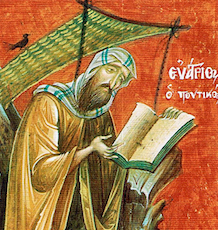
Evagrius1A few years ago, I came across a quotation from Evagrius of Pontus on my students’ papers. Actually, it was a paraphrase of a famous bit of Evagrius, in which he says that ‘one who prays truly will be a theologian, and one who is a theologian will pray truly.’ The impression you would have had from the context in which Evagrius was being paraphrased  is that anyone who prays is a theologian. My uncertainty about that, which started as a certain skepticism (of the form ‘I do not think it means what you think it means’), has led me to wonder about the relationship between prayer and the practice of theology down the ages. Now I am a theologian, but not a historian. And this topic warrants historical and theological investigation. So I need help!

It therefore makes me feel like the luckiest person in the world to be able to gather a small group of wise and learned and spiritually astute people to talk about just this topic. Not only that, but we are gathering at my very favorite place on the planet: Minster Abbey. For two days, we will join the community for prayer and spend the rest of the time in conversation about the relationship between prayer and theology in a handful of theologians from late antiquity onward.

What is the relationship between prayer and theology? While I fully expect that this question will continue to vex future generations, I have reason to hope that we who gather at Minster in Eastertide will be nourished in our lives of prayer and theology, and for that I am unimaginably grateful.

Deo gratias.


Another morning gone

6:05am.  Wake up. Realize that the reason it feels like it’s still the middle of the night it that the 4-year-old woke us at 1:00 because she was wearing the wrong pajama bottoms. The rest of the night was not, well, restful. Hit snooze.

6:14am. Wake up, round 2. Think. No, not yet possible. Hit snooze.

6:23am. Wake up. I must get up. At this point, I still believe I can make up for lost time. Brain will maybe catch up with the body eventually, but at least the physical activity of the day must now begin.

6:25am. Stretches. Almost-yoga. I am not virtuous. I am totally dependent on doing back stretches in the morning to be able to move about normally during the day. If I don’t do them, eventually I will move in a way that would be fine for most people my age, but will result in me finding myself on the floor. So I stretch.

6:45am. Husband arrives with coffee as I am finishing stretches.

I love this man.

6:50am. 4-year-old wakes up, requires cuddle. She’s the fourth (of four!) and I know how quickly the cuddle-able stage will pass. Without really considering my lateness, I oblige.

7:15am. Now lateness is absolutely irreversible, but I am still not awake enough to take this seriously. 4-year-old announces she wants pasta for breakfast. ‘Sure,’ I say: there’s some leftover pasta from last night, and this is not a battle I ever, ever fight. I resist, if it means cooking pasta, but I surrender easily. She does not negotiate with 40-somethings.

7:25am. While said 4-year-old is eating breakfast, I begin to tease the kitchen into a state I will later find conducive to work. This involves a broom, a bit of spot-scrubbing, and getting the boys (ages 9 and 12) to help with dishes: unload dishwasher, help stray glasses and bowls to find their way into empty dishwasher. Oddly the 9-year-old is less resistant than the 12-year-old. Or maybe it’s not so odd.

Somewhere in the middle of that, make second cup of coffee. Some of it will end up spilled on the hall table in the midst of the Battle of Finding-Things-and-Departing. Never mind: 60% of it will make it to its target, and I will slowly become a functioning adult human being. (Ok, I admit this is optimistic. But I am still not admitting that we’ll be late, so optimism is pretty much my morning modus operandi, until about 8:45–the time we ABSOLUTELY MUST LEAVE if we are to be on time.)

Time passes. This is always the mystery of the morning: where does the time between 7:30 and 8:40 go? I pack up laundry to be taken somewhere else to be washed: this is an admission of defeat. I manage to get the kitchen floor looking less awful. The boys clear away a good bit of stuff in the kitchen. Someone rouses the 14-year-old, who miraculously gets up and starts getting ready for school. I pack up the girls’ backpacks. How does this all take more than an hour?

7:45-8:30. Get 4-year-old ready for school. Insist that she put school clothes on even though she insists that she’ not feeling well and can’t possibly go to school. Remind her that the alternative to teeth brushing is not to have any. Remind her that socks instead of tights are a bad idea in January. (She tried this last week: I let her have the choice, and she admitted before she even got to school that it wasn’t a good one. Mummy was right.) Agree that she can have a sticker if she does anything at all, really.

8:25. Husband takes boys and laundry. 12-year-old spends last 5 minutes at home frantically searching for his keys and phone. (Poor kid is definitely ours.) Leaves with keys, without phone, dissatisfied with his organizational skills. Blow him a kiss from the window: he needs it.

8:45. Realize that girls are going to be late. Think: these children need a new mother. One who is on time for things. Clearly the 12-year-old has inherited his organizational skills from me.

9:00. Take 4-year-old to school. ‘Will we get there before the bell, Mummy?’ she asks. ‘No, darling. The bell rang 5 minutes ago.’ She decides not to play the game where she remains just out of reach as I try to come up with some kind of choice for her to make that will allow her to get in her seat without losing. And I try not to lose my temper. But today, nothing is lost.

9:05am. Arrive at school, grateful that we live so close. Realize I am not alone in being late to school. The kids don’t need a new mum; I just need to get over it.

9:15am. Time to get 14-year-old to school. Insist she brushes teeth. Try to do too much while she is doing that. Get to school late and realize that she’s not brushed her hair. Sigh.

9:30am. Arrive back home. Find 2 loads of laundry left behind. Sigh. I face the usual choice: how much of the domestic chaos do I attempt to order before turning to the writing project before me (the one I should have finished last week)? Make the usual decision and try to order too much of the chaos, and find the day slipping away, writing project staring at me from across the kitchen table.

11:00am. Despair.

11:10am. Write the 800+ words I should be adding to some writing project or other here on my blog. Hope I will live long enough to do some writing after the children are grown.

Noon. Might as well go to Mass. Although I fear I will just hang my head and weep, I know from experience that I probably won’t. And I need to repent of my despair and self-loathing, and remember that it’s not about what I accomplish in a day. Sometimes I forget what it is all about. Somewhere between the sign of the cross and the ‘go in peace’, I usually remember.

I just hope I don’t forget it again by tomorrow morning.


To begin 2016, think about the end

During the autumn, I wrote a series of short commentaries on the Nicene (Niceno-Constantinopolitan) Creed. The final installment is for this Sunday, and focuses on the very last line of the creed: death, resurrection and new life. As this week began (for me) with an op-ed article about death (see below) and has seen the deaths of two talented and justly celebrated men, some reflection on this part of the creed seemed quite timely.

The creed concludes by directing our attention to our own end: we ‘look forward to the resurrection of the dead and the life of the world to come’. Maybe by the time we get to the last line, our attention has moved on to the next part of the Mass, or even to what’s for Sunday lunch. Or maybe the repetition week by week has dulled our perception of its oddity. The resurrection of the dead? The life of the world to come? However often we say these things, and however much we might know about the Church’s teaching on resurrection and new life, the future remains ultimately mysterious: we believe, but we do not grasp these things.

Yet remembering our end is of critical importance: even the New York Times advises us to do so. In a recent article Arthur Brooks* advised readers to bear their death in mind in order to live a more fulfilling life. (This week our mortality has been brought into incredibly sharp focus, too, by the deaths of David Bowie and Alan Rickman.) Rather than making us more gloomy, he says, remembering the transitory nature of our life heightens our capacity for humour and joy. Not only that: Brooks suggests that concentrating on the ‘scarcity of time’ can help us to choose our pastimes more consciously, focusing on those things that bring real satisfaction (and those listed include prayer and worship) over those that merely distract us.

The op-ed section isn’t the place I would usually turn for spiritual guidance. In this case, though, Brooks points to something we ought to know: that growth in our spiritual life requires a form of attention that directs us to our ultimate end. For his readers, death is the end. We look forward to something else: the resurrection of the dead, and the life of the world to come. Contemplating this mystery forms a crucial part of the practice of Christian life, and bathes our ordinary experience in everlasting light.


not the usual Sunday night Compline

Usually, we say compline together each evening. And most evenings we follow basic form set out for the office, the way the nuns sing it at Minster Abbey. We have our own prayer that stands in for the hymn, one the children learned at school and like to say.

I thought as our 9-year old is about to make his first confession, that we might talk a little bit more about the examination of conscience that normally occurs just at the beginning of Compline. So last night I did.  We followed our brief conversation with the confiteor, which we don’t often say. Afterward, my 9-year-old observed that the language includes asking ‘brothers and sisters’ to pray for us. This sparked a further conversation about the relationship between members of the body of Christ: although in the context of our family, I am the mother and they the children, in the family of God, we are all brothers and sisters.

Suddenly they were all attentive. Not only that, I said (taking advantage of this miraculously teachable moment): you have a very special place within the body of Christ, as children. When Jesus’ disciples were arguing with each other about who was the greatest, he put a child in the midst of them, and told them that unless they became like little children, they would never enter the kingdom of heaven. Amazement. We talked a little bit about what it was about children that was so important to Jesus. Not their crazy antics (mine are especially prone), but some key qualities. The one we spoke about was a capacity for awe and wonder. My 9-year-old interjected something about a really huge snake. Exactly! Awe and wonder. Of course there are other things, but the teachable moment is just that, at least with my children: a moment.

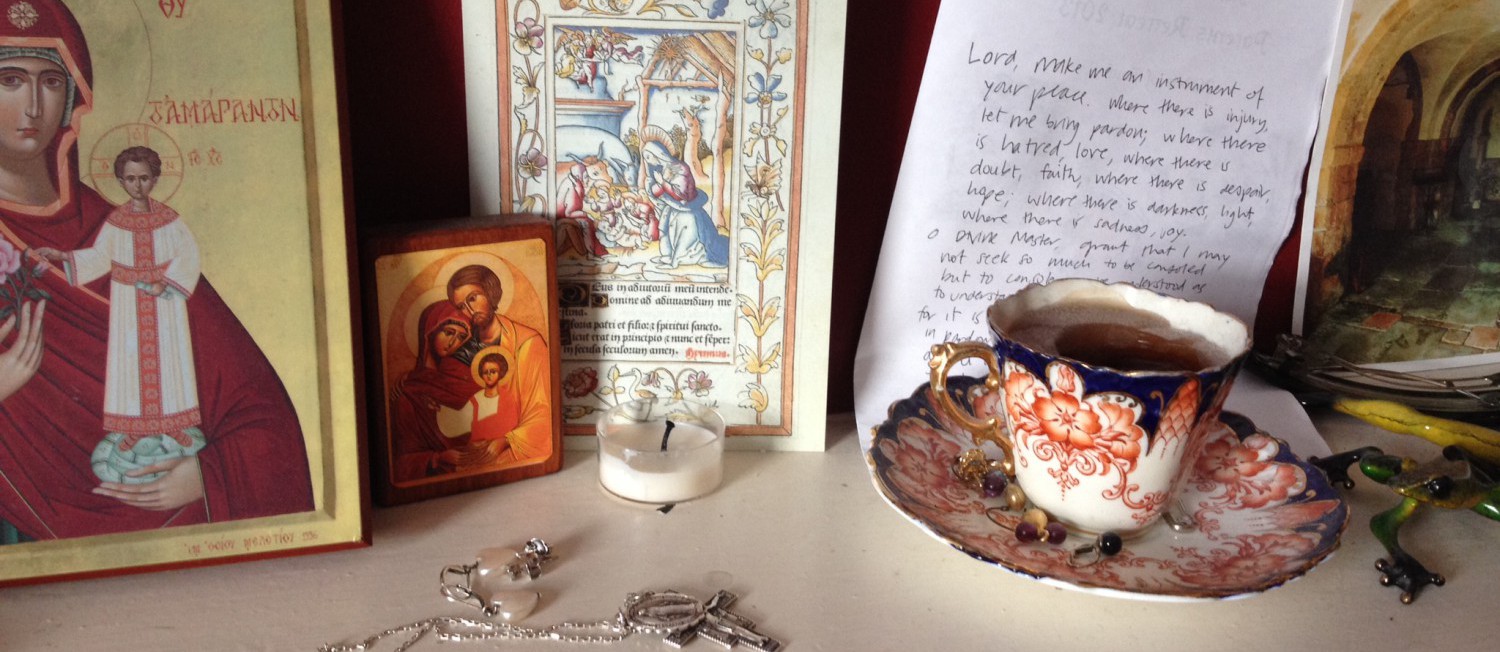
After that we veered off course slightly, according to the rubrics. We each said a ‘God bless’ or a ‘thank you, God’ and said a Hail Mary, at the 4-year-old’s request. Then we had the nunc dimittis and final prayer. As I prepared to play the Alma redemptoris mater (we like the Marian antiphon for the season), I realized there was a problem. Just as I was about to be frustrated, one suggested (again the 9-year-old) that we simply stand around the prayer table and look at the candles. So we did. It was the most beautiful silence I have ever experienced. It was not only quiet, but peace.

Deo gratias.