Last week, I had the privilege of convening a symposium on prayer and the practice of theology at
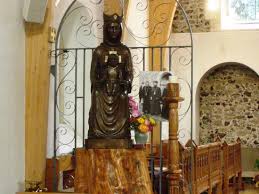 Minster Abbey. Over the next few weeks, I expect I’ll be thinking aloud about that experience, for which I am profoundly grateful. The Benedictine sisters of the community joined with us, and a few shared with us something of their journey. This was a great blessing to all of us theologians present! I am glad to be able to pass some of that blessing along to you, in the form of my first ever guest post, in which Sr Johanna reflects on the experience of praying the psalms.
What is it like to use the psalms for prayer every day and many times a day? By God’s grace, my experience of praying the psalms daily now stretches over nearly four decades. I shall try to say a little about what I have learned during this time.
For me, the psalms are one of the chief means by which I’m able to fulfil the call I received from God so many years ago. How is this so?
Some personal background seems necessary here: I was a “cradle Catholic”, who was taught her faith and who received the Sacraments in the way that was customary at the time. I went to Mass and said my prayers, but without much grasp of what was behind all this. And had any choice been available to me, I am sure I’d have chosen to leave the Church sometime in my teens.
It came, then, as a huge re-orderig of my existence when, in early adulthood, some seeds of belief that had been dormant in me began to put forth shoots. Circumstances at that time conspired to give me a desire to explore my faith – and I did. This exploration was the beginning of my serious practice of Catholicism. I received the gift of faith in God, Jesus, the Holy Spirit; also the gift of faith in the Church as bearer of truth for humanity. And people! People were very much part of this conversion – humanity loomed large. I developed a hunger to be present to suffering humanity in a deeper way than was possible to me within the constraints of what was then a career in classical ballet. How could I bring Christ to birth in the world? I had received the grace of conversion, and I longed to be instrumental in that grace reaching others. I wanted to be everywhere and present to everyone, on the deepest possible level.
I began to look at religious orders. I gradually realised that it was through prayer that my intense desire to be everywhere and present to everyone could be fulfilled. This faith in the power of prayer was another great gift from this period in my life. Eventually, monastic life, with its strong emphasis on the apostolate of prayer, seemed the way forward for me.
Now, nearly forty years later, how has this panned out? There are many aspects to a monastic vocation, but I’ve found that it is chiefly within the Opus Dei – the Divine Office – that I find that I can be everywhere and with everyone. That is because of the prayer book that’s used – which is the psalter.
When I go into the chapel for the Divine Office, yes, it is a time for being with God in the deep places of the soul. But, really, all humanity is there, too, because all humanity is represented in the psalter. In the Divine Office, we sing the one-hundred and fifty psalms of the psalter through in a week, give or take. The psalms become familiar – some become friends. In the psalms we have theology expressed poetically. We have the human person’s experience of God crystallized – I suppose that’s what one might expect of biblical poetry. But, less predictably perhaps, we also have the human experience of being human expressed in the psalms. Every human emotion is there in the psalter: there’s praise and petition, euphoria and celebration; there are psalms of exhortation; some psalms refer to a congregation being there; others seem to be highly personal and private; kings and queens make appearances; shepherds, bulls, goats and rams; all Israel is there; the psalms tell the story of their exodus, of their election as the Chosen People of God, and of their failures: Israel’s infidelity is frankly admitted – again and again; but so too God’s faithfulness is confessed – again and again: the psalms testify with wonder and gratitude to his mercy and forgiveness. It’s notable, also, that the psalmist’s states of disillusionment and abandonment by God are written large in the psalter. The psalter’s pictures are not just the pretty ones about deliverance and forgiveness. Unlovely pictures of anger and anguish, rage and raving are painted in vivid colours in these inspired texts.
All this diversity is glorious, on the one hand. But on the other, how can I absorb it when I pray? Can it all become “me” every time I go in to pray? Perhaps the first thing to say in answer is that the psalms aren’t just about “me” because prayer isn’t just about me. I wanted to be present to others when God called me. The psalms in their diversity bring others to me and enable me to hear about their experiences as each psalm unfolds, verse by verse, day by day in the Divine Office. In praying the psalms it becomes possible to pray from the perspective of others, and in solidarity and empathy. I can take the psalmist’s experience and claim it as my own, pray it as my own.
The monastic writer, John Cassian, writes in the fifth century that when we pray the psalms over time, it will be like this:
 [The one praying will] take in to himself all the thoughts of the Psalms and will begin to sing them in such a way that he will utter them with the deepest emotion of heart [emphasis mine] not as if they were the compositions of the Psalmist, but rather as if they were his own utterances, and his very own prayer…. [c.f. Conf X:11].
How does this happen? Is the every-day experience something that always involves the “deepest emotion of heart”? Well, of course, there are good days and bad days, as is always the case with any human endeavour. But, on a deeper level, it may be important to say that the concept of the heart for the ancients had connotations that we don’t automatically think of today. The heart, for Cassian’s original audience, is really the most important part of the inner being. It includes the mind, but it is also to do with the will, the place of deepest inner truth, of self-dedication, firm decision, profound responsibility. So when Cassian talks about the deepest emotion of the heart we need to understand something that has more permanence and stability than we usually attribute to the emotions, maybe akin to a kind of “groundedness” in truth, I think.
And the psalms can take us there. Many of the psalms are composed in the first person. This allows a species of “transference” to take place, because when we pray things like “O God whom I praise, do not be silent, for the mouths of deceit and wickedness are opened against me” (108:1), or “When I think I have lost my foothold, your mercy Lord, holds me up” (93:18), or “I am beset with evils…” (39:13) and so on, the “I” in any given psalm can become our “I” when we’re praying, no matter what our mood might be at that particular time. In this way, the psalms become not only a mode of praying, but also a means of self-transcendence, and of empathy. The psalms enable us to say to humanity, “I am praying not merely for you, but as you”. We can pray the psalms from within the very consciousness of the one represented by any given psalm. This allows us to put our own “stuff” to the side, and really listen to and pray from the perspective of different “stuff.”
This may raise the question, what about the angry psalms – often called the cursing psalms – where the psalmist is ranting and raving and just lets it rip against his enemies. What about them? Should we be embarrassed about them, and try to hide them in a dark corner where no one will notice them? Emphatic no! I am so glad my community prays them and doesn’t leave them out. They are so important! It’s to do again with listening to humanity. Every good listener knows that when someone has been deeply hurt, the hurt person cannot arrive at forgiveness immediately. Stages need to be negotiated. Shock and denial usually come first, then a kind of mixed-up experience follows, that alternates between the acceptance of what happened and rage that it happened at all; forgiveness of the one who caused the hurt is usually way down the line. The rage must be allowed its place in the healing process or the capacity to forgive the one who caused the pain is compromised. In the angry psalms we find here the honest admission of anger within a relationship of prayer dedicated to the healing process. So we are identifying with those who are in that very painful place of hurt and rage. We don’t judge anything the psalmist expresses – that is not our role – we just allow it to be. This might happen to be cathartic, also, for the one praying – but it’s not by any means the whole story of what’s happening when we use the angry psalms for prayer.
We’re also learning something extremely important about God in these angry psalms. We’re learning that we have a God who allows us to say, “THIS IS UNBEARABLE” in bold print, underlined three times, with six exclamation marks, and who doesn’t mind. At all. The Jewish boast, “What other nation has its gods as close to them as our God is to us,” could be interpreted in this sense: that God wants us to bring him everything, not just the nice presentable bits of ourselves, but the really raw bits, too, the whole kit and caboodle, our entire inner life. The angry psalms help us to do this.
On the opposite end of the scale perhaps, are psalms which my express states which we feel unworthy to call our own: states of innocence, maybe. Or holiness. The New Testament Canticle, the Magnificat, might fall into this category. It’s not actually a psalm, strictly speaking – but we pray it every night at Vespers, so I think it deserves a mention. We might think, ‘How can I, a twit and sinner, pray the Magnificat. How can I say, “henceforth all ages will call me blessed”, for example. Again, the Divine Office is not just about me. St. Augustine says about psalmody that sometimes we pray in the voice of Christ our head, sometimes we pray in the voice of his members. Here, we pray in Our Lady’s voice, and in our way, we allow her words to continue to resound in the Church. Imagine the impoverishment to the Church if, out of a misguided humility, the Church had no tradition of praying the Magnificat! In the Magnificat, we are recalling, re-presenting, the astounding fact of Our Lady’s immaculate heart. She knew that it was all God’s gift – and says so in the canticle. We are praying in hope that we might receive a like gift of purity of heart – to return to one of Cassian’s favourite themes. Admittedly, the Magnificat is one of those prayers that are too big for us, and maybe we feel like the child trying to walk about in its parent’s shoes when we pray it. We need to “grow into” it. But, people, by God’s grace, do grow into it. It’s not a futile hope. He does give the gift of holiness. Saints are real people. I was just reading about the recent martyrdom of a group of Missionaries of Charity and their volunteer helpers in Yemen. I suspect they felt themselves to be pretty ordinary people. Yet, now all ages will call them blessed.
And, a few words about singing. In the fifth century text I quoted above from John Cassian, he refers to singing the psalms – which indicates that this was an accepted practice. To give a proper treatment of why singing is a good way to pray the psalms would require another talk. Again, from my personal perspective as an ex-ballet dancer, music is highly important to me, and I am so grateful that this long tradition of singing prayer exists. The psalms were first used in Jewish worship, and they were composed to be sung there; the poets intended this when they wrote them. The link-up between music and meaning is extremely close in these works; music wasn’t an afterthought. So it’s arguable that the psalms come alive most fully when the words are integrated with music. There are other reasons, too for singing. St. Benedict says, “Let us stand to sing the psalms in such a way that our minds are in harmony with our voices.” He’s talking about the power of music to keep us focused and recollected. Singing integrates more of the body into the act of worship than is enlisted in reading silently. In singing you involve the eyes, the ears and the voice most obviously. Less obviously, you have the effect of musical rhythm. Even if one is singing while standing or sitting still, this rhythm is felt by the whole body. Music also elicits a response from the emotions – beauty and pathos can be expressed even in a simple, repetitive melody. Song, further, is an aid to memory. A snatch of a verse from a psalm may return to me later in the day because melody has a way of coming back and back. This is how it works for me. And I am so grateful that music and psalms have been partners in my vocation for nearly 40 years.
I am never alone when praying the psalms, and this is not just because I pray them in the liturgy and in community. Many people pray the psalms privately, and they, too, are not alone. This is because the psalms, you might say, “refashion” the heart of the person praying. Our hearts tend to be self-concerned, but the psalms fashion a heart that is “other-concerned” because that is the way the psalms are. One of our Oblates, Maude Felicity, offered the insight when she read this talk that the psalms give one a “communal heart.” And so perhaps Cassian’s phrase that we “utter the psalms with the deepest emotion of heart” refers to this communal heart that is, over time, formed within the person who prays the psalms. Therefore, through the psalms, our narrow, personal concerns can widen out, as we learn to take on the concerns that each psalm places before us. When I say to individual people that I am praying for them, I know that the psalms enable me to pray for them in depth. I can pray not only for the particular thing they have requested, but with reference to their whole person, the whole state of their heart. This is what I felt called to do nearly forty years ago. Thanks be to God for showing me the way.
May 2016
Sr. Johanna Caton, O.S.B.
Minster Abbey
 Against this backdrop, I was fascinated to read an
  It may have been watching Goldfinger that made me alert to the three articles in one newspaper (the New York Times) this morning, all touching on the situation of women in the contemporary Western world. I was slightly shocked by the behaviour of our favourite spy towards women–obviously it has been a while since I watched the Sean Connery films. Fortunately, two of the articles today suggest that the reason I find his behaviour inappropriate is that things have changed for women, not only in the US, but also, finally, in
  The article about women on Wall Street makes
 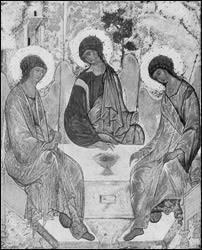 Now, maybe you’re wondering what the Trinity and the whole business of feminism have in common. No, I am not going to go in the direction of feminist theology. Yesterday, in that terrifying experience of trying to say something to children about the Trinity, a beautiful thing happened. There we were, talking about the Glory be, and listening to the gospel (John 16:12-15), and trying to make sense of it all (without actually using the word Trinity, which seemed extraneous), and the children somehow managed it. Why don’t we hear ‘Son’ in the gospel, we wondered. Because Jesus is the Son, and he’s speaking, offered one of the children. We wondered how God was present with us now. ‘In our hearts,’ offered another child; and ‘by the Spirit,’ said a third. But the best of all was in their free drawing time. One of the girls came up to show me her drawing afterward. Below the text of the Glory be, she had drawn a circle with a series of arrows to indicate the circle’s direction. ‘Because it continues,’ she explained.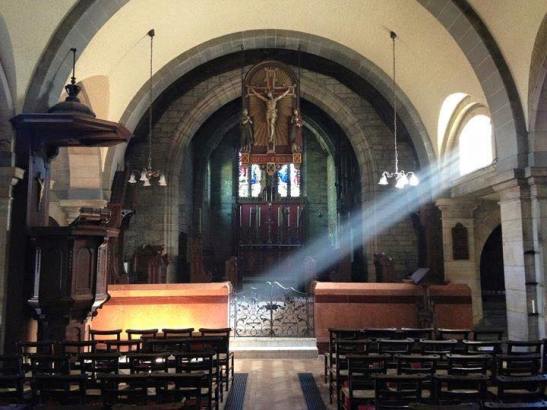
 The glory of God might seem an odd topic for reflection during Lent. After all, we omit the Gloria at Mass, and we direct our attention to the Lord’s temptation and his passion. But the Sanctus reminds us, week by week—even during Lent—that ‘heaven and earth are full of [God’s] glory’. We don’t always recognize that glory: it is hidden. As John’s gospel tells us: ‘the Word became flesh and dwelt among us, full of grace and truth; we have beheld his glory, glory as of the only Son of the Father’ (1.14). Jesus makes God known to us; all the fullness of the Godhead was pleased to dwell—hidden—in Christ. Peter, James and John glimpsed that glory at the transfiguration of the Lord. They learned to see in Jesus, even after his brightness subsided, the radiance of divine glory. So also we learn to see the world differently as the eyes of our hearts are trained by faith: to see Christ’s presence in the Eucharist, for example; or to see his face in the faces of the poor and the marginalized.
 a theologian in the family